Collective cell dynamics could define stem cells identity, number, and dynamics
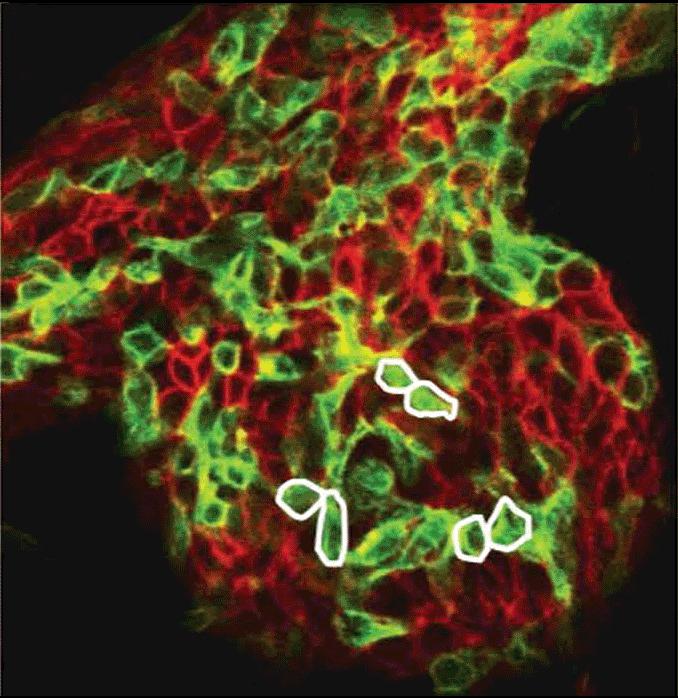
Credit: Colinda Scheele / Oncode Institute
Stem cells are central to organ development and renewal. In most organs, stem cells are located in specific regions and, in some cases, can be identified through several intrinsic properties, like molecular markers. They can differentiate into various types of cells and divide indefinitely to produce more stem cells. However, does this mean the stem cell at the top is immortal? Or can any cell overthrow this? The scientific community is in an open debate whether stem cells actually arise from intrinsic cell properties or from the collective dynamics of the tissue itself. In this second scenario, potential stem cells are in constant competition to sit in certain “niche” regions. Each cell wants to overtake its neighbor by replication and, therefore, continuously pushes them. The functional stem cell will be the one that wins this competition, while losers will be pushed away from the niche, differentiate, and ultimately die.
Here, the Hannezo group at IST Austria looked at the mechanism to overcome such pushing forces away from the niche, in collaboration with researchers from the National Cancer Institute of Netherlands and the University of Cambridge. They used a live-imaging microscope to record stem cell movements in the breast, intestine, and kidney tissue. The team found that in addition to constant flow and pushing forces, many random movements were observed. Why would those be important? “A famous saying in real estate business is “location, location, location.” In the case of stem cells, this saying transfers to a location determining stemness (rather than the other way around). Then, random movements become key, as they allow you to get to the right location even if you started in the wrong one.” summarizes Edouard Hannezo.
Under that framework, the tissues look like the exit of the subway station in the rush hour, with some people able to randomly turn back against the drift of the mass, trying to take the subway again. Under this metaphor, random movements are key to allow cells away from the stem cell niche to eventually go back to it. “We wanted to know what defines the number and dynamics of the stem cells, and to what extent this could be answered by mathematically exploring only the movements of the cells and the geometry of the organs,” says Bernat Corominas-Murtra, the leading scientist in this study. They then mathematically mapped this noisy cell dynamics into the geometry of the organs and could predict, among others, the number of functional stem cells (the ones that can get to the right location in time, given the amount of noise/mobility in the system). They found that during tissue renewal or growth, stem cell regions developed naturally, without needing to make assumptions on the molecular nature of the cells. Therefore, the scientists showed that the dynamics and geometry alone play an essential role.
Bernat Corominas-Murtra describes their results: “You would expect that the randomness of cell movements blurs the properties of the system or makes it more unstable. Instead, it is key for the emergence of robust, complex patterns like the stem cell region, which remarkably coincides with the one previously identified using biomolecular markers of individual cells.” These results contribute to the open debate on the nature of stem cells in tissues and potentially opens a new dimension in the understanding of organ renewal.
###
Media Contact
Patrick Müller
[email protected]
Original Source
https:/
Related Journal Article
http://dx.