• HOME
  • NEWS
  • EXPLORE
    • CAREER
      • Companies
      • Jobs
    • EVENTS
    • iGEM
      • News
      • Team
    • PHOTOS
    • VIDEO
    • WIKI
  • BLOG
  • COMMUNITY
    • FACEBOOK
    • INSTAGRAM
    • TWITTER
Thursday, April 9, 2026
BIOENGINEER.ORG
No Result
View All Result
  • Login
  • HOME
  • NEWS
  • EXPLORE
    • CAREER
      • Companies
      • Jobs
        • Lecturer
        • PhD Studentship
        • Postdoc
        • Research Assistant
    • EVENTS
    • iGEM
      • News
      • Team
    • PHOTOS
    • VIDEO
    • WIKI
  • BLOG
  • COMMUNITY
    • FACEBOOK
    • INSTAGRAM
    • TWITTER
  • HOME
  • NEWS
  • EXPLORE
    • CAREER
      • Companies
      • Jobs
        • Lecturer
        • PhD Studentship
        • Postdoc
        • Research Assistant
    • EVENTS
    • iGEM
      • News
      • Team
    • PHOTOS
    • VIDEO
    • WIKI
  • BLOG
  • COMMUNITY
    • FACEBOOK
    • INSTAGRAM
    • TWITTER
No Result
View All Result
Bioengineer.org
No Result
View All Result
Home NEWS Science News

New evidence on the formation of the solar system

Bioengineer by Bioengineer
December 2, 2016
in Science News
Reading Time: 2 mins read
0
Share on FacebookShare on TwitterShare on LinkedinShare on RedditShare on Telegram
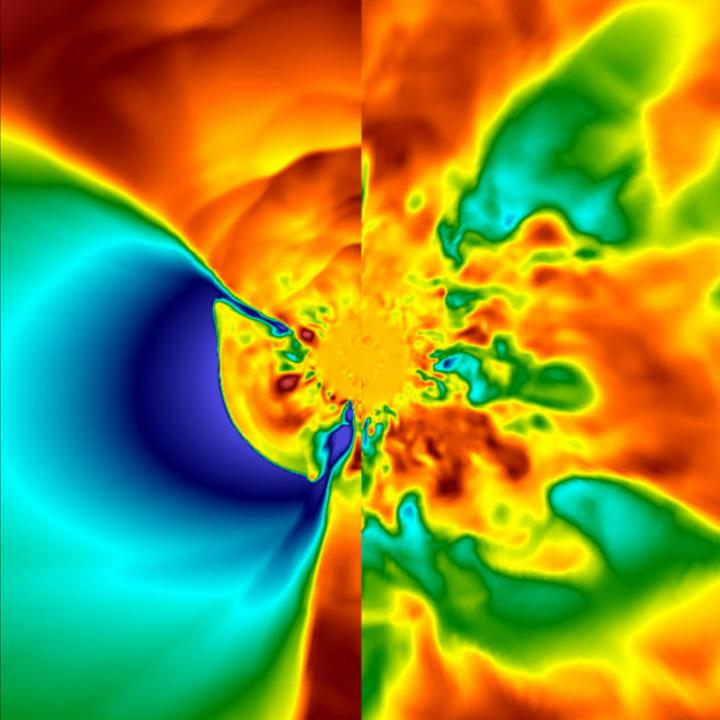
IMAGE

Credit: Bernhard Mueller, MNRAS 453, 287-310 (2015)

International research involving a Monash University scientist is using new computer models and evidence from meteorites to show that a low-mass supernova triggered the formation of our solar system.

The research is published in the most recent issue of leading scientific journal Nature Communications.

About 4.6 billion years ago, a cloud of gas and dust that eventually formed our solar system was disturbed.

The ensuing gravitational collapse formed the proto-Sun with a surrounding disc where the planets were born. A supernova–a star exploding at the end of its life-cycle–would have enough energy to induce the collapse of such a gas cloud.

"Before this model there was only inconclusive evidence to support this theory," said Professor Alexander Heger from the Monash School of Physics and Astronomy.

The research team, led by University of Minnesota School of Physics and Astronomy Professor Yong-Zhong Qian, decided to focus on short-lived radioactive nuclei only present in the early solar system.

Due to their short lifetimes, these nuclei could only have come from the triggering supernova. Their abundances in the early solar system have been inferred from their decay products in meteorites. As the debris from the formation of the solar system, meteorites are comparable to the leftover bricks and mortar in a construction site. They tell us what the solar system is made of and in particular, what short-lived nuclei the triggering supernova provided.

"Identifying these 'fingerprints' of the final supernova is what we needed to help us understand how the formation of the solar system was initiated," Professor Heger said.

"The fingerprints uniquely point to a low-mass supernova as the trigger.

"The findings in this paper have opened up a whole new direction of research focusing on low-mass supernovae," he said.

In addition to explaining the abundance of Beryllium-10, this low-mass supernova model would also explain the short-lived nuclei Calcium-41, Palladium-107, and a few others found in meteorites.

Professor Qian said the group would like to examine the remaining mysteries surrounding short-lived nuclei found in meteorites. The research is funded by the US Department of Energy Office of Nuclear Physics.

Professor Heger and a new Monash Future Fellow, Dr Bernhard Mueller, also study such supernovae using computational facilities at the Minnesota Supercomputing Institute.

###

To read the full paper, titled "Evidence from stable isotopes and Be-10 for solar system formation triggered by a low-mass supernova," visit the Nature Communications website

Media Contact

Alexander Heger
[email protected]
61-468-469-432
@MonashUni

http://www.monash.edu.au

############

Story Source: Materials provided by Scienmag

Share12Tweet8Share2ShareShareShare2

Related Posts

Insilico Achieves Breakthrough in Cancer Therapy by Uncovering Selective PKMYT1 Inhibitors Through Sulfur-Lone Pair Interactions

Insilico Achieves Breakthrough in Cancer Therapy by Uncovering Selective PKMYT1 Inhibitors Through Sulfur-Lone Pair Interactions

April 9, 2026
Unveiling Graphene’s Role in Photocatalytic Composites Through Theoretical Modeling

Unveiling Graphene’s Role in Photocatalytic Composites Through Theoretical Modeling

April 9, 2026

Dr. Nancy L. Lewis Appointed Chief Scientific Officer at National Comprehensive Cancer Network (NCCN)

April 9, 2026

ACP’s 2026 Annual Meeting Brings Together Pioneers Shaping the Future of Internal Medicine

April 9, 2026
Please login to join discussion

POPULAR NEWS

  • blank

    Revolutionary AI Model Enhances Precision in Detecting Food Contamination

    98 shares
    Share 39 Tweet 25
  • Imagine a Social Media Feed That Challenges Your Views Instead of Reinforcing Them

    1012 shares
    Share 400 Tweet 250
  • Popular Anti-Aging Compound Linked to Damage in Corpus Callosum, Study Finds

    44 shares
    Share 18 Tweet 11
  • Revolutionary Theory Transforms Quantum Perspective on the Big Bang

    40 shares
    Share 16 Tweet 10

About

We bring you the latest biotechnology news from best research centers and universities around the world. Check our website.

Follow us

Recent News

Insilico Achieves Breakthrough in Cancer Therapy by Uncovering Selective PKMYT1 Inhibitors Through Sulfur-Lone Pair Interactions

Unveiling Graphene’s Role in Photocatalytic Composites Through Theoretical Modeling

Dr. Nancy L. Lewis Appointed Chief Scientific Officer at National Comprehensive Cancer Network (NCCN)

Subscribe to Blog via Email

Enter your email address to subscribe to this blog and receive notifications of new posts by email.

Join 78 other subscribers
  • Contact Us

Bioengineer.org © Copyright 2023 All Rights Reserved.

Welcome Back!

Login to your account below

Forgotten Password?

Retrieve your password

Please enter your username or email address to reset your password.

Log In
No Result
View All Result
  • Homepages
    • Home Page 1
    • Home Page 2
  • News
  • National
  • Business
  • Health
  • Lifestyle
  • Science

Bioengineer.org © Copyright 2023 All Rights Reserved.