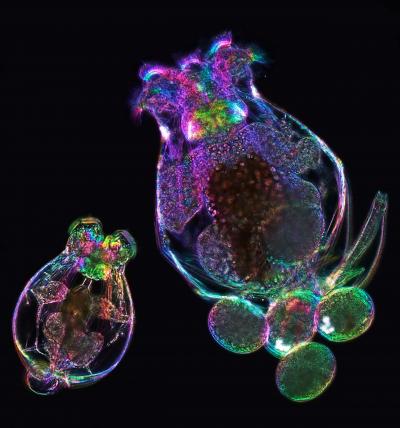
Credit: Michael Shribak, Evgeny Ivashkin, Kristin Gribble
WOODS HOLE, Mass. – The offspring of older mothers don’t fare as well as those of younger mothers, in humans and many other species. They aren’t as healthy, or they don’t live as long, or they have fewer offspring themselves. A longstanding puzzle is why evolution would maintain this maternal effect in so many species, since these late-born offspring are less fit to survive and reproduce.
In a new study in rotifers (microscopic invertebrates), scientists tested the evolutionary fitness of older-mother offspring in several real and simulated environments, including the relative luxury of laboratory culture, under threat of predation in the wild, or with reduced food supply. They confirmed that this effect of older maternal age, called maternal effect senescence, does reduce evolutionary fitness of the offspring in all environments, primarily through reduced fertility during their peak reproductive period. They also suggest an evolutionary mechanism for why this may occur. The study, led by Kristin Gribble of the Marine Biological Laboratory and Christina Hernández of Woods Hole Oceanographic Institution, is published this week in Proceedings of the National Academy of Sciences.
“This study is unique in that combines laboratory data from our prior work with mathematical modeling to address a longstanding question in the evolution of aging,” Gribble says. “Natural selection should weed out these less-fit offspring of older mothers. So why do we see this phenomenon across so many species?”
To address this, Hernández and collaborators built mathematical models to calculate, for the first time, the strength of natural selection pressure on the survival and fertility of offspring populations as functions of the age of their mothers. They found this pressure, called the selection gradient, declines with maternal age.
“Because the selection pressure decreases as the mothers age, it may not be strong enough to remove these less-fit [offspring] from the population,” Hernandez says.
“Because of this, maternal effect senescence will persist and continue to evolve in the population, even though it results in decreased fitness,” Gribble adds. They don’t yet fully understand the genetic mechanisms that cause offspring quality to decrease with maternal age.
The models that the team developed can be applied to a wide range of species to evaluate the fitness consequences of maternal effect senescence. “As long as you have experimental data, as we did, on lifespan and fecundity of offspring from mothers of different ages, you can address this question in many organisms,” Gribble says.
###
Other collaborators on the research include Michael Neubert from Woods Hole Oceanographic Institution, and Silke van Daalen and Hal Caswell from University of Amsterdam.
The Marine Biological Laboratory (MBL) is dedicated to scientific discovery – exploring fundamental biology, understanding marine biodiversity and the environment, and informing the human condition through research and education. Founded in Woods Hole, Massachusetts in 1888, the MBL is a private, nonprofit institution and an affiliate of the University of Chicago.
Media Contact
Diana Kenney
[email protected]
Related Journal Article
http://dx.