Kyushu University research based on NASA InSight Martian lander seismometer data reveals different sources of different types and frequencies of Martian “microtremors”, showing the potential to use such data to image the Martian subsurface
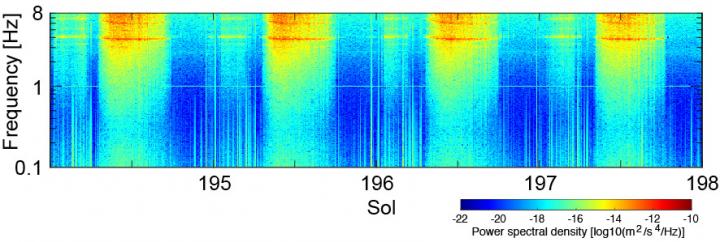
Credit: Takeshi Tsuji, I2CNER, Kyushu University
Fukuoka, Japan – Compared with our own planet Earth, Mars might seem like a “dead” planet, but even there, the wind blows and the ground moves. On Earth, we study the ambient seismic noise rippling mainly due to ocean activity to peek underground at the structure of the Earth’s interior. Can we do the same on Mars without ocean?
According to a new study by researchers at Kyushu University’s International Institute for Carbon-Neutral Energy Research, we’re closer than ever to achieving this goal.
The study, published in Geophysical Research Letters, is based on data collected by NASA’s InSight (“Interior Exploration using Seismic Investigations, Geodesy and Heat Transport”) Martian lander, which landed on Mars on November 26, 2018. The InSight lander placed a seismometer on the surface of Mars and its readings are transmitted back to Earth. Continuous seismic records collected between February and June 2019 revealed the existence of several hundred “marsquakes.” Most were much weaker than the quakes typically felt on Earth, although some reached a magnitude of almost 4.
The data from these “microtremors” were analyzed to determine their directions of propagation and directional intensity. Study co-author Tatsunori Ikeda explains, “Our polarization analysis revealed that seismic waves of different frequencies and types showed different patterns of variation over the course of the Martian day. The temporal variations in low-frequency P-waves were related to distant changes in wind and solar irradiation, and the low-frequency Rayleigh waves were related to the wind direction in the region near the lander. Higher-frequency ambient noises were dominated by vibration of the lander itself. Thus, microtremors of different types and frequencies likely have different sources, and some are probably influenced by geological structures.”
These important differences between the dominant sources of different types of Martian microtremors may help in efforts to identify geological structures in Mars’s interior, as we inferred the lithological boundary beneath the seismometer from high frequency ambient noise.
A single seismometer is not yet enough to reconstruct images of the planet’s interior, however. On Earth, data from networks of multiple seismometers must be used together for that purpose. But this analysis of the InSight lander’s seismic data is an important step toward achieving that goal on Mars. According to senior author Takeshi Tsuji, “These results demonstrate the feasibility of ambient noise methods on Mars. Future seismic network projects will enable us to model and monitor the planet’s interior geological structure, and may even contribute to resource exploration on Mars, such as for buried ice.”
###
The article, “Temporal variation and frequency dependence of seismic ambient noise on Mars from polarization analysis,” was published in Geophysical Research Letters at DOI: doi.org/10.1029/2020GL087123.
Summary: Analysis of seismometer data from the InSight Martian lander revealed that different types and frequencies of ambient low-magnitude “microtremors” on Mars were associated with different sources, and some reflected daily variations in wind and solar irradiance, either in distant locations or near the lander. These findings will contribute to future projects seeking to model and monitor the Martian subsurface.
Media Contact
Tomoya Koga
[email protected]
Related Journal Article
http://dx.