• HOME
  • NEWS
  • EXPLORE
    • CAREER
      • Companies
      • Jobs
    • EVENTS
    • iGEM
      • News
      • Team
    • PHOTOS
    • VIDEO
    • WIKI
  • BLOG
  • COMMUNITY
    • FACEBOOK
    • INSTAGRAM
    • TWITTER
Monday, January 19, 2026
BIOENGINEER.ORG
No Result
View All Result
  • Login
  • HOME
  • NEWS
  • EXPLORE
    • CAREER
      • Companies
      • Jobs
        • Lecturer
        • PhD Studentship
        • Postdoc
        • Research Assistant
    • EVENTS
    • iGEM
      • News
      • Team
    • PHOTOS
    • VIDEO
    • WIKI
  • BLOG
  • COMMUNITY
    • FACEBOOK
    • INSTAGRAM
    • TWITTER
  • HOME
  • NEWS
  • EXPLORE
    • CAREER
      • Companies
      • Jobs
        • Lecturer
        • PhD Studentship
        • Postdoc
        • Research Assistant
    • EVENTS
    • iGEM
      • News
      • Team
    • PHOTOS
    • VIDEO
    • WIKI
  • BLOG
  • COMMUNITY
    • FACEBOOK
    • INSTAGRAM
    • TWITTER
No Result
View All Result
Bioengineer.org
No Result
View All Result
Home NEWS Science News

New system combines smartphone videos to create 4D visualizations

Bioengineer by Bioengineer
July 1, 2020
in Science News
Reading Time: 2 mins read
0
IMAGE
Share on FacebookShare on TwitterShare on LinkedinShare on RedditShare on Telegram

Carnegie Mellon approach requires neither studio nor specialized cameras
IMAGE

Credit: Carnegie Mellon University

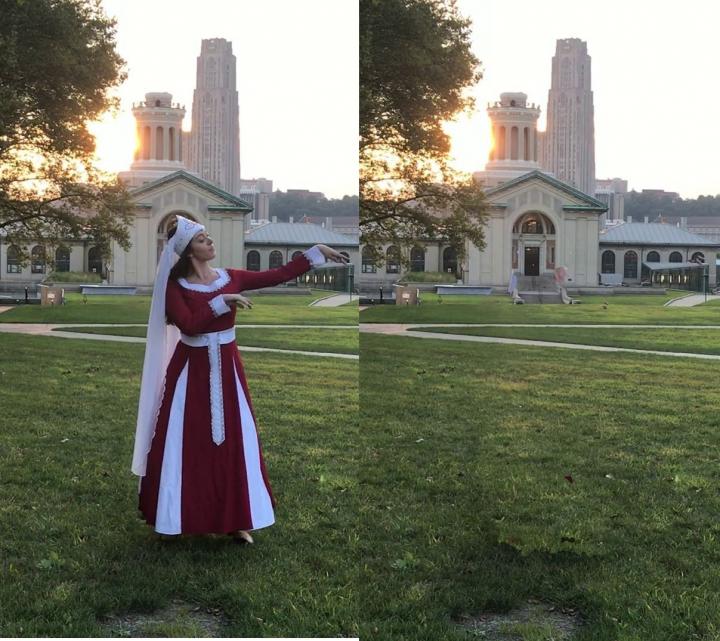
PITTSBURGH–Researchers at Carnegie Mellon University have demonstrated that they can combine iPhone videos shot “in the wild” by separate cameras to create 4D visualizations that allow viewers to watch action from various angles, or even erase people or objects that temporarily block sight lines.

Imagine a visualization of a wedding reception, where dancers can be seen from as many angles as there were cameras, and the tipsy guest who walked in front of the bridal party is nowhere to be seen.

The videos can be shot independently from variety of vantage points, as might occur at a wedding or birthday celebration, said Aayush Bansal, a Ph.D. student in CMU’s Robotics Institute. It also is possible to record actors in one setting and then insert them into another, he added.

“We are only limited by the number of cameras,” Bansal said, with no upper limit on how many video feeds can be used.

Bansal and his colleagues presented their 4D visualization method at the Computer Vision and Pattern Recognition virtual conference last month.

“Virtualized reality” is nothing new, but in the past it has been restricted to studio setups, such as CMU’s Panoptic Studio, which boasts more than 500 video cameras embedded in its geodesic walls. Fusing visual information of real-world scenes shot from multiple, independent, handheld cameras into a single comprehensive model that can reconstruct a dynamic 3D scene simply hasn’t been possible.

Bansal and his colleagues worked around that limitation by using convolutional neural nets (CNNs), a type of deep learning program that has proven adept at analyzing visual data. They found that scene-specific CNNs could be used to compose different parts of the scene.

The CMU researchers demonstrated their method using up to 15 iPhones to capture a variety of scenes — dances, martial arts demonstrations and even flamingos at the National Aviary in Pittsburgh.

“The point of using iPhones was to show that anyone can use this system,” Bansal said. “The world is our studio.”

The method also unlocks a host of potential applications in the movie industry and consumer devices, particularly as the popularity of virtual reality headsets continues to grow.

Though the method doesn’t necessarily capture scenes in full 3D detail, the system can limit playback angles so incompletely reconstructed areas are not visible and the illusion of 3D imagery is not shattered.

###

In addition to Bansal, the research team included Robotics Institute faculty members Yaser Sheikh, Deva Ramanan and Srinivasa Narasimhan. The team also included Minh Vo, a former Ph.D. student who now works at Facebook Reality Lab. The National Science Foundation, Office of Naval Research and Qualcomm supported this research.

Video: https://www.youtube.com/watch?v=quovnDPwL1k&feature=youtu.be

Media Contact
Byron Spice
[email protected]

Tags: Computer ScienceTechnology/Engineering/Computer Science
Share12Tweet8Share2ShareShareShare2

Related Posts

Cholesterol’s Role in Macrophage Changes in COPD

January 19, 2026

Five-Year Evaluation of Community Substance Use Recovery

January 19, 2026

Cross-Cultural Body Ratio Preferences in Four Countries

January 19, 2026

Challenging Aging Myths in Mason’s A Star Ain’t Nothin’

January 19, 2026
Please login to join discussion

POPULAR NEWS

  • Enhancing Spiritual Care Education in Nursing Programs

    155 shares
    Share 62 Tweet 39
  • PTSD, Depression, Anxiety in Childhood Cancer Survivors, Parents

    148 shares
    Share 59 Tweet 37
  • Robotic Ureteral Reconstruction: A Novel Approach

    78 shares
    Share 31 Tweet 20
  • Study Reveals Lipid Accumulation in ME/CFS Cells

    54 shares
    Share 22 Tweet 14

About

We bring you the latest biotechnology news from best research centers and universities around the world. Check our website.

Follow us

Recent News

Cholesterol’s Role in Macrophage Changes in COPD

Five-Year Evaluation of Community Substance Use Recovery

Cross-Cultural Body Ratio Preferences in Four Countries

Subscribe to Blog via Email

Enter your email address to subscribe to this blog and receive notifications of new posts by email.

Join 71 other subscribers
  • Contact Us

Bioengineer.org © Copyright 2023 All Rights Reserved.

Welcome Back!

Login to your account below

Forgotten Password?

Retrieve your password

Please enter your username or email address to reset your password.

Log In
No Result
View All Result
  • Homepages
    • Home Page 1
    • Home Page 2
  • News
  • National
  • Business
  • Health
  • Lifestyle
  • Science

Bioengineer.org © Copyright 2023 All Rights Reserved.