• HOME
  • NEWS
  • EXPLORE
    • CAREER
      • Companies
      • Jobs
    • EVENTS
    • iGEM
      • News
      • Team
    • PHOTOS
    • VIDEO
    • WIKI
  • BLOG
  • COMMUNITY
    • FACEBOOK
    • INSTAGRAM
    • TWITTER
Saturday, February 7, 2026
BIOENGINEER.ORG
No Result
View All Result
  • Login
  • HOME
  • NEWS
  • EXPLORE
    • CAREER
      • Companies
      • Jobs
        • Lecturer
        • PhD Studentship
        • Postdoc
        • Research Assistant
    • EVENTS
    • iGEM
      • News
      • Team
    • PHOTOS
    • VIDEO
    • WIKI
  • BLOG
  • COMMUNITY
    • FACEBOOK
    • INSTAGRAM
    • TWITTER
  • HOME
  • NEWS
  • EXPLORE
    • CAREER
      • Companies
      • Jobs
        • Lecturer
        • PhD Studentship
        • Postdoc
        • Research Assistant
    • EVENTS
    • iGEM
      • News
      • Team
    • PHOTOS
    • VIDEO
    • WIKI
  • BLOG
  • COMMUNITY
    • FACEBOOK
    • INSTAGRAM
    • TWITTER
No Result
View All Result
Bioengineer.org
No Result
View All Result
Home NEWS Science News Biology

Researchers discover algorithms and neural circuit mechanisms of escape responses

Bioengineer by Bioengineer
June 29, 2020
in Biology
Reading Time: 2 mins read
0
IMAGE
Share on FacebookShare on TwitterShare on LinkedinShare on RedditShare on Telegram

IMAGE

Credit: USTC

Ordered and variable animal behaviours emerge to explore and adapt to the environment. They are generally considered as the combination of a series of stereotyped motor primitives. However, how the nervous system shapes the dynamics of motor sequences remains to be solved.

In a study published in eLife, Prof. WEN Quan from School of Life Sciences, University of Science and Technology of China (USTC) of the Chinese Academy of Sciences (CAS) has proposed the algorithms and circuit mechanisms for the robust and flexible motor states of nematodes during escape responses.

Prof. WEN’s group investigated nematode Caenorhabditis elegans (C. elegans) on the neural circuit mechanisms of how robust and flexible the motor sequences are generated.

C. elegans are ideal subjects for their simple yet fully functional neural system with only 302 neurons, approximately 6400 chemical synapses and 890 electrical synapses. Early in the 1980s, the coupling image of neural networks were reconstituted at the synapse scale by the electron microscope, laying a solid foundation for the research on the neural circuit. Besides, optical manipulation and detection are easily conducted considering C. elegans’ overall transparent bodies.

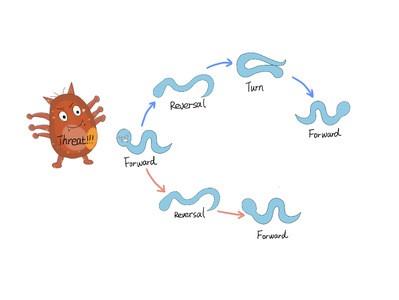
Potential threats like mechanical or thermal stimuli robustly trigger escape responses comprised of stereotyped motor modules including forward movement, backward movement and turning movement. However, the sequence and timing of actions of every module vary from each other.

With the help of optogenetic technology, calcium image and computational models, the researchers discovered that the excitatory feedforward coupling accounts for certain motor sequences robustly triggered by stimuli, while a winner-take-all operation via mutual inhibition between motor modules realizes the flexible alteration of different motor patterns. Also, the plasticity of short-term synapses and the intrinsic noise of the nervous system play an important role in the sequence and timing of motor patterns.

Applying the coupling image of neural networks of C. elegans and molecular biological methods, the researchers further proved that electrical synapses contribute to feedforward coupling, whereas glutamatergic synapses contribute to inhibition between modules through glutamate-gated chloride expressed by downstream neurons.

The study opens more possibilities to understand the mechanisms of motor manipulation of advanced organisms, and sheds new light on the design of the next generation of brain-inspired intelligence.

###

Media Contact
Jane FAN Qiong
[email protected]

Original Source

http://english.cas.cn/newsroom/research_news/life/202006/t20200628_239286.shtml

Related Journal Article

http://dx.doi.org/10.7554/eLife.56942

Tags: Biologyneurobiology
Share12Tweet8Share2ShareShareShare2

Related Posts

Florida Cane Toad: Complex Spread and Selective Evolution

Florida Cane Toad: Complex Spread and Selective Evolution

February 7, 2026
New Study Uncovers Mechanism Behind Burn Pit Particulate Matter–Induced Lung Inflammation

New Study Uncovers Mechanism Behind Burn Pit Particulate Matter–Induced Lung Inflammation

February 6, 2026

DeepBlastoid: Advancing Automated and Efficient Evaluation of Human Blastoids with Deep Learning

February 6, 2026

Navigating the Gut: The Role of Formic Acid in the Microbiome

February 6, 2026
Please login to join discussion

POPULAR NEWS

  • Robotic Ureteral Reconstruction: A Novel Approach

    Robotic Ureteral Reconstruction: A Novel Approach

    82 shares
    Share 33 Tweet 21
  • Digital Privacy: Health Data Control in Incarceration

    63 shares
    Share 25 Tweet 16
  • Study Reveals Lipid Accumulation in ME/CFS Cells

    57 shares
    Share 23 Tweet 14
  • Breakthrough in RNA Research Accelerates Medical Innovations Timeline

    53 shares
    Share 21 Tweet 13

About

We bring you the latest biotechnology news from best research centers and universities around the world. Check our website.

Follow us

Recent News

Personalized Guide to Understanding and Reducing Chemicals

Inflammasome Protein ASC Drives Pancreatic Cancer Metabolism

Phage-Antibiotic Combo Beats Resistant Peritoneal Infection

Subscribe to Blog via Email

Enter your email address to subscribe to this blog and receive notifications of new posts by email.

Join 73 other subscribers
  • Contact Us

Bioengineer.org © Copyright 2023 All Rights Reserved.

Welcome Back!

Login to your account below

Forgotten Password?

Retrieve your password

Please enter your username or email address to reset your password.

Log In
No Result
View All Result
  • Homepages
    • Home Page 1
    • Home Page 2
  • News
  • National
  • Business
  • Health
  • Lifestyle
  • Science

Bioengineer.org © Copyright 2023 All Rights Reserved.