• HOME
  • NEWS
  • EXPLORE
    • CAREER
      • Companies
      • Jobs
    • EVENTS
    • iGEM
      • News
      • Team
    • PHOTOS
    • VIDEO
    • WIKI
  • BLOG
  • COMMUNITY
    • FACEBOOK
    • INSTAGRAM
    • TWITTER
Tuesday, May 19, 2026
BIOENGINEER.ORG
No Result
View All Result
  • Login
  • HOME
  • NEWS
  • EXPLORE
    • CAREER
      • Companies
      • Jobs
        • Lecturer
        • PhD Studentship
        • Postdoc
        • Research Assistant
    • EVENTS
    • iGEM
      • News
      • Team
    • PHOTOS
    • VIDEO
    • WIKI
  • BLOG
  • COMMUNITY
    • FACEBOOK
    • INSTAGRAM
    • TWITTER
  • HOME
  • NEWS
  • EXPLORE
    • CAREER
      • Companies
      • Jobs
        • Lecturer
        • PhD Studentship
        • Postdoc
        • Research Assistant
    • EVENTS
    • iGEM
      • News
      • Team
    • PHOTOS
    • VIDEO
    • WIKI
  • BLOG
  • COMMUNITY
    • FACEBOOK
    • INSTAGRAM
    • TWITTER
No Result
View All Result
Bioengineer.org
No Result
View All Result
Home NEWS Science News Biology

Dynamics of DNA replication revealed at the nanoscale

Bioengineer by Bioengineer
June 25, 2020
in Biology
Reading Time: 2 mins read
0
IMAGE
Share on FacebookShare on TwitterShare on LinkedinShare on RedditShare on Telegram

New study using super resolution technology gives new insight into a poorly understood area of DNA replication
IMAGE

Credit: University of Technology Sydney

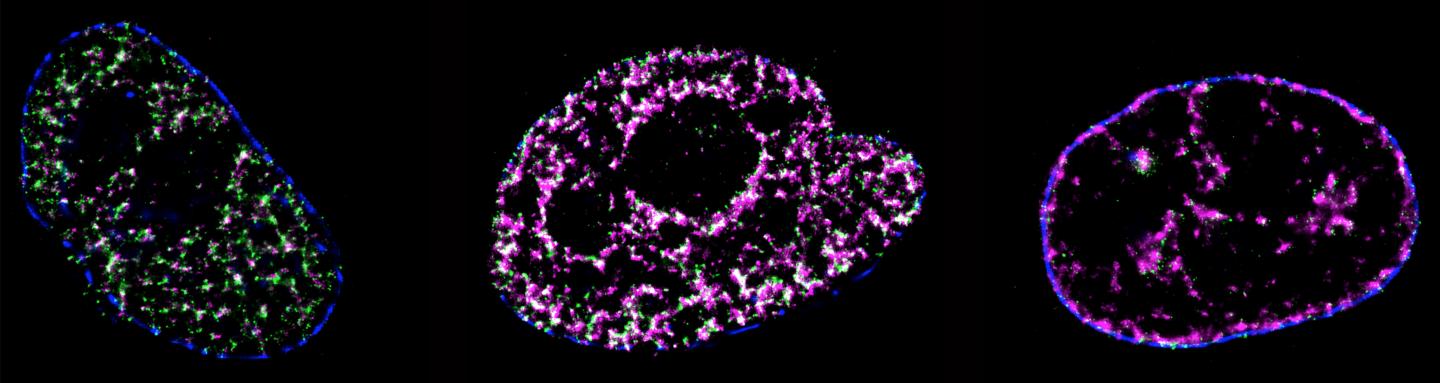
DNA replication is a process of critical importance to the cell, and must be coordinated precisely to ensure that genomic information is duplicated once and only once during each cell cycle. Using super-resolution technology a University of Technology Sydney led team has directly visualised the process of DNA replication in single human cells.

This is the first quantitative characterization to date of the spatio-temporal organisation, morphology, and in situ epigenetic signatures of individual replication foci (RFi) in single human cells at the nanoscale.

The results of the study, published in PNAS (Proceedings of the National Academy of Sciences) give new insight into a poorly understood area of DNA replication namely how replication origin sites are chosen from thousands of possible sites.

Lead author of the study, biophysicist Dr Peter Su from UTS Institute of Biomedical Materials and Devices (IBMD), explains that it’s known DNA replication is initiated at numerous sites along the chromosomes.

“These are known as replication origins, which are clustered into thousands of replication domains (RDs) across the genome, which in turn cluster within the cell nucleus as RFi ” he says.

“Such organization is critically important for the cell but how replication origins are chosen within individual RDs remains poorly understood, and it is unclear whether the origins are activated randomly or preferentially near certain chromatin features,” he says.
Chromatin helps package DNA material together so it can fit efficiently within the nucleus of a cell a, thus protecting the DNA from damage.

The collaboration with scientists from Peking University and National University of Singapore revealed a distinct pattern of replication propagation dynamics that reverses directionality across S-phase of the cell cycle, and is diminished upon knockdown of CTCF, a key regulator of 3D genome architecture.

The researchers say that together with simulation and bioinformatic analyses, these findings point to a model in which replication is preferentially activated on CTCF-organized looped chromatin structures, and suggest a non-random selection mechanism for replication activation at the sub-RD level.

Dr. Su said: “Our findings shed critical insights into the role local epigenetic environment plays in coordinating DNA replication across the genome, and could have wide-ranging implications for our understanding of how multi-scale chromatin architecture controls the organization and dynamics of diverse intranuclear processes in space and time.”

###

Media Contact
Marea Martlew
[email protected]

Related Journal Article

http://dx.doi.org/10.1073/pnas.2001521117

Tags: BiologyCell BiologyMolecular Biology
Share12Tweet8Share2ShareShareShare2

Related Posts

Fischer’s Blue Butterflies Less Attractive on Non-Native Diet, Study Finds — Biology

Fischer’s Blue Butterflies Less Attractive on Non-Native Diet, Study Finds

May 19, 2026

How One Protein Uses Embryonic Brain Language to Maintain Plasticity in Adult Neurons

May 19, 2026

Scientists Can Now Monitor America’s Dolphin Populations Using DNA Floating in Seawater

May 19, 2026

New Insights into How Smoking Causes Lung Stiffness

May 19, 2026
Please login to join discussion

POPULAR NEWS

  • Research Indicates Potential Connection Between Prenatal Medication Exposure and Elevated Autism Risk

    845 shares
    Share 338 Tweet 211
  • New Study Reveals Plants Can Detect the Sound of Rain

    731 shares
    Share 292 Tweet 182
  • Salmonella Haem Blocks Macrophages, Boosts Infection

    62 shares
    Share 25 Tweet 16
  • Breastmilk Balances E. coli and Beneficial Bacteria in Infant Gut Microbiomes

    58 shares
    Share 23 Tweet 15

About

We bring you the latest biotechnology news from best research centers and universities around the world. Check our website.

Follow us

Recent News

Myelin Damage in Donor Skin Distinguishes Synucleinopathies

FGFR1, Not S6K1/2, Fuels BRAF Resistance

Fischer’s Blue Butterflies Less Attractive on Non-Native Diet, Study Finds

Subscribe to Blog via Email

Enter your email address to subscribe to this blog and receive notifications of new posts by email.

Join 82 other subscribers
  • Contact Us

Bioengineer.org © Copyright 2023 All Rights Reserved.

Welcome Back!

Login to your account below

Forgotten Password?

Retrieve your password

Please enter your username or email address to reset your password.

Log In
No Result
View All Result
  • Homepages
    • Home Page 1
    • Home Page 2
  • News
  • National
  • Business
  • Health
  • Lifestyle
  • Science

Bioengineer.org © Copyright 2023 All Rights Reserved.