• HOME
  • NEWS
  • EXPLORE
    • CAREER
      • Companies
      • Jobs
    • EVENTS
    • iGEM
      • News
      • Team
    • PHOTOS
    • VIDEO
    • WIKI
  • BLOG
  • COMMUNITY
    • FACEBOOK
    • INSTAGRAM
    • TWITTER
Sunday, February 8, 2026
BIOENGINEER.ORG
No Result
View All Result
  • Login
  • HOME
  • NEWS
  • EXPLORE
    • CAREER
      • Companies
      • Jobs
        • Lecturer
        • PhD Studentship
        • Postdoc
        • Research Assistant
    • EVENTS
    • iGEM
      • News
      • Team
    • PHOTOS
    • VIDEO
    • WIKI
  • BLOG
  • COMMUNITY
    • FACEBOOK
    • INSTAGRAM
    • TWITTER
  • HOME
  • NEWS
  • EXPLORE
    • CAREER
      • Companies
      • Jobs
        • Lecturer
        • PhD Studentship
        • Postdoc
        • Research Assistant
    • EVENTS
    • iGEM
      • News
      • Team
    • PHOTOS
    • VIDEO
    • WIKI
  • BLOG
  • COMMUNITY
    • FACEBOOK
    • INSTAGRAM
    • TWITTER
No Result
View All Result
Bioengineer.org
No Result
View All Result
Home NEWS Science News Chemistry

3D printed insoles offers new hope for patients with diabetes

Bioengineer by Bioengineer
June 25, 2020
in Chemistry
Reading Time: 2 mins read
0
IMAGE
Share on FacebookShare on TwitterShare on LinkedinShare on RedditShare on Telegram

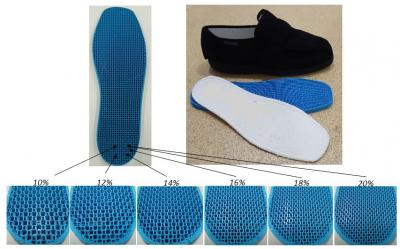
Scientists from Staffordshire University claim that new 3D printed insoles can significantly improve the foot health of people suffering with diabetes.
IMAGE

Credit: Staffordshire University

Scientists from Staffordshire University claim that new 3D printed insoles can significantly improve the foot health of people suffering with diabetes.

This study offers hope for millions of patients with diabetes who are at risk of developing foot ulcers, which in many cases end up in amputation. It presents the first quantitative evidence in support of optimised cushioning in diabetic footwear as part of standard clinical practice.

In their latest paper [‘Optimised cushioning in diabetic footwear can significantly enhance their capacity to reduce plantar pressure’] published in Gait and Posture, researchers conclude that selecting the correct cushioning stiffness in footwear can significantly reduce pressures experienced on the feet which can lead to ulcers and other painful complications.

In the study carried out in Malta, 15 participants with diabetic foot disease were asked to walk in footwear fitted with made to measure 3D-printed insoles designed by the Centre for Biomechanics and Rehabilitation Technologies (CBRT) at Staffordshire University. These footbeds were used to change the stiffness of the entire sole across a spectrum of very soft to very stiff.

Dr Chatzistergos, Associate Professor at CBRT and the lead author of ths study said: “The optimum stiffness is clearly related to the patient’s body mass index (BMI). This study adds to our earlier findings and concludes that stiffer materials are needed for people with a higher BMI.”

Collaborators Dr Alfred Gatt and Dr Cynthia Formosa from the University of Malta and Visiting Fellows at CBRT provided clinical support for this study and led the experiments in Malta. Dr Gatt noted: “We hope that the results reported within this study will generate interest amongst all professionals managing this debilitating condition.”

Further work is now underway to develop a method to help professionals identify the optimum cushioning stiffness on a patient-specific basis. Professor Nachi Chockalingam, Director of CBRT and a co-inventor of the technology said “With numerous patients losing their limbs to diabetic foot disease, our research will help clinicians effectively manage this disease.”

###

Media Contact
Amy Platts
[email protected]

Related Journal Article

http://dx.doi.org/10.1016/j.gaitpost.2020.05.009

Tags: BiologyBiomechanics/BiophysicsDiabetesOrthopedic Medicine
Share12Tweet8Share2ShareShareShare2

Related Posts

blank

Breakthrough in Environmental Cleanup: Scientists Develop Solar-Activated Biochar for Faster Remediation

February 7, 2026
blank

Cutting Costs: Making Hydrogen Fuel Cells More Affordable

February 6, 2026

Scientists Develop Hand-Held “Levitating” Time Crystals

February 6, 2026

Observing a Key Green-Energy Catalyst Dissolve Atom by Atom

February 6, 2026
Please login to join discussion

POPULAR NEWS

  • Robotic Ureteral Reconstruction: A Novel Approach

    Robotic Ureteral Reconstruction: A Novel Approach

    82 shares
    Share 33 Tweet 21
  • Digital Privacy: Health Data Control in Incarceration

    63 shares
    Share 25 Tweet 16
  • Breakthrough in RNA Research Accelerates Medical Innovations Timeline

    53 shares
    Share 21 Tweet 13
  • Mapping Tertiary Lymphoid Structures for Kidney Cancer Biomarkers

    50 shares
    Share 20 Tweet 13

About

We bring you the latest biotechnology news from best research centers and universities around the world. Check our website.

Follow us

Recent News

Group Therapy Boosts Recovery in Elderly Depression

Evaluating Biosimilar Trastuzumab for Breast Cancer in Thailand

Decoding Phantom Limb Movements via Intraneural Signals

Subscribe to Blog via Email

Enter your email address to subscribe to this blog and receive notifications of new posts by email.

Join 74 other subscribers
  • Contact Us

Bioengineer.org © Copyright 2023 All Rights Reserved.

Welcome Back!

Login to your account below

Forgotten Password?

Retrieve your password

Please enter your username or email address to reset your password.

Log In
No Result
View All Result
  • Homepages
    • Home Page 1
    • Home Page 2
  • News
  • National
  • Business
  • Health
  • Lifestyle
  • Science

Bioengineer.org © Copyright 2023 All Rights Reserved.