Colourful bugs look very different as young and adults, but why?
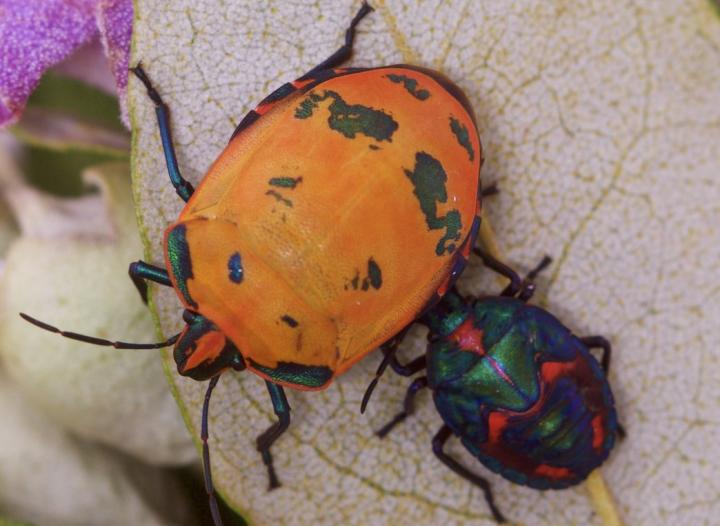
Credit: Iliana Medina
New research has revealed for the first time that shield bugs use a variety of colours throughout their lives to avoid predators.
Shield bugs are often bright, colourful insects that use colours to warn off their distastefulness to predators. The paper, published in Proceedings of the Royal Society B, found that it is impossible to predict how an adult bug will look like based on their colour when young.
“We found that in most species, the same individual bug will use different colour combinations as nymphs – young bugs – and adults, going for example from red and green to yellow and green,” said lead author and ecologist, Dr Iliana Medina, from the University of Melbourne’s School of Biosciences.
“This is significant because many of these species use colour to warn predators that they are distasteful, and for years it has been thought that animals living in the same environment – like nymphs and adults of the same species – should use similar warning colours, not different ones.”
The joint research between scientists at the University of Melbourne and the Australian National University combined information on colour in young and adults for more than 100 species of shield bugs worldwide. They then used field work in Canberra, with white-winged choughs, to measure how likely these birds were to attack adult and nymphs of one Australian species of shield bug, the cotton harlequin bug.
Experiments were also conducted in the aviary, training two-week-old chicks to see how fast they learned to avoid nymphs and adults, then testing whether their previous experience with adults could reduce attack rates on nymphs.
“Our experiments with the cotton harlequin bug showed that predators could quickly learn to avoid both types of colour signals from nymphs and adults, but nymphs get a larger benefit,” Dr Medina said.
“Although young and adult cotton harlequin bugs have different colours, previous experience with adults make chicks less likely to attack the nymphs. Also, chicks and wild predators that have never seen the insects before do not show much interest in eating them. The colours in these insects are a great strategy against predators.”
Many animals such as frogs, insects and sea slugs use bright colourations to advertise toxicity or distastefulness. In theory, warning signals of prey that live in the same environment should be the same because predators can learn more effectively to avoid one type of pattern, instead of many different ones.
While this idea has been used to explain the great examples of mimicry in nature, and why distantly related species end up having the same warning colours, such as black and red, or black and yellow, researchers say there are multiple examples of variation in local warning signals and an overlooked type of variation is that across life stages.
“If predators were able to learn to avoid only one type of warning colour, we would expect nymphs and adults to look similar in many species,” Dr Medina said. “What our findings show, however, is that the wide colour variation in shield bugs is probably the result of predators being able to learn to avoid different types of colourful signals.”
###
Media Contact
Lito Vilisoni Wilson
[email protected]
Original Source
https:/