• HOME
  • NEWS
  • EXPLORE
    • CAREER
      • Companies
      • Jobs
    • EVENTS
    • iGEM
      • News
      • Team
    • PHOTOS
    • VIDEO
    • WIKI
  • BLOG
  • COMMUNITY
    • FACEBOOK
    • INSTAGRAM
    • TWITTER
Friday, January 16, 2026
BIOENGINEER.ORG
No Result
View All Result
  • Login
  • HOME
  • NEWS
  • EXPLORE
    • CAREER
      • Companies
      • Jobs
        • Lecturer
        • PhD Studentship
        • Postdoc
        • Research Assistant
    • EVENTS
    • iGEM
      • News
      • Team
    • PHOTOS
    • VIDEO
    • WIKI
  • BLOG
  • COMMUNITY
    • FACEBOOK
    • INSTAGRAM
    • TWITTER
  • HOME
  • NEWS
  • EXPLORE
    • CAREER
      • Companies
      • Jobs
        • Lecturer
        • PhD Studentship
        • Postdoc
        • Research Assistant
    • EVENTS
    • iGEM
      • News
      • Team
    • PHOTOS
    • VIDEO
    • WIKI
  • BLOG
  • COMMUNITY
    • FACEBOOK
    • INSTAGRAM
    • TWITTER
No Result
View All Result
Bioengineer.org
No Result
View All Result
Home NEWS Science News Chemistry

Ion conducting polymer crucial to improving neuromorphic devices

Bioengineer by Bioengineer
June 24, 2020
in Chemistry
Reading Time: 2 mins read
0
IMAGE
Share on FacebookShare on TwitterShare on LinkedinShare on RedditShare on Telegram

IMAGE

Credit: Shunsuke Yamamoto

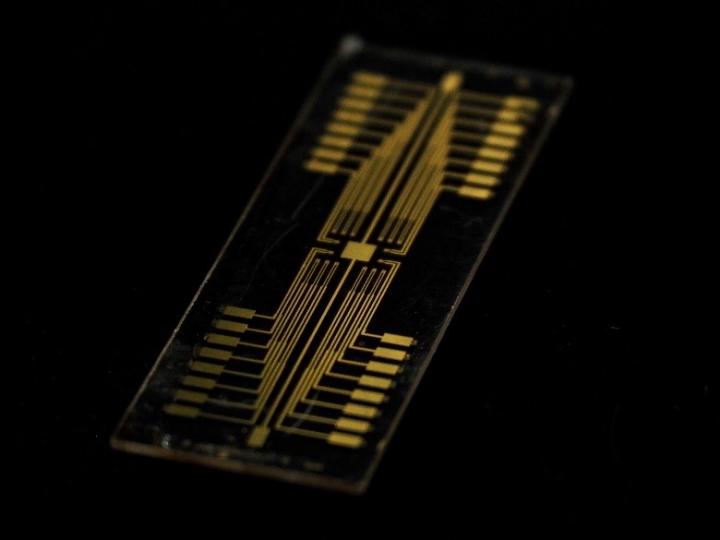
“Neuromorphic” refers to mimicking the behavior of brain neural cells. When one speaks of neuromorphic computers, they are talking about making computers think and process more like human brains-operating at high-speed with low energy consumption.

Despite a growing interest in polymer-based neuromorphic devices, researchers have yet to establish an effective method for controlling the response speed of devices. Researchers from Tohoku University and the University of Cambridge, however, have overcome this obstacle through mixing the polymers PSS-Na and PEDOT:PSS, discovering that adding an ion conducting polymer enhances neuromorphic device response time.

Polymers are materials composed of long molecular chains and play a fundamental aspect in modern life from the rubber in tires, to water bottles, to polystyrene. Mixing polymers together results in the creation of new materials with their own distinct physical properties.

Most studies on neuromorphic devices based on polymer focus exclusively on the application of PEDOT: PSS, a mixed conductor that transports both electrons and ions. PSS-Na, on the other hand, transports ions only. By blending these two polymers, the researchers could enhance the ion diffusivity in the active layer of the device. Their measurements confirmed an increase in device response time, achieving a 5-time shorting at maximum. The results also proved how closely related response time is to the diffusivity of ions in the active layer.

“Our study paves the way for a deeper understanding behind the science of conducting polymers.” explains co-author Shunsuke Yamamoto from the Department of Biomolecular Engineering at Tohoku University’s Graduate School of Engineering. “Moving forward, it may be possible to create artificial neural networks composed of multiple neuromorphic devices,” he adds.

###

Media Contact
Shunsuke Yamamoto
[email protected]

Related Journal Article

http://dx.doi.org/10.1021/acsaelm.0c00203

Tags: Computer ScienceElectrical Engineering/ElectronicsNanotechnology/MicromachinesTechnology/Engineering/Computer Science
Share12Tweet8Share2ShareShareShare2

Related Posts

Selective GlcNAc to GalNAc Epimerization via Kinetic Control

Selective GlcNAc to GalNAc Epimerization via Kinetic Control

January 15, 2026
blank

Thermal [2+2] Cycloaddition Builds Gem-Difluoro Bicycloalkanes

January 13, 2026

Cobalt-Catalyzed Thioester Coupling via Siloxycarbene

January 12, 2026

Advancing Alkene Chemistry: Homologative Difunctionalization Breakthrough

January 8, 2026
Please login to join discussion

POPULAR NEWS

  • Enhancing Spiritual Care Education in Nursing Programs

    155 shares
    Share 62 Tweet 39
  • PTSD, Depression, Anxiety in Childhood Cancer Survivors, Parents

    147 shares
    Share 59 Tweet 37
  • Robotic Ureteral Reconstruction: A Novel Approach

    76 shares
    Share 30 Tweet 19
  • Study Reveals Lipid Accumulation in ME/CFS Cells

    53 shares
    Share 21 Tweet 13

About

We bring you the latest biotechnology news from best research centers and universities around the world. Check our website.

Follow us

Recent News

Chemical Reprogramming Transforms Human T Cells to Pluripotency

Enhancing Shanshui Animation with Perlin Noise Techniques

Revolutionary Model Enhances Drug Interaction Prediction

Subscribe to Blog via Email

Enter your email address to subscribe to this blog and receive notifications of new posts by email.

Join 71 other subscribers
  • Contact Us

Bioengineer.org © Copyright 2023 All Rights Reserved.

Welcome Back!

Login to your account below

Forgotten Password?

Retrieve your password

Please enter your username or email address to reset your password.

Log In
No Result
View All Result
  • Homepages
    • Home Page 1
    • Home Page 2
  • News
  • National
  • Business
  • Health
  • Lifestyle
  • Science

Bioengineer.org © Copyright 2023 All Rights Reserved.