Credit: ©Science China Press
The photosynthetic systems of green plants have developed a dual function of efficient light collection under low light intensity and photoprotection under intense sunshine to prevent the oxidative damage of reaction centers.
Whereas it is widely accepted that such a dual function is mainly realized through the most major light-harvesting complex of photosystem II (LHCII) in response to the photo-induced pH change at lumenal side, a long-lasting puzzle remains how this photosynthetic protein switches between these two opposite functions via fast structural change in adaption to changes of the environmental conditions. Prof. Weng, the Laboratory of Soft Matter Physics, Institute of Physics, CAS, said “an answer to this question would be instructive to engineering plants with higher efficiency in photosynthesis, and a greater productivity.”
“Our study probes protein dynamics and allosteric structure changes of LHCII by integrating time-resolved spectroscopy and atomistic molecular dynamics simulations.” Prof. Weng said, “In collaboration with the Minnesota groups headed by Professors Jiali Gao and Gianluigi Veglia (Department of Chemistry and Department of Biochemistry, Molecular Biology and Biophysics, University of Minnesota, USA), molecular dynamics simulations carried out by Dr. Yingjie Wang, now an Associate Research Investigator at Shenzhen Bay Laboratory, revealed that LHCII trimer itself can act as a molecular machine in response to environmental conditions, including increased temperature, acidity, or both cooperatively. The atomistic simulation results are fully consistent with, and helped to interpret experimental observations.”
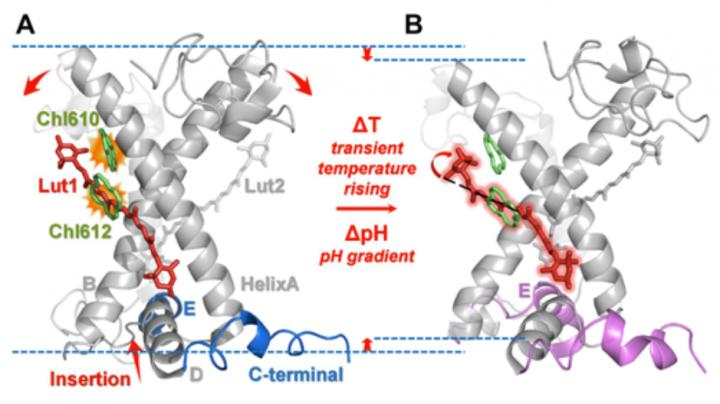
The net effect of the mechanical scissoring motions is to bring closer chromophores – molecules that absorbs and transfers photo-energy – such that the “bright” state of chlorophyll transmit its excited energy into the “dark” state of lutein. The lowest excited state of lutein does not emit or absorb photon directly, thus, a dark state, and eventually dissipates the excess energy as heat through thermal vibrations. This mechanism links phenomenological and environmental factors such as rapid fluctuations of Sun radiation due to clouds movement, which cause changes in physiological conditions across the membrane of the photosynthetic machinery, leading to structural changes of the light-harvesting antenna proteins at the atomistic level. The research also showed that aggregation of LHCII promotes energy dissipation both at high temperature and increased acidity conditions, a process well-known in the community under these conditions.
“The allosteric motions can be illustrated in the Figure below,” Weng told us. “An increase either in temperature or in acidity, or both, induces local helices formation, which triggers a global transmembrane protein-conformation change, leading to close proximity between the embedded chromophores. This process is reversed when temperature and acidity are lowed when clouds move in, restoring the high efficiency mode of energy transfer for light harvesting.”
###
See the article:
Li H, Wang Y, Ye M, Li S, Li D, Ren H, Wang M, Du L, Li H, Veglia G, Gao J, Weng Y. Dynamical allosteric regulation of photoprotection in light harvesting complex II. Sci. China Chem., 2020, 63, doi:10.1007/s11426-020-9771-2
https:/
Media Contact
Yuxiang Weng
[email protected]
Related Journal Article
http://dx.