Credit: Ben-Gurion University of the Negev
BEER-SHEVA, Israel…June 23, 2020 – Could furry social robots help bolster moods and reduce pain when human to human contact isn’t an option, for example, during a pandemic?
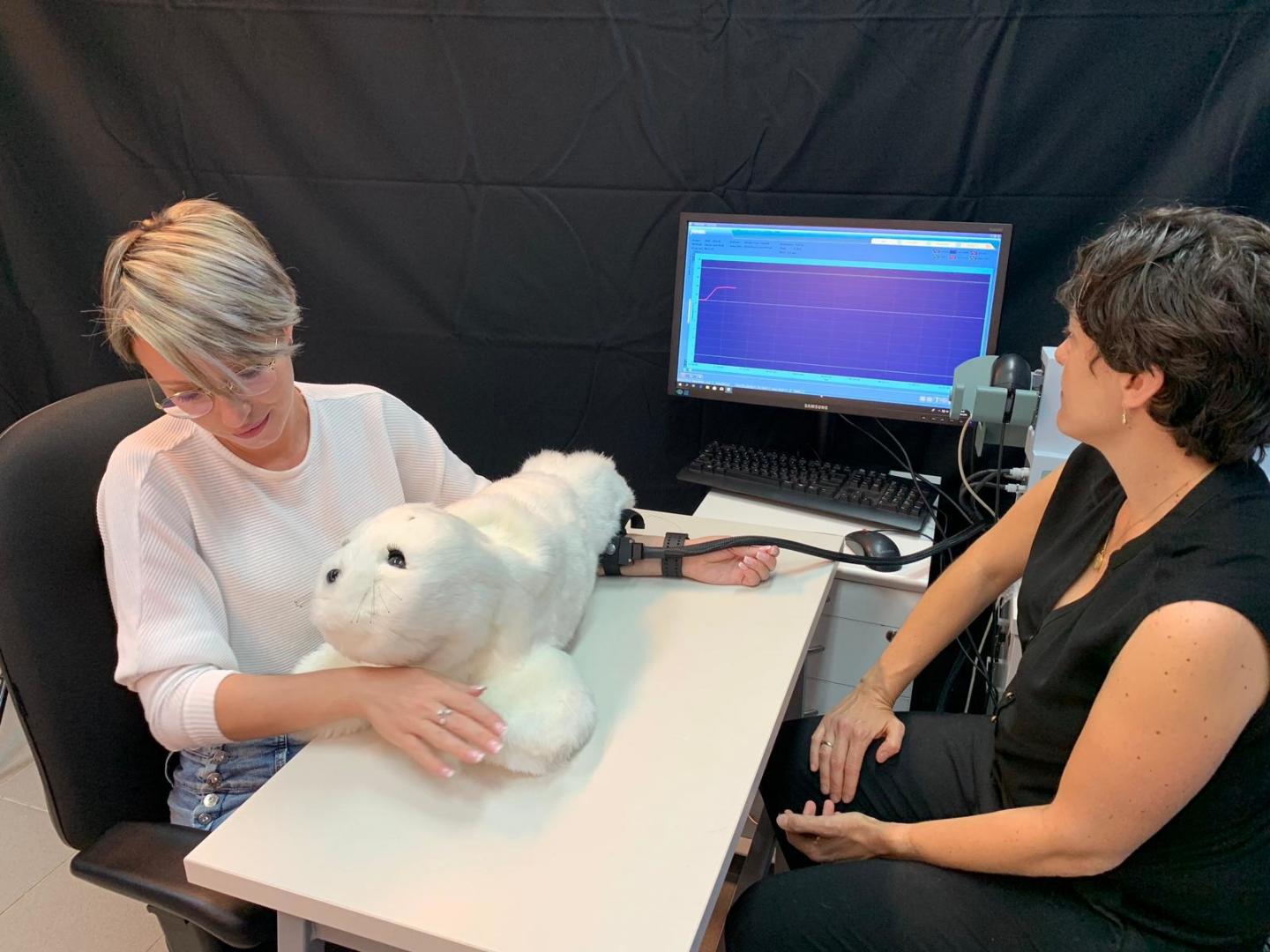
According to a new study by Ben-Gurion University of the Negev (BGU) researchers published in Scientific Reports, a one-time, hour-long session with a plush, seal-like social robot reduced pain and oxytocin levels, and increased happiness. The Japanese social robot, PARO, emits seal-like sounds and moves its head and flippers in response to being spoken to and touched.
Human-to-human contact has been found to bolster mood and reduce pain in previous studies. Dr. Shelly Levy-Tzedek of the BGU Department of Physical Therapy and her team investigated whether a furry social robot could induce similar effects when normal human-to-human contact is not available.
Levy-Tzedek and her team discovered that a single, 60-minute interaction with PARO actually improved mood as well as reduced mild or severe pain. When participants touched PARO, they experienced greater pain reduction than when it was simply present in their room.
Surprisingly, the BGU researchers discovered lower oxytocin levels in those who interacted with PARO than in the control group participants, who did not meet PARO. Typically, oxytocin, sometimes called “the love homone,” is elevated among romantic partners or mothers playing with their children, so a lower level of oxytocin wasn’t expected. However, more recent studies have shown that outside of close relationships, oxytocin production is a stress indicator and therefore, a reduction could indicate relaxation.
“These findings offer new strategies for pain management and for improving well-being, which are particularly needed at this time, when social distancing is a crucial factor in public health,” says Dr. Levy-Tzedek.
###
The research was partially supported by the Helmsley Charitable Trust through the Agricultural, Biological and Cognitive Robotics Initiative and by the Marcus Endowment Fund, both at the Ben-Gurion University of the Negev. Financial support was provided by the Rosetrees Trust, the Borten Family Foundation and the Consolidated Anti-Aging Foundation grants. This research was also supported by the Israel Science Foundation (grants No. 535/16 and 2166/16), the Israel Pain Association, and received funding from the European Union’s Horizon 2020 research and innovation program under the Marie Sk?odowska-Curie grant agreement No 754340.
American Associates, Ben-Gurion University of the Negev
American Associates, Ben-Gurion University of the Negev (AABGU) plays a vital role in sustaining David Ben-Gurion’s vision: creating a world-class institution of education and research in the Israeli desert, nurturing the Negev community and sharing the University’s expertise locally and around the globe. Celebrating the 50th birthday of Ben-Gurion University of the Negev (BGU), AABGU imagines a future that goes beyond the walls of academia. It is a future where BGU invents a new world and inspires a vision for a stronger Israel and its next generation of leaders. Together with supporters, AABGU will help the University foster excellence in teaching, research and outreach to the communities of the Negev for the next 50 years and beyond. AABGU, headquartered in Manhattan, has regional offices throughout the United States. For more information visit http://www.
Media Contact
Andrew Lavin
[email protected]
Related Journal Article
http://dx.