• HOME
  • NEWS
  • EXPLORE
    • CAREER
      • Companies
      • Jobs
    • EVENTS
    • iGEM
      • News
      • Team
    • PHOTOS
    • VIDEO
    • WIKI
  • BLOG
  • COMMUNITY
    • FACEBOOK
    • INSTAGRAM
    • TWITTER
Saturday, February 7, 2026
BIOENGINEER.ORG
No Result
View All Result
  • Login
  • HOME
  • NEWS
  • EXPLORE
    • CAREER
      • Companies
      • Jobs
        • Lecturer
        • PhD Studentship
        • Postdoc
        • Research Assistant
    • EVENTS
    • iGEM
      • News
      • Team
    • PHOTOS
    • VIDEO
    • WIKI
  • BLOG
  • COMMUNITY
    • FACEBOOK
    • INSTAGRAM
    • TWITTER
  • HOME
  • NEWS
  • EXPLORE
    • CAREER
      • Companies
      • Jobs
        • Lecturer
        • PhD Studentship
        • Postdoc
        • Research Assistant
    • EVENTS
    • iGEM
      • News
      • Team
    • PHOTOS
    • VIDEO
    • WIKI
  • BLOG
  • COMMUNITY
    • FACEBOOK
    • INSTAGRAM
    • TWITTER
No Result
View All Result
Bioengineer.org
No Result
View All Result
Home NEWS Science News Chemistry

Catalyzing a green future

Bioengineer by Bioengineer
June 22, 2020
in Chemistry
Reading Time: 2 mins read
0
IMAGE
Share on FacebookShare on TwitterShare on LinkedinShare on RedditShare on Telegram

IMAGE

Credit: © 2020 Nikita Kolobov

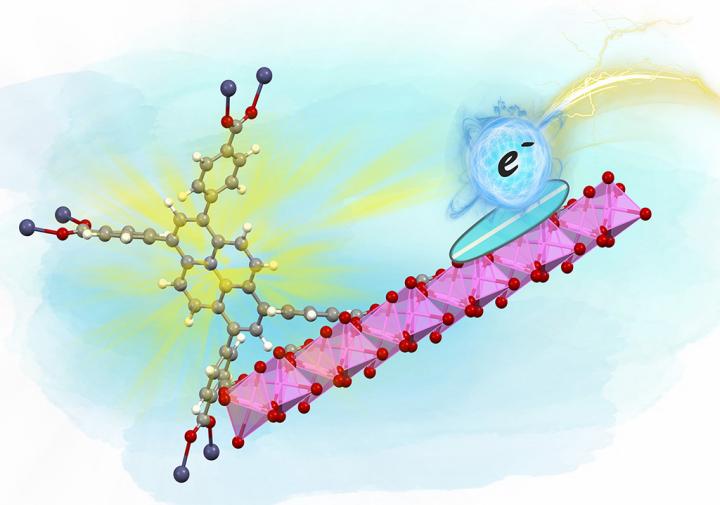
A metal organic framework (MOF)-based water splitting photocatalyst, developed at KAUST, has brought researchers a step closer to generating clean hydrogen fuel using sunlight.

“Using solar energy to efficiently make green fuels is the ultimate goal for many catalysis researchers,” says Jorge Gascon, director of the KAUST Catalysis Center, who led the research. However, it remains challenging to find efficient, long-lived, low-cost water-splitting photocatalysts.

In Gascon’s team, the aim is to use MOFs to find sustainable photocatalytic water splitting materials. “We work with MOFs because they are like a LEGO construction toy–you have different parts with which you can play and vary to get desired properties,” says Nikita Kolobov, a member of Gascon’s team.

MOFs consist of metal ions connected by carbon-based organic linkers in a highly regular and repeating two- or three-dimensional array. By varying the metal and the organic component, a diverse family of materials can be made. “This modularity makes MOFs an excellent platform for developing a fundamental understanding of photocatalytic processes,” Gascon says. “We can evaluate new concepts in photocatalysis that may be difficult or impossible to develop and evaluate using other classes of materials.”

For their latest work, Gascon, Kolobov, Amandine Cadiau and their colleagues created a MOF that used titanium metal ions with H4TBAPy, an organic linker known to absorb energy from a broad spectrum of sunlight. By combining H4TBAPy with titanium, the team aimed to create a material that could efficiently put that energy to use.

The titanium in the light-activated MOF had the ideal energy levels for the hydrogen production part of photocatalytic water splitting, the team showed. “The organic part of the MOF acted as an antenna that collected light and transmitted that energy to the metal node, which activated it to perform catalytic transformations,” Kolobov says.

“Although the new MOF’s hydrogen evolution reaction activity was modest compared to some inorganic semiconductors, its performance is already among the best titanium-based MOF materials,” Kolobov says. “MOFs are still in their infancy when it comes to photocatalytic applications,” he adds. “We believe the modular approach toward their construction offers unlimited possibilities for performance improvement, and we are taking the first steps in this direction.”

“Every step to better understand how catalysts work under light illumination is important,” Gascon says. “Our main objective at this moment is to come up with new MOF structures able to efficiently perform overall water splitting.”

###

Media Contact
Carolyn Unck
[email protected]

Original Source

https://discovery.kaust.edu.sa/en/article/984/catalyzing-a-green-future

Tags: Chemistry/Physics/Materials Sciences
Share12Tweet8Share2ShareShareShare2

Related Posts

blank

Breakthrough in Environmental Cleanup: Scientists Develop Solar-Activated Biochar for Faster Remediation

February 7, 2026
blank

Cutting Costs: Making Hydrogen Fuel Cells More Affordable

February 6, 2026

Scientists Develop Hand-Held “Levitating” Time Crystals

February 6, 2026

Observing a Key Green-Energy Catalyst Dissolve Atom by Atom

February 6, 2026
Please login to join discussion

POPULAR NEWS

  • Robotic Ureteral Reconstruction: A Novel Approach

    Robotic Ureteral Reconstruction: A Novel Approach

    82 shares
    Share 33 Tweet 21
  • Digital Privacy: Health Data Control in Incarceration

    63 shares
    Share 25 Tweet 16
  • Study Reveals Lipid Accumulation in ME/CFS Cells

    57 shares
    Share 23 Tweet 14
  • Breakthrough in RNA Research Accelerates Medical Innovations Timeline

    53 shares
    Share 21 Tweet 13

About

We bring you the latest biotechnology news from best research centers and universities around the world. Check our website.

Follow us

Recent News

Phage-Antibiotic Combo Beats Resistant Peritoneal Infection

Boosting Remote Healthcare: Stepped-Wedge Trial Insights

Barriers and Boosters of Seniors’ Physical Activity in Karachi

Subscribe to Blog via Email

Enter your email address to subscribe to this blog and receive notifications of new posts by email.

Join 73 other subscribers
  • Contact Us

Bioengineer.org © Copyright 2023 All Rights Reserved.

Welcome Back!

Login to your account below

Forgotten Password?

Retrieve your password

Please enter your username or email address to reset your password.

Log In
No Result
View All Result
  • Homepages
    • Home Page 1
    • Home Page 2
  • News
  • National
  • Business
  • Health
  • Lifestyle
  • Science

Bioengineer.org © Copyright 2023 All Rights Reserved.