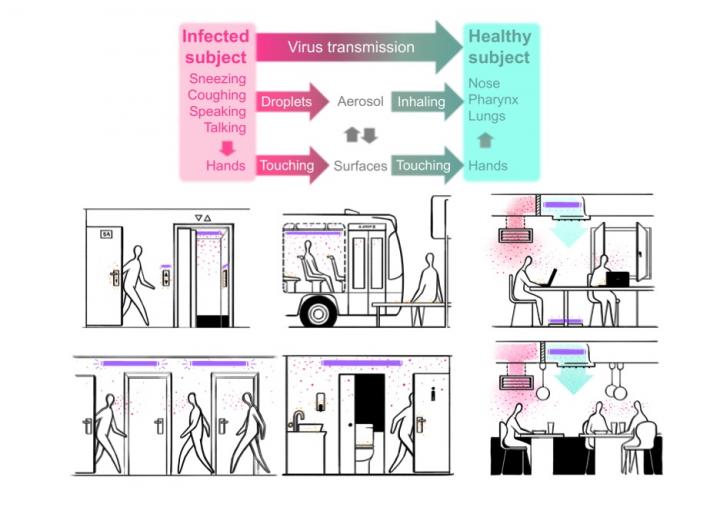
Credit: Image sketches by Nacho Gaubert.
The SARS-CoV-2 outbreak is posing an extraordinary challenge that requires swift worldwide action for the massive deployment of affordable and ready-to-apply measures to drastically reduce its transmission probabilities in indoor spaces, and eventually return to conventional activities such as working at the office, going to school, or even attending entertainment events.
Studies show that the virus transmission follows two main paths. Firstly, the virus can transmit through air in droplets exhaled by infected individuals and inhaled by healthy individuals. Secondly, it can be deposited on surfaces from either exhalations or hand contact. Now, several measures are being adopted to help prevent the transmission of this disease. The common ones refer to facial masks and other physical barriers that if properly used have proven to be highly effective but that however depend on compliance of the population.
A long series of studies suggest that virus transmission in indoor spaces has a much higher transmission rate than outdoors. Filters and chemicals have been presented as possible solutions to minimize this problem, but even though these are efficient solutions to reduce the concentration of contaminated particles and droplets through ventilation systems, their installation may be costly and time-consuming. In addition, chemicals such as ozone are very effective for virus disinfection, but if misused they are harmful for humans.
In this context, in a study recently published in ACS Nano, ICREA Prof. at ICFO Javier García de Abajo, in collaboration with ICREA Profs. Andreas Meyerhans (Universitat Pompeu Fabra) and Joan Rosell-Llompart (University Rovira i Virgili), together with Profs. Rufino Javier Hernández (University of the Basque Country), Ido Kaminer (Technion), and Tilman Sanchez-Elsner (University of Southampton), experts in the fields of virology, immunology, aerosols, architecture, and physics, have surveyed the possible methods to prevent SARS-CoV-2 propagation in indoor spaces. Following this survey, they advocate for one measure that they believe to be particularly efficient, easily deployable, and economically affordable: virus inactivation by ultraviolet light.
The study gives information on the currently available UV-C sources, such as fluorescent lamps, microcavity plasmas, and LEDs, emphasizing that, by irradiating this type of light inside the ventilation systems of buildings and in shared indoor spaces while not in use, it is possible to quickly and efficiently deactivate airborne and surface-deposited SARS-CoV-2 viruses.
They also explore costs and investments in deploying such technology and argue that a global capital investment of a few billion dollars in UV-C sources could protect of the order of ~10^9 indoor workers worldwide.
###
Disclaimer: UV-C equipment for virus disinfection is being commercialized by a number of companies worldwide. The authors of the study have no interests in or are sponsored by any of such companies.
Reference: https:/
ABOUT ICFO
ICFO was founded by the Government of Catalonia and the Universitat Politècnica de Catalunya (UPC), both of which are members of its board of trustees along with the Cellex and Mir-Puig Foundations, philanthropic entities that have played a critical role in the advancement of the institute. Located in the Mediterranean Technology Park in the metropolitan area of Barcelona, the institute currently hosts 400 people, organized in 25 research groups in 60 state-of-the-art research laboratories. Research lines encompass diverse areas in which photonics plays a decisive role, with an emphasis on basic and applied themes relevant to medicine and biology, advanced imaging techniques, information technologies, a range of environmental sensors, tunable and ultra-fast lasers, quantum science, photovoltaics and the properties and applications of nano-materials such as graphene, among others. In addition to two state awarded Severo Ochoa accreditations of excellence, ICFOnians have secured 15 ICREA Professorships and 37 European Research Council grants. ICFO is proactive in fostering entrepreneurial activities, spin-off creation, and creating collaborations and links between industry and ICFO researchers. To date, ICFO has helped create 7 start-up companies.
Media Contact
Alina Hirschmann
[email protected]