• HOME
  • NEWS
  • EXPLORE
    • CAREER
      • Companies
      • Jobs
    • EVENTS
    • iGEM
      • News
      • Team
    • PHOTOS
    • VIDEO
    • WIKI
  • BLOG
  • COMMUNITY
    • FACEBOOK
    • INSTAGRAM
    • TWITTER
Saturday, February 7, 2026
BIOENGINEER.ORG
No Result
View All Result
  • Login
  • HOME
  • NEWS
  • EXPLORE
    • CAREER
      • Companies
      • Jobs
        • Lecturer
        • PhD Studentship
        • Postdoc
        • Research Assistant
    • EVENTS
    • iGEM
      • News
      • Team
    • PHOTOS
    • VIDEO
    • WIKI
  • BLOG
  • COMMUNITY
    • FACEBOOK
    • INSTAGRAM
    • TWITTER
  • HOME
  • NEWS
  • EXPLORE
    • CAREER
      • Companies
      • Jobs
        • Lecturer
        • PhD Studentship
        • Postdoc
        • Research Assistant
    • EVENTS
    • iGEM
      • News
      • Team
    • PHOTOS
    • VIDEO
    • WIKI
  • BLOG
  • COMMUNITY
    • FACEBOOK
    • INSTAGRAM
    • TWITTER
No Result
View All Result
Bioengineer.org
No Result
View All Result
Home NEWS Science News Biology

EMBL survey studies effects of COVID-19 pandemic on life scientists

Bioengineer by Bioengineer
June 22, 2020
in Biology
Reading Time: 2 mins read
0
IMAGE
Share on FacebookShare on TwitterShare on LinkedinShare on RedditShare on Telegram

IMAGE

Credit: EMBL

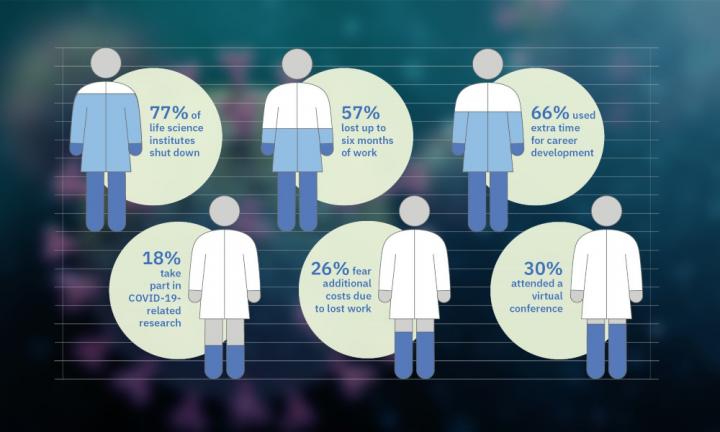
Jan Korbel and Oliver Stegle, both group leaders at EMBL Heidelberg, have performed a survey of fellow life scientists in Germany, Spain, the UK, Italy, France, Canada, Turkey, and the USA to learn how the current crisis, with partial or complete institutional shutdowns, is affecting their work.

The two researchers received 881 responses in total. Of the respondents, 77% stated that their institute had been fully shut down, with only essential service staff present on site. A partial shutdown, with less than half of the institute being operational, was reported by 19%. These numbers show the severe impact on the ability of researchers to work in their usual offices or labs.

The closure of the institutes also meant that more than half of the researchers lost part of their work on ongoing experiments, requiring between a single month and half a year to repeat. Personnel working in wet labs were more affected by this problem than computational researchers in dry labs.

Korbel and Stegle also analysed the stress level of participants and identified two potential risk groups. One was young trainees – especially trainees working outside their home country in institutes located on a different continent. “A third of these scientists live alone and are likely to feel more isolated in the time of a shutdown than their more settled or local colleagues,” explains Jan Korbel. The second group are female scientists. A higher proportion of female respondents were working in wet labs – which have been more affected by the shutdown than dry labs – and they were also more often bound by childcare duties than male respondents.

On the positive side, the survey showed that many researchers used the additional time on data analysis and writing – including manuscripts, theses, and grant applications – which has already led to an increase in manuscript submissions to scientific journals.

Overall, it seems, life scientists have adapted very well to the new circumstances. “The ability to work efficiently from home, and to collaborate productively with life scientists and clinicians nationally and internationally by videoconferencing, without extensive travel, might ultimately even result in benefits for scientific communities and society as a whole,” concludes Oliver Stegle.

###

Media Contact
Mathias Jäger
[email protected]

Original Source

https://www.embl.org/news/lab-matters/covid-19-impact-on-life-scientists/

Related Journal Article

http://dx.doi.org/10.1186/s13059-020-02031-1

Tags: BiologyCollaborationGrants/FundingGroup OrganizationMolecular BiologyProfessionalScience/Math
Share12Tweet8Share2ShareShareShare2

Related Posts

Florida Cane Toad: Complex Spread and Selective Evolution

Florida Cane Toad: Complex Spread and Selective Evolution

February 7, 2026
New Study Uncovers Mechanism Behind Burn Pit Particulate Matter–Induced Lung Inflammation

New Study Uncovers Mechanism Behind Burn Pit Particulate Matter–Induced Lung Inflammation

February 6, 2026

DeepBlastoid: Advancing Automated and Efficient Evaluation of Human Blastoids with Deep Learning

February 6, 2026

Navigating the Gut: The Role of Formic Acid in the Microbiome

February 6, 2026
Please login to join discussion

POPULAR NEWS

  • Robotic Ureteral Reconstruction: A Novel Approach

    Robotic Ureteral Reconstruction: A Novel Approach

    82 shares
    Share 33 Tweet 21
  • Digital Privacy: Health Data Control in Incarceration

    63 shares
    Share 25 Tweet 16
  • Study Reveals Lipid Accumulation in ME/CFS Cells

    57 shares
    Share 23 Tweet 14
  • Breakthrough in RNA Research Accelerates Medical Innovations Timeline

    53 shares
    Share 21 Tweet 13

About

We bring you the latest biotechnology news from best research centers and universities around the world. Check our website.

Follow us

Recent News

Barriers and Boosters of Seniors’ Physical Activity in Karachi

Evaluating Pediatric Emergency Care Quality in Ethiopia

TPMT Expression Predictions Linked to Azathioprine Side Effects

Subscribe to Blog via Email

Enter your email address to subscribe to this blog and receive notifications of new posts by email.

Join 73 other subscribers
  • Contact Us

Bioengineer.org © Copyright 2023 All Rights Reserved.

Welcome Back!

Login to your account below

Forgotten Password?

Retrieve your password

Please enter your username or email address to reset your password.

Log In
No Result
View All Result
  • Homepages
    • Home Page 1
    • Home Page 2
  • News
  • National
  • Business
  • Health
  • Lifestyle
  • Science

Bioengineer.org © Copyright 2023 All Rights Reserved.