• HOME
  • NEWS
  • EXPLORE
    • CAREER
      • Companies
      • Jobs
    • EVENTS
    • iGEM
      • News
      • Team
    • PHOTOS
    • VIDEO
    • WIKI
  • BLOG
  • COMMUNITY
    • FACEBOOK
    • INSTAGRAM
    • TWITTER
Saturday, February 7, 2026
BIOENGINEER.ORG
No Result
View All Result
  • Login
  • HOME
  • NEWS
  • EXPLORE
    • CAREER
      • Companies
      • Jobs
        • Lecturer
        • PhD Studentship
        • Postdoc
        • Research Assistant
    • EVENTS
    • iGEM
      • News
      • Team
    • PHOTOS
    • VIDEO
    • WIKI
  • BLOG
  • COMMUNITY
    • FACEBOOK
    • INSTAGRAM
    • TWITTER
  • HOME
  • NEWS
  • EXPLORE
    • CAREER
      • Companies
      • Jobs
        • Lecturer
        • PhD Studentship
        • Postdoc
        • Research Assistant
    • EVENTS
    • iGEM
      • News
      • Team
    • PHOTOS
    • VIDEO
    • WIKI
  • BLOG
  • COMMUNITY
    • FACEBOOK
    • INSTAGRAM
    • TWITTER
No Result
View All Result
Bioengineer.org
No Result
View All Result
Home NEWS Science News

Researchers design a system to reduce the noise of space rockets in the launch phase

Bioengineer by Bioengineer
June 18, 2020
in Science News
Reading Time: 2 mins read
0
IMAGE
Share on FacebookShare on TwitterShare on LinkedinShare on RedditShare on Telegram

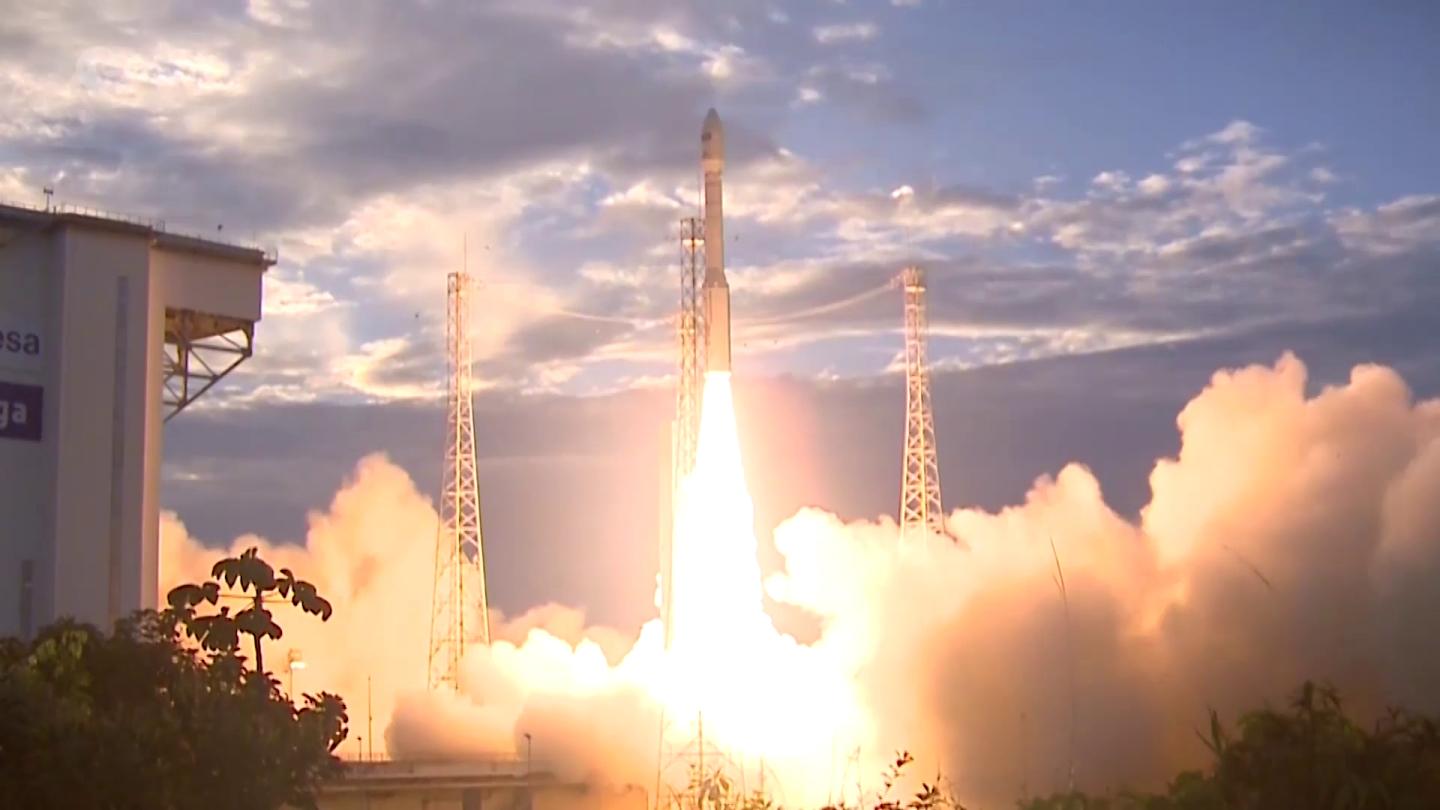
The prototype will increase the safety of launching
IMAGE

Credit: ESA

The thesis is focused on the research of methods that reduce the noise level of space rockets during the first phases of launching (engine ignition and takeoff). According to Iván Herrero, at those times, the levels of acoustic pressure experienced by the space vehicles are extremely high and could seriously affect the light structures onboard, such as solar panels and antennas, making it necessary to reduce the noise levels.

“During the launch of space rockets, over 150 dB of sound pressure level are reached at certain frequencies. It is the highest level sound event produced by a human being, only behind some natural events like an earthquake,” explains Iván Herrero.

In addition, the intense sound generated by the primary sources, engine and jet increases due to reflection at the bottom of the rocket launch site, which acts like a mirror from the acoustic point of view, and gives the energy released back to the rocket and the structures onboard, implying economic and safety consequences.

Prototype

The prototype designed by Iván Herrero, under the supervision of his thesis directors, is based on an array of Helmholtz resonators, which maximizes the sound absorption and diffusion, to mitigate the sound pressure levels generated during these events in the space context.

“The presence of Helmholtz resonators, as well as their specific distribution, produces a reduction of the speed of sound diffusion. This is due to the friction of acoustic waves with the resonator walls, which produces a deceleration. The design of this system was done by optimizing a specific frequency range, which they have been able to reduce by an average of 20 decibels,” explains Iván Herrero.

Despite of the importance of this problem, knowledge about the characteristics of the sources, the behavior of the ground installations regarding the sound diffusion and absorption, and the possible measures to mitigate the impact are still poor. The research work developed at the Gandia campus of UPV and the European Space Agency is in response to this need.

The Iván Herrero’s thesis was directed by Rubén Picó Vila, Víctor Sánchez Morcillo and Lluís García Raffi, from the Universitat Politècnica de Valènca, and by Vicente Romero García, from the Laboratoire d’Acoustique de l’Université du Maine (France).

NPI PROGRAM

Iván Herrero has developed part of his research work in the technical center of the European Space Agency (ESA) in Holland, thanks to the agreement signed between UPV and ESA within the Networking / Partnering Initiative (NPI) program, in which several universities and research institutes in advanced technologies are participating with potential space applications.

During the thesis work, Iván did two research stays in the European Space Research and Technology Centre (ESTEC) of ESA.

###

Media Contact
Luis Zurano Conches
[email protected]

Related Journal Article

http://dx.doi.org/10.3390/app10051690

Tags: Computer ScienceTechnology/Engineering/Computer Science
Share12Tweet8Share2ShareShareShare2

Related Posts

Evaluating Pediatric Emergency Care Quality in Ethiopia

February 7, 2026

TPMT Expression Predictions Linked to Azathioprine Side Effects

February 7, 2026

Improving Dementia Care with Enhanced Activity Kits

February 7, 2026

Decoding Prostate Cancer Origins via snFLARE-seq, mxFRIZNGRND

February 7, 2026
Please login to join discussion

POPULAR NEWS

  • Robotic Ureteral Reconstruction: A Novel Approach

    Robotic Ureteral Reconstruction: A Novel Approach

    82 shares
    Share 33 Tweet 21
  • Digital Privacy: Health Data Control in Incarceration

    63 shares
    Share 25 Tweet 16
  • Study Reveals Lipid Accumulation in ME/CFS Cells

    57 shares
    Share 23 Tweet 14
  • Breakthrough in RNA Research Accelerates Medical Innovations Timeline

    53 shares
    Share 21 Tweet 13

About

We bring you the latest biotechnology news from best research centers and universities around the world. Check our website.

Follow us

Recent News

Evaluating Pediatric Emergency Care Quality in Ethiopia

TPMT Expression Predictions Linked to Azathioprine Side Effects

Improving Dementia Care with Enhanced Activity Kits

Subscribe to Blog via Email

Success! An email was just sent to confirm your subscription. Please find the email now and click 'Confirm' to start subscribing.

Join 73 other subscribers
  • Contact Us

Bioengineer.org © Copyright 2023 All Rights Reserved.

Welcome Back!

Login to your account below

Forgotten Password?

Retrieve your password

Please enter your username or email address to reset your password.

Log In
No Result
View All Result
  • Homepages
    • Home Page 1
    • Home Page 2
  • News
  • National
  • Business
  • Health
  • Lifestyle
  • Science

Bioengineer.org © Copyright 2023 All Rights Reserved.