Credit: Kashif Aziz Khan, York University
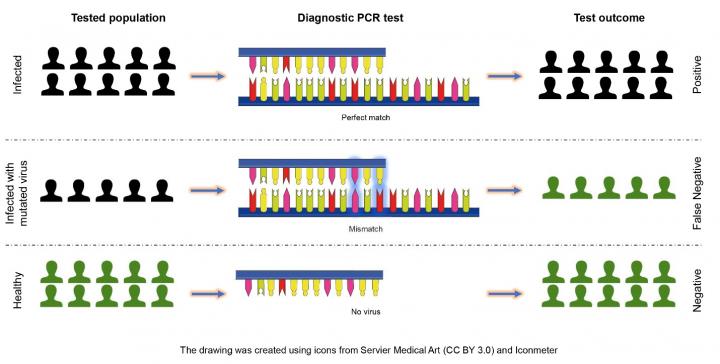
As SARS-CoV-2 has the potential to mutate, it is important to check the efficacy of current diagnostic tests, say York University researchers, who found seven out of 27 methods had potential sequence mismatch issues that may lead to underperforming or false-negative COVID-19 test results.
Many of the tests were developed early in the outbreak when the virus was first identified and sequenced. The researchers say it is important to re-evaluate them periodically to ensure they still work.
“COVID-19 tests use polymerase chain reaction (PCR) assays to diagnose the virus in patients, but if those assays are mismatched due to genetic variability in the viral genome, that raises the concern that the tests may not be detecting all the circulating variants of the virus and results could be inaccurate,” says York research associate Kashif Aziz Khan, corresponding author of a new study published today in the journal Royal Society Open Science with Associate Professor Peter Cheung of the Faculty of Science.
Correcting any mismatches between the assays and the SARS-CoV-2 genome may help to improve the sensitivity and accuracy of some of the diagnostic tests.
The early sequencing of the virus allowed for the development of several PCR detection protocols by multiple national organizations that were published by the World Health Organization (WHO), but it may have also led to tests that do not account for variations and mutations.
This is not uncommon with viruses and has led at times to improper diagnosis of influenza, dengue, rabies, respiratory syncytial virus, hepatitis B and human immunodeficiency virus.
The researchers tested genetic variations in more than 17,000 publicly available viral genome sequences worldwide and performed an exhaustive evaluation of 27 published diagnostic PCR assays, including those recommended by the WHO.
“These findings are potentially important for clinicians, laboratory professionals and policy-makers as it gives them a better idea of which tests may deliver the best results and how to ensure the tests they are using are properly matched to the virus genome,” says Khan.
###
The study, “Presence of mismatches between diagnostic PCR assays and coronavirus SARS-CoV-2 genome,” was funded by the Canadian Institutes of Health Research.
See video: https:/
York University champions new ways of thinking that drive teaching and research excellence. Our students receive the education they need to create big ideas that make an impact on the world. Meaningful and sometimes unexpected careers result from cross-disciplinary programming, innovative course design and diverse experiential learning opportunities. York students and graduates push limits, achieve goals and find solutions to the world’s most pressing social challenges, empowered by a strong community that opens minds. York U is an internationally recognized research university – our 11 faculties and 25 research centres have partnerships with 200+ leading universities worldwide. Located in Toronto, York is the third largest university in Canada, with a strong community of 53,000 students, 7,000 faculty and administrative staff, and more than 300,000 alumni. York U’s fully bilingual Glendon Campus is home to Southern Ontario’s Centre of Excellence for French Language and Bilingual Postsecondary Education.
Media Contact
Sandra McLean
[email protected]
Original Source
https:/
Related Journal Article
http://dx.