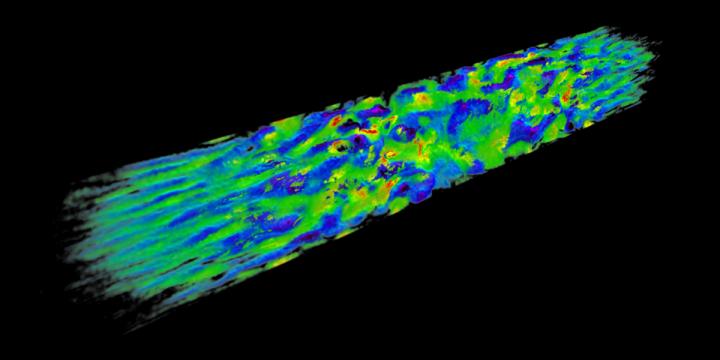
Credit: Courtesy Frederico Fiuza/SLAC National Accelerator Laboratory
When stars explode as supernovas, they produce shock waves in the plasma surrounding them. So powerful are these shock waves, they can act as particle accelerators that blast streams of particles, called cosmic rays, out into the universe at nearly the speed of light. Yet how exactly they do that has remained something of a mystery.
Now, scientists have devised a new way to study the inner workings of astrophysical shock waves by creating a scaled-down version of the shock in the lab. They found that astrophysical shocks develop turbulence at very small scales – scales that can’t be seen by astronomical observations – that helps kick electrons toward the shock wave before they’re boosted up to their final, incredible speeds.
“These are fascinating systems, but because they are so far away it’s hard to study them,” said Frederico Fiuza, a senior staff scientist at the Department of Energy’s SLAC National Accelerator Laboratory, who led the new study. “We are not trying to make supernova remnants in the lab, but we can learn more about the physics of astrophysical shocks there and validate models.”
The injection problem
Astrophysical shock waves around supernovas are not unlike the shockwaves and sonic booms that form in front of supersonic jets. The difference is that when a star blow up, it forms what physicists call a collisionless shock in the surrounding gas of ions and free electrons, or plasma. Rather than running into each other as air molecules would, individual electrons and ions are forced this way and that by intense electromagnetic fields within the plasma. In the process, researchers have worked out, supernova remnant shocks produce strong electromagnetic fields that bounce charged particles across the shock multiple times and accelerate them to extreme speeds.
Yet there’s a problem. The particles already have to be moving pretty fast to be able to cross the shock in first place, and no one’s sure what gets the particles up to speed. The obvious way to address that issue, known as the injection problem, would be to study supernovas and see what the plasmas surrounding them are up to. But with even the closest supernovas thousands of light years away, it’s impossible to simply point a telescope at them and get enough detail to understand what’s going on.
Fortunately, Fiuza, his postdoctoral fellow Anna Grassi and colleagues had another idea: They’d try to mimic the shock wave conditions of supernova remnants in the lab, something Grassi’s computer models indicated could be feasible.
Most significantly, the team would need to create a fast, diffuse shock wave that could imitate supernova remnant shocks. They would also need to show that the density and temperature of the plasma increased in ways consistent with models of those shocks – and, of course, they wanted to understand if the shock wave would shoot out electrons at very high speeds.
Igniting a shock wave
To achieve something like that, the team went to the National Ignition Facility, a DOE user facility at Lawrence Livermore National Laboratory. There, the researchers shot some of the world’s most powerful lasers at a pair of carbon sheets, creating a pair of plasma flows headed straight into each other. When the flows met, optical and X-ray observations revealed all the features the team were looking for, meaning they had produced in the lab a shock wave in conditions similar to a supernova remnant shock.
Most importantly, they found that when the shock was formed it was indeed capable of accelerating electrons to nearly the speed of light. They observed maximum electron velocities that were consistent with the acceleration they expected based on the measured shock properties. However, the microscopic details of how these electrons reached these high speeds remained unclear.
Fortunately, the models could help reveal some of the fine points, having first been benchmarked against experimental data. “We can’t see the details of how particles get their energy even in the experiments, let alone in astrophysical observations, and this is where the simulations really come into play,” Grassi said.
Indeed, the computer model revealed what may be a solution to the electron injection problem. Turbulent electromagnetic fields within the shock wave itself appear to be able to boost electron speeds up to the point where the particles can escape the shock wave and cross back again to gain even more speed, Fiuza said. In fact, the mechanism that gets particles going fast enough to cross the shock wave seems to be fairly similar to what happens when the shock wave gets particles up to astronomical speeds, just on a smaller scale.
Toward the future
Questions remain, however, and in future experiments the researchers will do detailed measurements of the X-rays emitted by the electrons the moment they are accelerated to investigate how electron energies vary with distance from the shock wave. That, Fiuza said, will further constrain their computer simulations and help them develop even better models. And perhaps most significantly, they will also look at protons, not just electrons, fired off by the shock wave, data which the team hopes will reveal more about the inner workings of these astrophysical particle accelerators.
More generally, the findings could help researchers go beyond the limitations of astronomical observations or spacecraft-based observations of the much tamer shocks in our solar system. “This work opens up a new way to study the physics of supernova remnant shocks in the lab,” Fiuza said.
###
Additional authors include researchers from Lawrence Livermore National Laboratory; the University of Rochester; the University of Michigan; Princeton University; the Massachusetts Institute of Technology; the University of Alberta, Canada; Friedrich Alexander University Erlangen-Nuremberg, Germany; Oxford University, UK; and Osaka University, Japan. The research was supported by the Department of Energy’s Office of Science.
Media Contact
Nathan Collins
[email protected]
Original Source
https:/
Related Journal Article
http://dx.