• HOME
  • NEWS
  • EXPLORE
    • CAREER
      • Companies
      • Jobs
    • EVENTS
    • iGEM
      • News
      • Team
    • PHOTOS
    • VIDEO
    • WIKI
  • BLOG
  • COMMUNITY
    • FACEBOOK
    • INSTAGRAM
    • TWITTER
Saturday, February 7, 2026
BIOENGINEER.ORG
No Result
View All Result
  • Login
  • HOME
  • NEWS
  • EXPLORE
    • CAREER
      • Companies
      • Jobs
        • Lecturer
        • PhD Studentship
        • Postdoc
        • Research Assistant
    • EVENTS
    • iGEM
      • News
      • Team
    • PHOTOS
    • VIDEO
    • WIKI
  • BLOG
  • COMMUNITY
    • FACEBOOK
    • INSTAGRAM
    • TWITTER
  • HOME
  • NEWS
  • EXPLORE
    • CAREER
      • Companies
      • Jobs
        • Lecturer
        • PhD Studentship
        • Postdoc
        • Research Assistant
    • EVENTS
    • iGEM
      • News
      • Team
    • PHOTOS
    • VIDEO
    • WIKI
  • BLOG
  • COMMUNITY
    • FACEBOOK
    • INSTAGRAM
    • TWITTER
No Result
View All Result
Bioengineer.org
No Result
View All Result
Home NEWS Science News

Improving the mechanical properties of polymer gels through molecular design

Bioengineer by Bioengineer
December 1, 2016
in Science News
Reading Time: 2 mins read
0
Share on FacebookShare on TwitterShare on LinkedinShare on RedditShare on Telegram
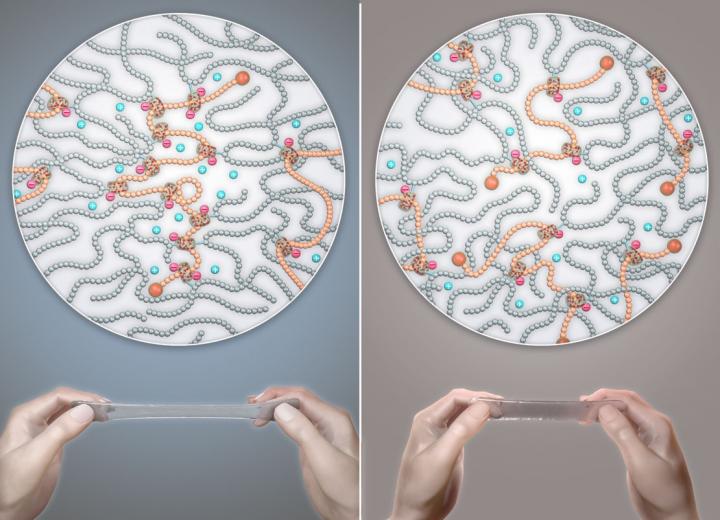
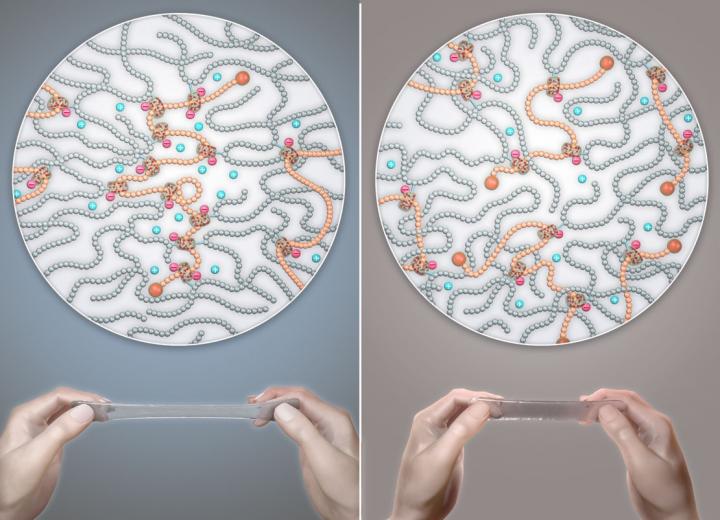
IMAGE

Credit: Yukikazu Takeoka

Nagoya, Japan – A polymer gel consists of a three-dimensional cross-linked polymer network swollen with liquid molecules. However, most conventional polymer gels are brittle because stress concentration readily occurs in their cross-linked polymer network structure. The mechanical properties of polymer gels need to be improved to facilitate their application as, for example, molecular sieves and superabsorbent materials.

An international researcher team from Nagoya University and The University of Tokyo have now found a way to increase the fracture resistance of polymer gels using a design based on molecular "beads" and polymer "threads." The molecular beads are modified cyclodextrin rings, which are threaded onto polyethylene glycol (PEG) threads. The cyclodextrin rings contain groups that allow the threaded structures to be cross-linked to form a three-dimensional polymer network that can be used as a polymer gel. The findings were recently published in ChemComm.

"We investigated the effect of the molecular weight of PEG per cyclodextrin ring on the strain and rupture strength of the resulting gels," study coauthor Yukikazu Takeoka says.

The researchers found that their polymer gels are resistant to fracture because the cyclodextrin beads can slide along the PEG threads when a force is applied, preventing stress concentration. The magnitude of this effect increases with the molecular weight of PEG per cyclodextrin ring, resulting in gels with greater strain and rupture strength. That is, the ability of the cyclodextrin beads to slide along the polymer threads increases with the length of thread between beads.

"The ability to improve the fracture resistance of polymer gels by increasing the molecular weight of polymer units for each cross-linking cyclodextrin ring is a convenient solution to overcome the problem of the brittleness of conventional polymer gels," lead author Kana Ohmori explains.

This approach to improve strain and rupture strength using mobile cross-linking molecular beads threaded on polymer chains should allow polymer gels with desired mechanical properties to be fabricated.

###

The article "Molecular weight dependency of polyrotaxane-cross-linked polymer gel extensibility" was published in ChemComm at DOI: 10.1039/c6cc07641f

Media Contact

Koomi Sung
[email protected]

http://www.nagoya-u.ac.jp/en/

############

Story Source: Materials provided by Scienmag

Share12Tweet8Share2ShareShareShare2

Related Posts

Personalized Guide to Understanding and Reducing Chemicals

February 7, 2026

Inflammasome Protein ASC Drives Pancreatic Cancer Metabolism

February 7, 2026

Phage-Antibiotic Combo Beats Resistant Peritoneal Infection

February 7, 2026

Boosting Remote Healthcare: Stepped-Wedge Trial Insights

February 7, 2026
Please login to join discussion

POPULAR NEWS

  • Robotic Ureteral Reconstruction: A Novel Approach

    Robotic Ureteral Reconstruction: A Novel Approach

    82 shares
    Share 33 Tweet 21
  • Digital Privacy: Health Data Control in Incarceration

    63 shares
    Share 25 Tweet 16
  • Study Reveals Lipid Accumulation in ME/CFS Cells

    57 shares
    Share 23 Tweet 14
  • Breakthrough in RNA Research Accelerates Medical Innovations Timeline

    53 shares
    Share 21 Tweet 13

About

We bring you the latest biotechnology news from best research centers and universities around the world. Check our website.

Follow us

Recent News

Personalized Guide to Understanding and Reducing Chemicals

Inflammasome Protein ASC Drives Pancreatic Cancer Metabolism

Phage-Antibiotic Combo Beats Resistant Peritoneal Infection

Subscribe to Blog via Email

Enter your email address to subscribe to this blog and receive notifications of new posts by email.

Join 73 other subscribers
  • Contact Us

Bioengineer.org © Copyright 2023 All Rights Reserved.

Welcome Back!

Login to your account below

Forgotten Password?

Retrieve your password

Please enter your username or email address to reset your password.

Log In
No Result
View All Result
  • Homepages
    • Home Page 1
    • Home Page 2
  • News
  • National
  • Business
  • Health
  • Lifestyle
  • Science

Bioengineer.org © Copyright 2023 All Rights Reserved.