• HOME
  • NEWS
  • EXPLORE
    • CAREER
      • Companies
      • Jobs
    • EVENTS
    • iGEM
      • News
      • Team
    • PHOTOS
    • VIDEO
    • WIKI
  • BLOG
  • COMMUNITY
    • FACEBOOK
    • INSTAGRAM
    • TWITTER
Wednesday, July 8, 2026
BIOENGINEER.ORG
No Result
View All Result
  • Login
  • HOME
  • NEWS
  • EXPLORE
    • CAREER
      • Companies
      • Jobs
        • Lecturer
        • PhD Studentship
        • Postdoc
        • Research Assistant
    • EVENTS
    • iGEM
      • News
      • Team
    • PHOTOS
    • VIDEO
    • WIKI
  • BLOG
  • COMMUNITY
    • FACEBOOK
    • INSTAGRAM
    • TWITTER
  • HOME
  • NEWS
  • EXPLORE
    • CAREER
      • Companies
      • Jobs
        • Lecturer
        • PhD Studentship
        • Postdoc
        • Research Assistant
    • EVENTS
    • iGEM
      • News
      • Team
    • PHOTOS
    • VIDEO
    • WIKI
  • BLOG
  • COMMUNITY
    • FACEBOOK
    • INSTAGRAM
    • TWITTER
No Result
View All Result
Bioengineer.org
No Result
View All Result
Home NEWS Science News Biology

New light for plants

Bioengineer by Bioengineer
June 8, 2020
in Biology
Reading Time: 3 mins read
0
IMAGE
Share on FacebookShare on TwitterShare on LinkedinShare on RedditShare on Telegram

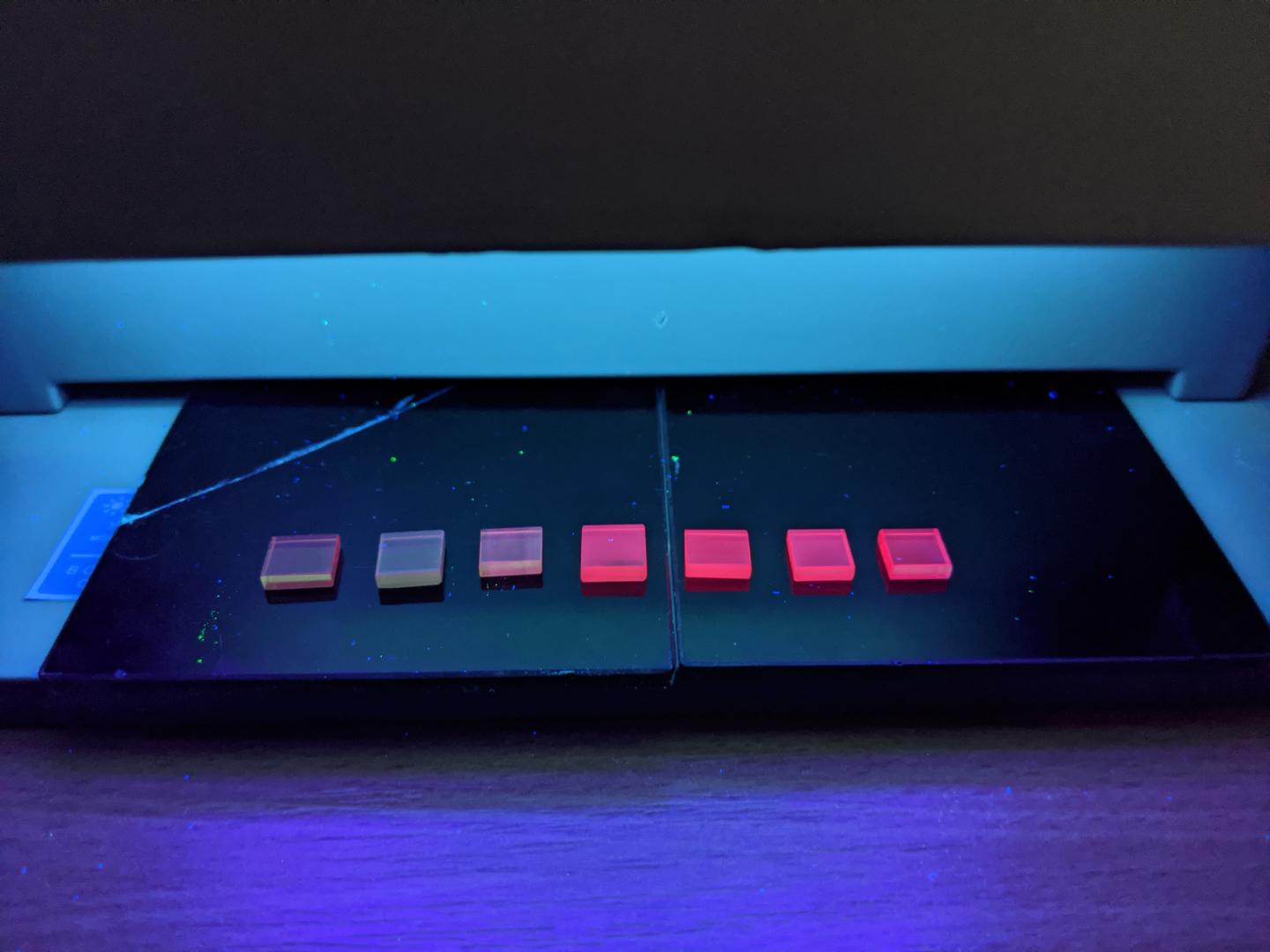
Scientists: Use of glass-ceramics in greenhouse lamps will facilitate plants’ growth
IMAGE

Credit: Anastasiia Babkina

Many may have seen bright pink light in some windows – it comes from special lamps that are used for providing sufficient lighting to house plants. Similar lamps are also used by farmers in greenhouses. Still, specialists in photophysiology argue that such lamps do not provide all the light that plants need. Scientists from ITMO in collaboration with their colleagues from Tomsk Polytechnic University came up with an idea to create light sources from ceramics with the addition of chrome: the light from such lamps offers not just red but also infrared (IR) light, which is expected to have a positive effect on plants’ growth. The research was completed as part of a Russian Science Foundation grant, and the results were published in Optical Materials.

Growing vegetables, fruit and berries in huge greenhouses rather than in the open is becoming more and more common. In such facilities, plants are protected from hail, droughts and chill. Then again, farmers have to compensate for the lack of natural sunlight in such greenhouses. Advanced agricultural facilities use light diodes for this purpose: they consume little energy, give bright light and can be easily set up in a greenhouse. The light they emit is pink, which is produced by simultaneous use of blue and red diodes.

“Scientists found out that such lighting isn’t optimal,” says Anastasia Babkina, a lab assistant at the Faculty of Photonics and Optical Information. “Thing is, a red diode lights in the range of about 650 nanometers, and its spectrum is very narrow, similar to that of a laser. Plants, however, absorb red and IR light better in the range that’s a bit more than 650 nanometers, which people can barely see. So you see, this means that we use the light that’s more comfortable for humans and not optimal for plants.”

All this means that we need to find a material that can be used in light diode lamps in such a way that they would produce light of a wider spectrum, including the IR range. A group of researchers from ITMO and Tomsk Polytechnic University took up this task. Classical red light diodes use materials based on manganese and europium compounds. The crystals of this chemical element make the diode emit at the wavelength of about 650 nanometers, making the light red, and jointly with the emission of the blue diode – pink.

“We decided to use not a different crystal but glass-ceramics,” says Anastasia Babkina. “This is a transitive material between glass and crystal. What’s the difference? We have to specifically grow crystals, whereas glass is synthesized by moulding, and it can be produced quickly and in large amounts, in any shape you need. The drawback is that glass is fragile. For this reason, we take glass and begin to slowly crystallize it so that it doesn’t lose transparency. In result, we get glass with microscopic crystals inside that are invisible to the eye. Such a material is more sturdy, has better luminescent properties – and is called glass-ceramics.”

Chrome is added to glass-ceramics at the production stage: this gives the material a pink tone that allows it to produce red and IR light at the same time. There are two potential applications for the new material.The first is to mill it to get microparticles which can be used to produce a new type of light diodes. This offers great prospects, but the introduction of such a technology calls for a lot of time and money. Another option is to use it to create lampshades.

“We can take blue and green light diodes and use our glass-ceramics as a filter to obtain a wide-spectrum emission that will include the IR range,” explains Anastasia Babkina.

###

Media Contact
Alena Gupaisova
[email protected]

Related Journal Article

http://dx.doi.org/10.1016/j.optmat.2020.109983

Tags: Agricultural Production/EconomicsAgricultureBiologyChemistry/Physics/Materials SciencesTechnology/Engineering/Computer Science
Share12Tweet8Share2ShareShareShare2

Related Posts

Here are a few rewritten headlines for a science magazine post, each with a slightly different tone: Intriguing & poetic: How do organs sculpt themselves? Sea stars hold the secret Direct & research-focused: Sea stars reveal the hidden rules of organ formation Metaphorical & inviting: Tiny architects beneath the waves: What sea stars teach us about building organs Short & punchy: Star-shaped clues to how our organs take shape Question-led: Could a sea star show us how organs form? Elegant & feature-style: The body’s blueprint, glimpsed in a sea star’s arm

July 6, 2026
Bacteria evolve faster with unconventional gene copies — Biology

Bacteria evolve faster with unconventional gene copies

July 6, 2026

Neighbours rewire soil feedback via root microbiome shifts

July 6, 2026

Evolution-Inspired Biosensors Revolutionize Lipid Tracking in Real Time

July 2, 2026
Please login to join discussion

POPULAR NEWS

  • Detection of EDCs in Breast Milk and Infant Urine Up to Six Months Highlights Early Exposure Risks

    77 shares
    Share 31 Tweet 19
  • New Drug Candidate Developed at McMaster Shows Potential for Treating Brain Cancer

    58 shares
    Share 23 Tweet 15
  • Saying Goodbye to PGY-6: Pediatric Fellowship Realities

    103 shares
    Share 41 Tweet 26
  • KTU Researchers Explore Ultrasound’s Role in Enhancing Blood Flow Beyond Diagnostics

    53 shares
    Share 21 Tweet 13

About

We bring you the latest biotechnology news from best research centers and universities around the world. Check our website.

Follow us

Recent News

Flame retardant BDE-209 targets molecularly linked to ulcerative colitis

Ultra-high frequency particle impacts mimic rockbursts to shatter hard rock

Kidney transplant outcomes in older adults studied by German researchers

Subscribe to Blog via Email

Success! An email was just sent to confirm your subscription. Please find the email now and click 'Confirm' to start subscribing.

Join 83 other subscribers
  • Contact Us

Bioengineer.org © Copyright 2023 All Rights Reserved.

Welcome Back!

Login to your account below

Forgotten Password?

Retrieve your password

Please enter your username or email address to reset your password.

Log In
No Result
View All Result
  • Homepages
    • Home Page 1
    • Home Page 2
  • News
  • National
  • Business
  • Health
  • Lifestyle
  • Science

Bioengineer.org © Copyright 2023 All Rights Reserved.