Credit: ©Science China Press
Recently, the value of the global market for microbes and microbial products is continuously increasing. However, the full exploitation of bacteria towards advanced biotechnology and bio-energetics is impeded by low biological activity and stability in the industrial reactors.
Single-cell nanoencapsulation is an emerging, non-genetic technique to address these limitations. It concerns to create extended cell surface functionalities, provide external stimuli to enhance cell stability and activity, and incorporate new properties. Colloidal packing is a common strategy for single-cell nanoencapsulation through an adsorption-assembly-encapsulation sequence. However, the disordered structure of current generation colloidal packings does not allow well-controlled exchange between a cell and its environment, affecting nutrient, waste and metabolite diffusion and therefore, cell activity and stability. Moreover, such colloidal packing results in direct contact between the shell and the cell surface, which is incompatible with cells and negatively affects their activity and stability even further.
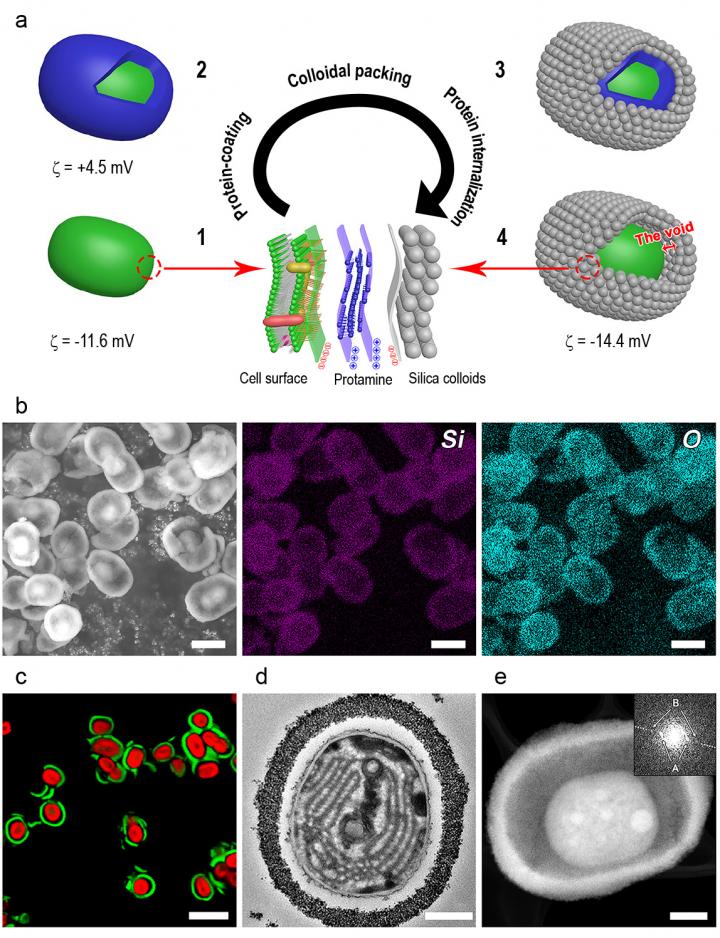
In response to this challenge, inspired by the yolk-shell structure of eggs and the structural ordering of cell surfaces in the evolution, the living materials team led by Prof. Bao-Lian Su from Wuhan University of Technology and the University of Namur proposed highly stable single cyanobacterium capsules with an ordered yolk-shell structure of uniformly organized and tunable nanoporosity shaped by protein-assisted, hydrophilic colloidal silica packing. The void between the ordered nanoporous shell and cell is created by the controlled internalization of protamine, which could subsequently be filled by nutrients. Shells thus constructed are not only biocompatible but also endow introduction of new and unprecedented cell surface functionalities, such as specific size-dependent permeability and defined molecular recognition abilities. Owing to the presence of the buffering interstitial hollow space filled by nutrient between the ordered nanoporous shell and the cell surface, cyanobacterial activity, and stability evolving from this yolk-shell encapsulation technology are highly enhanced. Because of the specific size-dependent permeability stemming from uniformly organized nanoporosity, the survival ability of yolk-shell encapsulated cyanobacteria against toxic chemical environments is significantly strengthened. In addition, this yolk-shell structure can also be equipped with molecular recognition abilities.
It is envisioned single cells encapsulated in their ordered yolk-shell structures have a broad scope in a wide range of applications with specific functionalities, including in photobioreactors, biochips, biosensors, biocatalysis, biofuel reactors, and controlled delivery therapeutics.
###
This research received funding from the National Natural Science Foundation of China, the Ministry of Education of China, the Natural Science Foundation of Hubei Province, European Regional Development Fund and Wallonia Region of Belgium, and China Scholarship Council.
See the article:
Li Wang, Yu Li, Xiao-Yu Yang, Bo-Bo Zhang, Nöelle Ninane, Henk J. Busscher, Zhi-Yi Hu, Cyrille Delneuville, Nan Jiang, Hao Xie, Gustaaf Van Tendeloo, Tawfique Hasan, and Bao-Lian Su
Single-cell yolk-shell nanoencapsulation for long-term viability with size-dependent permeability and molecular recognition
Natl Sci Rev, nwaa097. https:/
The National Science Review is the first comprehensive scholarly journal released in English in China that is aimed at linking the country’s rapidly advancing community of scientists with the global frontiers of science and technology. The journal also aims to shine a worldwide spotlight on scientific research advances across China.
Media Contact
Bao-Lian Su
[email protected]
Related Journal Article
http://dx.