• HOME
  • NEWS
  • EXPLORE
    • CAREER
      • Companies
      • Jobs
    • EVENTS
    • iGEM
      • News
      • Team
    • PHOTOS
    • VIDEO
    • WIKI
  • BLOG
  • COMMUNITY
    • FACEBOOK
    • INSTAGRAM
    • TWITTER
Thursday, April 2, 2026
BIOENGINEER.ORG
No Result
View All Result
  • Login
  • HOME
  • NEWS
  • EXPLORE
    • CAREER
      • Companies
      • Jobs
        • Lecturer
        • PhD Studentship
        • Postdoc
        • Research Assistant
    • EVENTS
    • iGEM
      • News
      • Team
    • PHOTOS
    • VIDEO
    • WIKI
  • BLOG
  • COMMUNITY
    • FACEBOOK
    • INSTAGRAM
    • TWITTER
  • HOME
  • NEWS
  • EXPLORE
    • CAREER
      • Companies
      • Jobs
        • Lecturer
        • PhD Studentship
        • Postdoc
        • Research Assistant
    • EVENTS
    • iGEM
      • News
      • Team
    • PHOTOS
    • VIDEO
    • WIKI
  • BLOG
  • COMMUNITY
    • FACEBOOK
    • INSTAGRAM
    • TWITTER
No Result
View All Result
Bioengineer.org
No Result
View All Result
Home NEWS Science News Chemistry

Tuning the interfacial properties of 2D heterophases though tilt-angles

Bioengineer by Bioengineer
June 2, 2020
in Chemistry
Reading Time: 2 mins read
0
IMAGE
Share on FacebookShare on TwitterShare on LinkedinShare on RedditShare on Telegram

IMAGE

Credit: ©Science China Press

Although the 2D semiconductor transistors keep the promise for future nanoelectronics, their applications are severely limited by the large contact resistance from the Schottky barrier between the deposited metal electrode and 2D semiconductor interface in the short-channel electronics for scaling integrated circuits. For now, to meet the requirements of ITRS (International Technology Roadmap for Semiconductors) 22-nm-node for the contact resistance, the heterophase engineering (such as 1T/2H-MoS2 and 1T’/2H-MoTe2) that substantially reduces the contact resistance seems to be the only solution. Therefore, in the past a few years, tremendous efforts have been made in the 2D phase engineering to achieve low-resistance contacts with 2D semiconductors for high-performance short-channel devices.

It is well known that the contact properties of such a metal-semiconductor TMDs phase boundaries are determined by their atomic structure, such as the nature of interface bonds and the relative orientation between metallic and semiconducting phases. In order to optimize the interfacial contact properties of 2D semiconductors, it is a prerequisite to understand the correlation between their characteristics and structures.

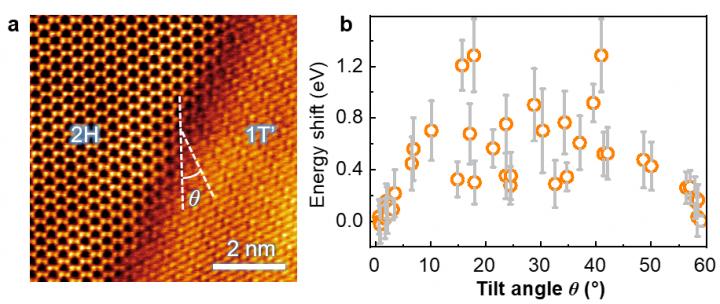
In a new research article published in the Beijing-based National Science Review, scientists at Peking University revealed the contact characteristics of the 1T’/2H-MoTe2 phase boundary using advanced scanning transmission electron microscopy and electron energy loss spectroscopy (EELS). They found that the contact characteristics of the phase boundary depend on the tilt angles between the metallic and semiconducting phases. For the phase boundary with a large tilt angle, the plasmon EELS clearly shifts to a lower energy loss, while there is no significant energy change at the phase boundary with a 0° tilt angle (a-b). Their findings indicate that the 0° tilted phase boundary has stronger atomic bonds and better contact performance. The scientists also unraveled the subtle influence of 1T’ phase on 2H phase in the two unit cells near the phase boundary.

“The tilt-angle acts as a knob to tune the contact properties,” the scientists stated. “Thus, future angle-controlled synthesis technologies may ultimately make short-channel transistors based on 2D heterostructures practical in nanoelectronics.”

###

This research received funding from National Key R&D Program of China, National Natural Science Foundation of China, Key R&D Program of Guangdong Province, Bureau of Industry and Information Technology of Shenzhen, National Equipment Program of China, Peking-Tsinghua-IOP Collaborative Innovation Center of Quantum Matter and State Key Laboratory of Powder Metallurgy of Central South University.

See the article:

Correlating the electronic structures of metallic/semiconducting MoTe2 interface to its atomic structures
Natl Sci Rev 2020; doi: 10.1093/nsr/nwaa087
https://doi.org/10.1093/nsr/nwaa087

The National Science Review is the first comprehensive scholarly journal released in English in China that is aimed at linking the country’s rapidly advancing community of scientists with the global frontiers of science and technology. The journal also aims to shine a worldwide spotlight on scientific research advances across China.

Media Contact
Peng Gao
[email protected]

Related Journal Article

http://dx.doi.org/10.1093/nsr/nwaa087

Tags: Chemistry/Physics/Materials Sciences
Share12Tweet8Share2ShareShareShare2

Related Posts

blank

Five-Year Study Uncovers Smarter Biochar Approach to Slash Methane Emissions in Rice Paddies

April 2, 2026
Scientists Achieve Reliable Quantum Network Connections Across Kilometers of Noisy Fiber

Scientists Achieve Reliable Quantum Network Connections Across Kilometers of Noisy Fiber

April 1, 2026

Stretchy, Heat-Activated Skin Patch Offers Non-Surgical Melanoma Treatment

April 1, 2026

Quantum switches perform best in extreme cold, new research finds

April 1, 2026
Please login to join discussion

POPULAR NEWS

  • blank

    Revolutionary AI Model Enhances Precision in Detecting Food Contamination

    96 shares
    Share 38 Tweet 24
  • Imagine a Social Media Feed That Challenges Your Views Instead of Reinforcing Them

    1007 shares
    Share 398 Tweet 249
  • Promising Outcomes from First Clinical Trials of Gene Regulation in Epilepsy

    51 shares
    Share 20 Tweet 13
  • Popular Anti-Aging Compound Linked to Damage in Corpus Callosum, Study Finds

    44 shares
    Share 18 Tweet 11

About

We bring you the latest biotechnology news from best research centers and universities around the world. Check our website.

Follow us

Recent News

CUX2 Neuron Growth Demands Enhanced DNA Repair

From Algae Waste to High-Performance Filters: Innovative Biochar Membranes Boost Wastewater Purification

Study Finds Hydrochar Enhances Soil Carbon Storage and Structure More Effectively Than Biochar

Subscribe to Blog via Email

Enter your email address to subscribe to this blog and receive notifications of new posts by email.

Join 78 other subscribers
  • Contact Us

Bioengineer.org © Copyright 2023 All Rights Reserved.

Welcome Back!

Login to your account below

Forgotten Password?

Retrieve your password

Please enter your username or email address to reset your password.

Log In
No Result
View All Result
  • Homepages
    • Home Page 1
    • Home Page 2
  • News
  • National
  • Business
  • Health
  • Lifestyle
  • Science

Bioengineer.org © Copyright 2023 All Rights Reserved.