• HOME
  • NEWS
  • EXPLORE
    • CAREER
      • Companies
      • Jobs
    • EVENTS
    • iGEM
      • News
      • Team
    • PHOTOS
    • VIDEO
    • WIKI
  • BLOG
  • COMMUNITY
    • FACEBOOK
    • INSTAGRAM
    • TWITTER
Sunday, August 16, 2026
BIOENGINEER.ORG
No Result
View All Result
  • Login
  • HOME
  • NEWS
  • EXPLORE
    • CAREER
      • Companies
      • Jobs
        • Lecturer
        • PhD Studentship
        • Postdoc
        • Research Assistant
    • EVENTS
    • iGEM
      • News
      • Team
    • PHOTOS
    • VIDEO
    • WIKI
  • BLOG
  • COMMUNITY
    • FACEBOOK
    • INSTAGRAM
    • TWITTER
  • HOME
  • NEWS
  • EXPLORE
    • CAREER
      • Companies
      • Jobs
        • Lecturer
        • PhD Studentship
        • Postdoc
        • Research Assistant
    • EVENTS
    • iGEM
      • News
      • Team
    • PHOTOS
    • VIDEO
    • WIKI
  • BLOG
  • COMMUNITY
    • FACEBOOK
    • INSTAGRAM
    • TWITTER
No Result
View All Result
Bioengineer.org
No Result
View All Result
Home NEWS Science News Biology

Project to introduce a coconut rhinoceros beetle disease in Guam gets $240,000 grant

Bioengineer by Bioengineer
June 2, 2020
in Biology
Reading Time: 2 mins read
0
IMAGE
Share on FacebookShare on TwitterShare on LinkedinShare on RedditShare on Telegram

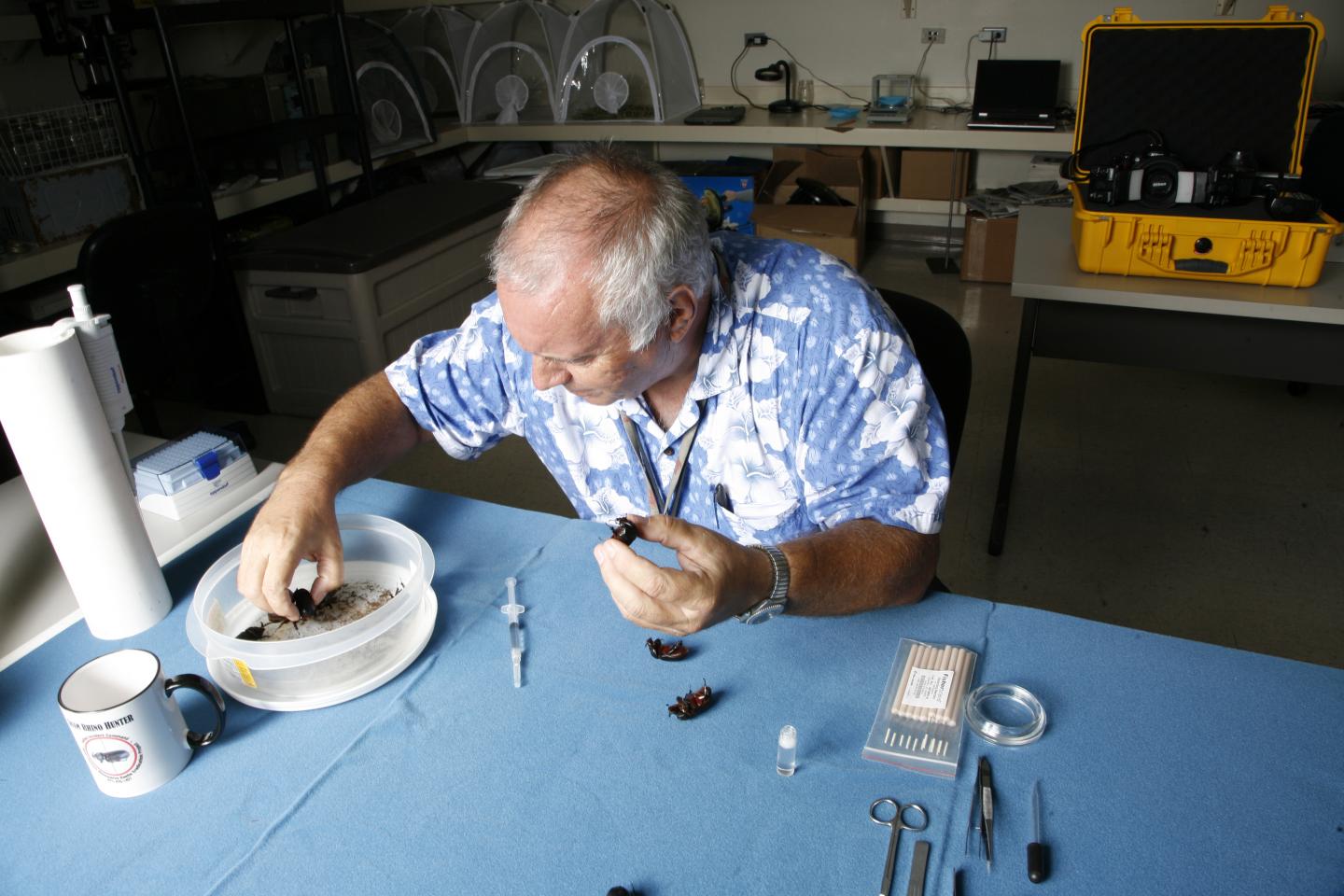
IMAGE

Credit: University of Guam

The Office of Insular Affairs (DOI-OIA) of the U.S. Department of the Interior has awarded $239,994 to the University of Guam College of Natural and Applied Sciences in response to a grant proposal titled “Establishment of Self-sustaining Biological Control of Coconut Rhinoceros Beetle Biotype G in Micronesia” submitted by Aubrey Moore, an entomologist at the University of Guam.

Part of the funding will be used for partial support of an existing project to implement self-sustaining control of coconut rhino beetles (CRB) throughout Guam by introducing an insect disease caused by a naturally occurring insect virus that infects only rhino beetles. This virus is called Oryctes rhinoceros nudivirus, or OrNV.

Different strains of OrNV have been very effective in providing long-lasting control of rhino beetles on many Pacific Islands. Typically, after the virus is introduced into the CRB population, damage to coconut palms and other palms falls to very low levels within a few months and stays at those low levels indefinitely.

The other part of the grant funding will be used to pay the salary of James Grasela, an insect pathologist who has spent his career finding ways to control pest insects with insect diseases instead of poisoning them with insecticides. Grasela has been working under a contract at the University of Guam for the past two years under a previous DOI-OIA grant. He has screened OrNV strains collected from several locations in the Asia-Pacific region and has found two that have potential for controlling the biotype, CRB-G, causing so much damage on Guam.

###

For more information regarding research on the CRB and other insects conducted by scientists at the University of Guam, please visit https://www.uog.edu/wptrc/entomology.

For detailed information on the recent grant award, download Moore’s grant proposal from https://github.com/aubreymoore/2020-DOI-CRB-Biocontrol/blob/master/doi_proposal.pdf.

Media Contact
Aubrey Moore
[email protected]

Original Source

https://www.uog.edu/news-announcements/2019-2020/2020-press-release-project-to-introduce-a-coconut-rhinoceros-beetle-disease-in-guam-gets-240000-grant.php

Tags: Agricultural Production/EconomicsBiologyEcology/EnvironmentEntomologyFertilizers/Pest ManagementForestryGrants/FundingNaturePlant SciencesVirology
Share12Tweet8Share2ShareShareShare2

Related Posts

Strubbelig–NHL3 Receptor Complex Helps Arabidopsis Respond to Cellulose Deficiency

Strubbelig–NHL3 Receptor Complex Helps Arabidopsis Respond to Cellulose Deficiency

August 15, 2026
Bombyx mori Satellitome Analysis Reveals Evolutionary Stability, Dispersed Chromosomal Organization, Transposon Origins

Bombyx mori Satellitome Analysis Reveals Evolutionary Stability, Dispersed Chromosomal Organization, Transposon Origins

August 15, 2026

Synthetic pyrenoid reconstruction reveals EPYC1-driven carbon concentration mechanisms and evolution

August 15, 2026

Endophytic Flavobacterium boosts root hairs and drought tolerance through ERF–CEP5 signaling

August 15, 2026
Please login to join discussion

POPULAR NEWS

  • KAIST develops semiconductor neuron that harnesses noise to selectively process signals

    29 shares
    Share 12 Tweet 7
  • Imagining natural and extra robotic thumbs together strengthens kinesthetic sensorimotor networks

    29 shares
    Share 12 Tweet 7
  • PARP1 Drives Neuropathic Pain Through GPX4-Dependent Ferroptosis in Injured Mice’s Sensory Neurons

    29 shares
    Share 12 Tweet 7
  • Strubbelig–NHL3 Receptor Complex Helps Arabidopsis Respond to Cellulose Deficiency

    29 shares
    Share 12 Tweet 7

About

We bring you the latest biotechnology news from best research centers and universities around the world. Check our website.

Follow us

Recent News

KAIST develops semiconductor neuron that harnesses noise to selectively process signals

Imagining natural and extra robotic thumbs together strengthens kinesthetic sensorimotor networks

PARP1 Drives Neuropathic Pain Through GPX4-Dependent Ferroptosis in Injured Mice’s Sensory Neurons

Subscribe to Blog via Email

Success! An email was just sent to confirm your subscription. Please find the email now and click 'Confirm' to start subscribing.

Join 85 other subscribers
  • Contact Us

Bioengineer.org © Copyright 2023 All Rights Reserved.

Welcome Back!

Login to your account below

Forgotten Password?

Retrieve your password

Please enter your username or email address to reset your password.

Log In
No Result
View All Result
  • Homepages
    • Home Page 1
    • Home Page 2
  • News
  • National
  • Business
  • Health
  • Lifestyle
  • Science

Bioengineer.org © Copyright 2023 All Rights Reserved.