• HOME
  • NEWS
  • EXPLORE
    • CAREER
      • Companies
      • Jobs
    • EVENTS
    • iGEM
      • News
      • Team
    • PHOTOS
    • VIDEO
    • WIKI
  • BLOG
  • COMMUNITY
    • FACEBOOK
    • INSTAGRAM
    • TWITTER
Saturday, February 7, 2026
BIOENGINEER.ORG
No Result
View All Result
  • Login
  • HOME
  • NEWS
  • EXPLORE
    • CAREER
      • Companies
      • Jobs
        • Lecturer
        • PhD Studentship
        • Postdoc
        • Research Assistant
    • EVENTS
    • iGEM
      • News
      • Team
    • PHOTOS
    • VIDEO
    • WIKI
  • BLOG
  • COMMUNITY
    • FACEBOOK
    • INSTAGRAM
    • TWITTER
  • HOME
  • NEWS
  • EXPLORE
    • CAREER
      • Companies
      • Jobs
        • Lecturer
        • PhD Studentship
        • Postdoc
        • Research Assistant
    • EVENTS
    • iGEM
      • News
      • Team
    • PHOTOS
    • VIDEO
    • WIKI
  • BLOG
  • COMMUNITY
    • FACEBOOK
    • INSTAGRAM
    • TWITTER
No Result
View All Result
Bioengineer.org
No Result
View All Result
Home NEWS Science News Biology

Musical rhythm has very deep evolutionary roots and is present in some animals

Bioengineer by Bioengineer
May 26, 2020
in Biology
Reading Time: 3 mins read
0
IMAGE
Share on FacebookShare on TwitterShare on LinkedinShare on RedditShare on Telegram

According to a study of the biological foundations of music conducted in a mouse model by Alexandre Celma-Miralles, a researcher at Aarhus University in Denmark, and Juan Manuel Toro, ICREA research professor at the Center for Brain and Cognition
IMAGE

Credit: UPF

The musical motives of a song emerge from the temporal arrangement of discrete tones. These tones normally have few durational values, and are organized in structured groups to create metrical patterns.

“We all identify the rhythm of a song we know, whether there are changes in volume, the instrument or the speed at which it is played. This is because the rhythm is organized on the basis of metric hierarchies that are easily recognizable in music”, explains Alexandre Celma-Miralles, a researcher at the Center for Brain and Cognition (CBC) and at the Center for Music in the Brain of the Department of Clinical Medicine at Aarhus University (Denmark).

In a study published on 14 May in the journal Psychonomic Bulletin & Review, the authors explore the evolutionary roots of rhythmic organization. The research is part of a joint project with the Bial Foundation on the biological foundations of music.

The authors of the paper are Alexandre Celma-Miralles and Juan Manuel Toro, ICREA research professor with the Department of Information and Communication Technologies (DTIC) and coordinator of the Research Group on Language and Comparative Cognition (LCC) at the CBC at UPF.

Animals can identify the rhythm of the song

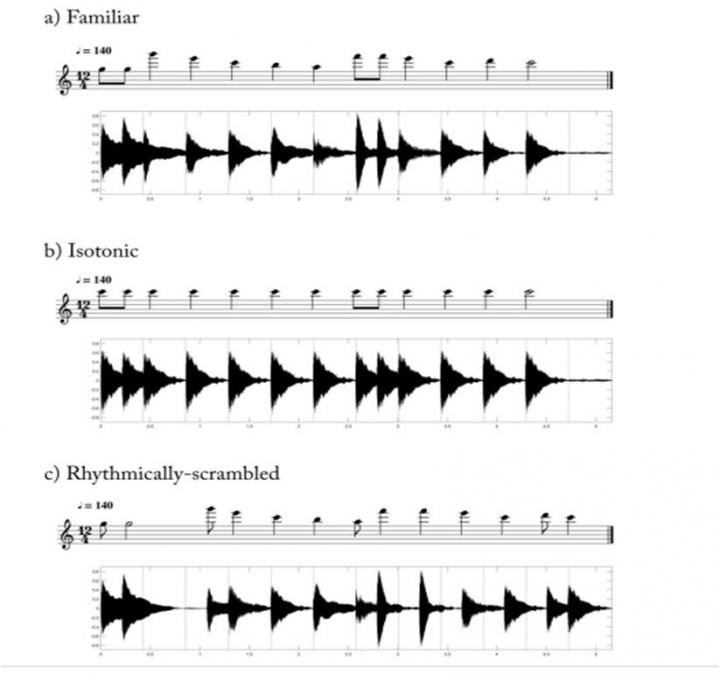
Their paper shows that the ability to detect the rhythmic structure of a song, while ignoring changes in the surface, is also present in other animal species. Thus, the experimental part of the research consisted of familiarizing forty rodents of the species Ratus norvegicus with the second half of the song “Happy Birthday”. Next, the researchers presented the subjects of the experiment with two new versions of the same song and analysed the rats’ response to these changes.

“In one version we reduced all the notes of the song to a single note, but we kept the rhythmic structure intact. In the other version, we changed the rhythmic structure, but we kept the notes”, the authors of the article affirm.

The researchers found that the rats identified the version that maintained the rhythm, but not the version that changed it (regardless of changes to the notes). This demonstrates that animals are sensitive at least to some parts of the rhythmic structure of melody and can identify the rhythm of the song. The results suggest that the principles of rhythmic organization that we find in music can also be found in other animals just like humans and, therefore, this cognitive ability must have very deep evolutionary roots.

###

Media Contact
Nuria Perez
[email protected]

Original Source

https://www.upf.edu/web/focus/noticies/-/asset_publisher/qOocsyZZDGHL/content/id/235077348/maximized

Related Journal Article

http://dx.doi.org/10.3758/s13423-020-01739-2

Tags: Animal Research/RightsArts/CultureBiology
Share12Tweet8Share2ShareShareShare2

Related Posts

Florida Cane Toad: Complex Spread and Selective Evolution

Florida Cane Toad: Complex Spread and Selective Evolution

February 7, 2026
New Study Uncovers Mechanism Behind Burn Pit Particulate Matter–Induced Lung Inflammation

New Study Uncovers Mechanism Behind Burn Pit Particulate Matter–Induced Lung Inflammation

February 6, 2026

DeepBlastoid: Advancing Automated and Efficient Evaluation of Human Blastoids with Deep Learning

February 6, 2026

Navigating the Gut: The Role of Formic Acid in the Microbiome

February 6, 2026
Please login to join discussion

POPULAR NEWS

  • Robotic Ureteral Reconstruction: A Novel Approach

    Robotic Ureteral Reconstruction: A Novel Approach

    82 shares
    Share 33 Tweet 21
  • Digital Privacy: Health Data Control in Incarceration

    63 shares
    Share 25 Tweet 16
  • Study Reveals Lipid Accumulation in ME/CFS Cells

    57 shares
    Share 23 Tweet 14
  • Breakthrough in RNA Research Accelerates Medical Innovations Timeline

    53 shares
    Share 21 Tweet 13

About

We bring you the latest biotechnology news from best research centers and universities around the world. Check our website.

Follow us

Recent News

Evaluating Pediatric Emergency Care Quality in Ethiopia

TPMT Expression Predictions Linked to Azathioprine Side Effects

Improving Dementia Care with Enhanced Activity Kits

Subscribe to Blog via Email

Success! An email was just sent to confirm your subscription. Please find the email now and click 'Confirm' to start subscribing.

Join 73 other subscribers
  • Contact Us

Bioengineer.org © Copyright 2023 All Rights Reserved.

Welcome Back!

Login to your account below

Forgotten Password?

Retrieve your password

Please enter your username or email address to reset your password.

Log In
No Result
View All Result
  • Homepages
    • Home Page 1
    • Home Page 2
  • News
  • National
  • Business
  • Health
  • Lifestyle
  • Science

Bioengineer.org © Copyright 2023 All Rights Reserved.