UD engineer part of international collaboration that explains aging in paste materials
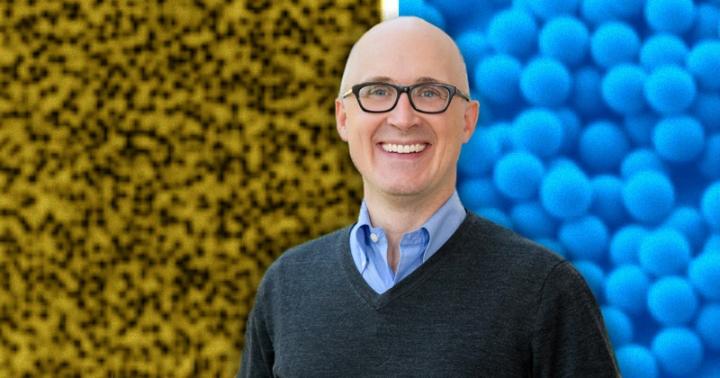
Credit: Photo illustration by Joy Smoker
Take a look inside the cap of your favorite toothpaste, and you might see hard, white residue, a firm version of the smooth paste you squeeze onto your brush.
Many paste materials, also known as dense colloidal suspensions, stiffen as they age. Structural dynamics, or changes in the loads the materials undergo over time, are partly responsible for this change, but for decades, experts have suspected that there’s more going on inside these materials.
Now, University of Delaware chemical and biomolecular engineering professor and chair Eric Furst and a team of researchers from the Ecole des Ponts and University Paris-Est and in France have discovered a process called contact-controlled aging that explains some age-related changes in paste materials.
They found that contacts form between particles, stabilizing the microstructure of these materials. Then, those contacts stiffen, increasing the stiffness of the materials.
The team described their findings in a paper published in the journal Nature Materials.
“When people think about aging in materials and the mechanical properties of materials as they age, especially in rheology or the study of how things flow, this mechanism has been overshadowed by changes in the organization, or microstructure, of the material,” said Furst.
Not only are the findings novel, they are likely to prove useful. By understanding how materials age, the people who use them can design better ways to predict and mitigate unwanted changes in materials performance. The experiments closely tie the chemistry of the particle surfaces, which can be tailored by chemical reactions or with additives like surfactants and polymers, to the bulk material properties.
“This paper has some broad-ranging implications because there are a lot of types of problems out there where this type of contact aging may be really important,” said Furst.
People in a wide range of industries could benefit from understanding the aging process of materials of this type, which includes cements, clays, soils, inks, paints, and more.
The researchers used a variety of methods to explore aging in silica and polymer latex suspensions. Initial experiments showed that the microstructure of the materials does not change over time. If the particles don’t change positions, the team thought, then something must be happening between them.
In previous experiments, Furst has used laser tweezers — use of a focused laser beam to manipulate, bend, and break microscopic structures of particles — which proved to be the right experimental setup for spelunking this particular problem. Francesco Bonacci, then a doctoral student in France, visited UD to conduct laser tweezer experiments and study the stiffness of bonds in the silica and latex materials under investigation. These experiments enabled the discovery of contact aging.
Additional experiments suggested genericity — that the results are likely to apply to a wide variety of dense colloidal suspensions.
For Furst, this project is an example of the power of collaborating with experts around the world.
“This was the result of an incredible international collaboration, just a beautiful team,” he said. The co-authors on the paper include Bonacci, Xavier Chateau, Julie Goyon, Jennifer Fusier, and Anaël Lemaître.
###
Media Contact
Peter Kerwin
[email protected]
Original Source
https:/