Credit: JAIST
Valleytronics gives rise to valley current, a stable, dissipationless current which is driven by a pseudo-magnetic field, Berry curvature. This gives rise to valletronics based information processing and storage technology. A pre-requisite for the emergence of Berry curvature is either a broken inversion symmetry or a broken time-reversal symmetry. Thus two-dimensional materials such as transition metal dichalcogenides and gated bilayer graphene are widely studied for valleytronics as they exhibit broken inversion symmetry.
For most of the studies related to graphene and other two-dimensional materials, these materials are encapsulated with hexagonal boron nitride (hBN), a wide band gap material which has comparable lattice parameter to that of graphene. Encapsulation with hBN layer protects the graphene and other two-dimensional materials from unwanted adsorption of stray molecules while keeping their properties intact. hBN also acts as a smooth twodimensional substrate unlike SiO2 which is highly non-uniform, increasing the mobility of carriers in graphene. However, most of the valleytronics studies on bilayer graphene with hBN encapsulation has not taken into account the effect of hBN layer in breaking the layer symmetry of bilayer graphene and inducing Berry curvature.
This is why Japan Advanced Institute of Science and Technology (JAIST) postdoc Afsal Kareekunnan, senior lecturer Manoharan Muruganathan and Professor Hiroshi Mizuta decided it was vital to take into account the effect of hBN as a substrate and as an encapsulation layer on the valleytronics properties of bilayer graphene. By using first-principles calculations, they have found that for hBN/bilayer graphene commensurate heterostructures, the configuration, as well as the orientation of the hBN layer, has an immense effect on the polarity as well as the magnitude of the Berry curvature.
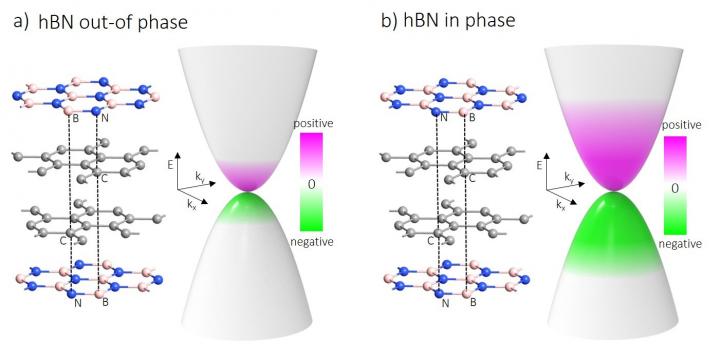
For non-encapsulated hBN/bilayer graphene heterostructure, where hBN is present only at the bottom, the layer symmetry is broken due to the difference in the potential experienced by the two layers of the bilayer graphene. This layer asymmetry induces a non-zero Berry curvature. However, encapsulation of the bilayer graphene with hBN (where the top and bottom hBN are out of phase with each other) nullifies the effect of hBN and drives the system towards symmetry, reducing the magnitude of the Berry curvature. A small Berry curvature which is still present is the feature of pristine bilayer graphene where the spontaneous charge transfer from the valleys to one of the layers results in a slight asymmetry between the layers as reported by the group earlier. Nonetheless, encapsulating bilayer graphene with the top and bottom hBN in phase with each other enhances the effect of hBN, leading to an increase in the asymmetry between the layers and a large Berry curvature. This is due to the asymmetric potential experienced by the two layers of bilayer graphene from the top and bottom hBN. The group has also found that the magnitude and the polarity of the Berry curvature can be tuned in all the above-mentioned cases with the application of an out-of-plane electric field.
“We believe that, from both theoretical and experimental perspective, such precise analysis of the effect of the use of hBN both as a substrate and as an encapsulation layer for graphene-based devices gives deep insight into the system which has great potential to be an ideal valleytronic material,” Professor Mizuta said.
###
More information: Afsal Kareekunnan et al Manipulating Berry curvature in hBN/bilayer graphene commensurate heterostructures Physical Review B 101 195406 (2020) DOI: 10.1103/PhysRevB.101.195406.
Media Contact
Hiroshi Mizuta
[email protected]
Related Journal Article
http://dx.