Credit: ©Science China Press
In recent years, topology has emerged as an important tool to classify and characterize properties of materials. It has been found that many materials exhibit a number of unusual topological properties, which are unaffected by deformations, e.g., stretching, compressing, or twisting. These topological properties include quantized Hall currents, large magnetoresistance, and surface excitations that are immune to disorder. It is hoped that these properties could be utilized for future technologies, such as, low-power electronics, ultrafast detectors, high-efficiency energy converters, or for quantum computing.
More recently, topology has been applied also to synthetic materials, e.g., photonic crystals or networks of electric circuits. These synthetic materials have several benefits compared to their natural counterparts. For example, the topology of their excitations (i.e., their excitation bands) can be precisely controlled and manipulated. In addition, due to their long-ranged lattice connectivity, synthetic materials can realize topological excitations in dimensions greater than three. Hence, synthetic materials, and in particular electric circuit networks, offer the possibility to realize a number of interesting topological properties that are not accessible in real materials.
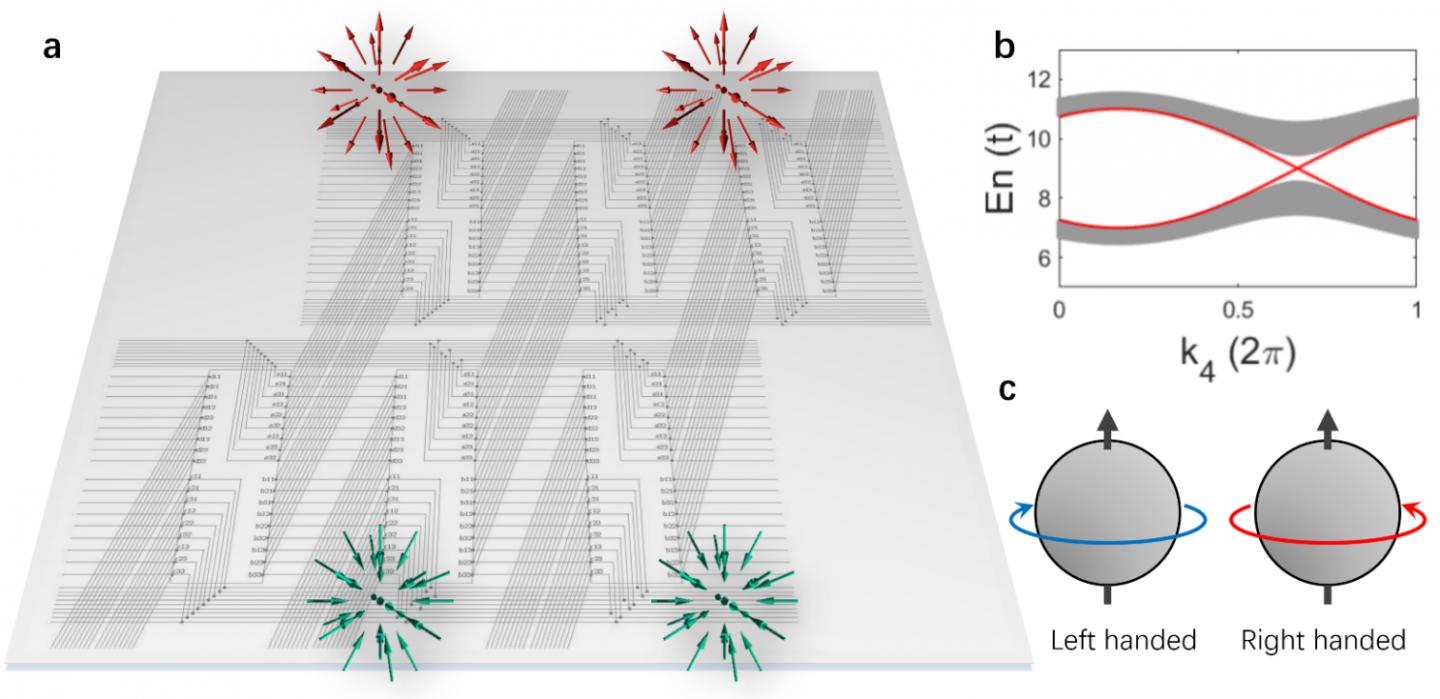
Rui Yu from Wuhan University, Yuxin Zhao from Nanjing University, and Andreas Schnyder from the Max-Planck-Institute Stuttgart have now demonstrated this potential by explicitly constructing an electric circuit network that simulates a four-dimensional (4D) topological insulator with a classical time-reversal symmetry [Fig. 1(a)]. Topological insulators are materials which are insulating in the bulk volume, but highly conducting at the surface, due gapless surface excitations. Similarly, the simulated 4D topological insulator has an excitation gap in the bulk volume, within which there exists a pair of surface excitations [Fig. 1(b)]. These 3D surface excitations have a linear dispersion, and more interestingly, they are of Weyl type with the same handedness, i.e., they have internal degrees of freedom that are spinning following the same left or right-handed rule with respect to their propagating direction [Fig. 1(c)]. They are of topological origin and are unlike any surface excitation found in conventional materials. Topology dictates that these 3D Weyl excitations must come in pairs and that they are robust to disorder and deformations. The authors have performed detailed numerical simulations of the topological circuit network and have shown that the 3D Weyl excitations can be readily observed in frequency-dependent measurements.
The authors’ work demonstrates that topological excitations can be easily realized on commercially available circuit boards or integrated-circuit wafers composed of inductors and capacitors. It paves the way for realizing arbitrary types of topological surface excitations, for example, so-called Dirac or Majorana excitations of dimension two, three, or even higher. The electric-circuit implementation of topological excitations has the advantage of being simple, easily reconfigurable, and allowing a high degree of control. This will make it possible to study in the future topological phase transitions, non-linear effects, out-of-equilibrium phenomena, and quantum open systems (e.g., non-Hermitian systems).
###
See the article:
Rui Yu, Y X Zhao, Andreas P Schnyder
4D spinless topological insulator in a periodic electric circuit
Natl Sci Rev, 2020, doi: 10.1093/nsr/nwaa065
https:/
Media Contact
Andreas P Schnyder
[email protected]
Related Journal Article
http://dx.