• HOME
  • NEWS
  • EXPLORE
    • CAREER
      • Companies
      • Jobs
    • EVENTS
    • iGEM
      • News
      • Team
    • PHOTOS
    • VIDEO
    • WIKI
  • BLOG
  • COMMUNITY
    • FACEBOOK
    • INSTAGRAM
    • TWITTER
Saturday, February 7, 2026
BIOENGINEER.ORG
No Result
View All Result
  • Login
  • HOME
  • NEWS
  • EXPLORE
    • CAREER
      • Companies
      • Jobs
        • Lecturer
        • PhD Studentship
        • Postdoc
        • Research Assistant
    • EVENTS
    • iGEM
      • News
      • Team
    • PHOTOS
    • VIDEO
    • WIKI
  • BLOG
  • COMMUNITY
    • FACEBOOK
    • INSTAGRAM
    • TWITTER
  • HOME
  • NEWS
  • EXPLORE
    • CAREER
      • Companies
      • Jobs
        • Lecturer
        • PhD Studentship
        • Postdoc
        • Research Assistant
    • EVENTS
    • iGEM
      • News
      • Team
    • PHOTOS
    • VIDEO
    • WIKI
  • BLOG
  • COMMUNITY
    • FACEBOOK
    • INSTAGRAM
    • TWITTER
No Result
View All Result
Bioengineer.org
No Result
View All Result
Home NEWS Science News Biology

Divergence in flowering time contributes reproductive isolation between wild rice species

Bioengineer by Bioengineer
May 20, 2020
in Biology
Reading Time: 2 mins read
0
IMAGE
Share on FacebookShare on TwitterShare on LinkedinShare on RedditShare on Telegram

IMAGE

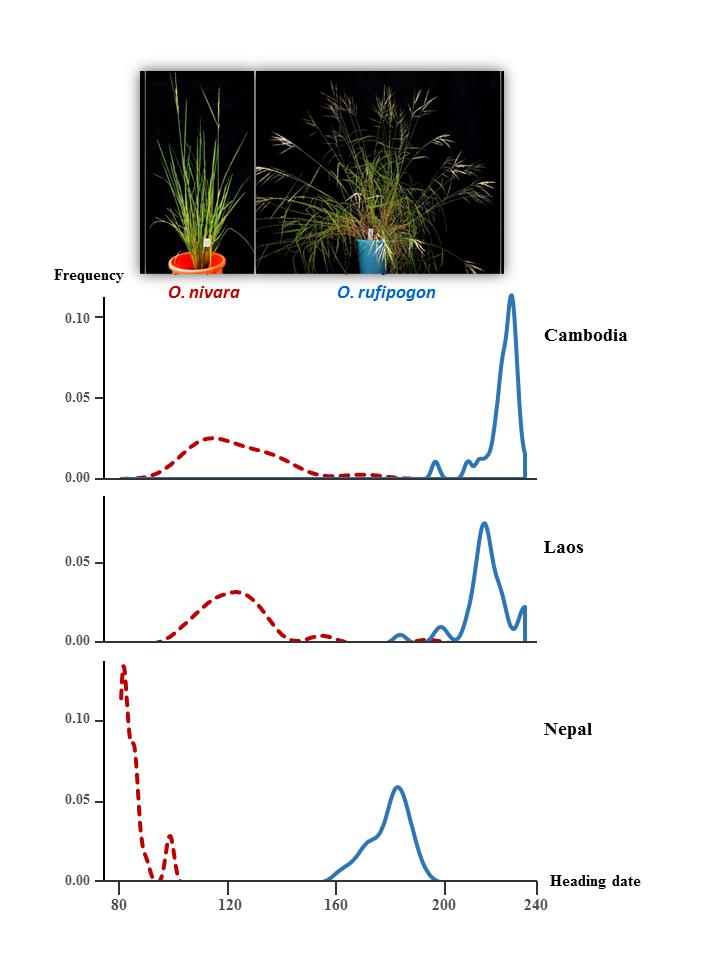
Credit: ©Science China Press

Speciation is the process by which new species forms and is the driving force of biodiversity. Since Darwin published On the Origin of Species, great efforts have been performed without interruption to explore the pattern and mechanism of speciation. It is well acknowledged that determining the forms of reproductive isolation and their relative importance in species divergence is of critical importance for our understanding of speciation. Although substantial investigations on reproductive isolation have been made on numerous model species, relatively limited work has been focused on natural systems that evolve in the wild. Previous studies have shown that, as the direct ancestors of Asian cultivated rice, Oryza rufipogon and O. nivara are a progenitor-daughter species pair and diverged very recently (roughly 150 thousand years) and provide a feasible model to study reproductive isolation and the underlying mechanism.

Here, researchers chose three pairs of sympatric populations of the two species from Nepal, Cambodia and Laos to have performed 238 combinations of artificial crossing, including the combinations between species, between populations within species, and between individuals within populations. On this basis, they estimated the seed set of crossing pollinations, F1 viability and fertility to evaluate the post-zygotic reproductive isolation. In addition, researchers collected the flowering time data of these populations censused in their previous common experiment to assess the pre-zygotic reproductive isolation.

The results showed that O. nivara flowered on average 80 earlier than O. rufipogon with non-overlap in flowering peak between sympatric populations. By contrast, no significant reduction was found in seed set of crossing pollinations, F1 viability and fertility relative to the estimates of the two parents. Researchers also found that interspecies crossing with O. nivara as the mother showed higher seed sets than the combinations with O. rufipogon as the mother and that artificial emasculation during hand pollinations affected the seed set to some extents. Together, this study demonstrated that divergent flowering time caused nearly complete reproductive isolation between two wild rice species and the change of flowering time of the new species O. nivara is an adaption to shifted environments.

###

This work was funded by the National Natural Science Foundation of China (91731301), the grants from the Chinese Academy of Sciences (XDB31000000; XDA08020103) and CAS/SAFEA International Partnership Program for Creative Research Teams.

See the article: Xu X et al. Divergence in flowering time is a major component contributing to reproductive isolation between two wild rice species (Oryza rufipogon and O. nivara ). Science China Life Sciences (in press).
http://engine.scichina.com/doi/10.1007/s11427-019-1678-6

Media Contact
Song Ge
[email protected]

Related Journal Article

http://dx.doi.org/10.1007/s11427-019-1678-6

Tags: Biology
Share12Tweet8Share2ShareShareShare2

Related Posts

Florida Cane Toad: Complex Spread and Selective Evolution

Florida Cane Toad: Complex Spread and Selective Evolution

February 7, 2026
New Study Uncovers Mechanism Behind Burn Pit Particulate Matter–Induced Lung Inflammation

New Study Uncovers Mechanism Behind Burn Pit Particulate Matter–Induced Lung Inflammation

February 6, 2026

DeepBlastoid: Advancing Automated and Efficient Evaluation of Human Blastoids with Deep Learning

February 6, 2026

Navigating the Gut: The Role of Formic Acid in the Microbiome

February 6, 2026
Please login to join discussion

POPULAR NEWS

  • Robotic Ureteral Reconstruction: A Novel Approach

    Robotic Ureteral Reconstruction: A Novel Approach

    82 shares
    Share 33 Tweet 21
  • Digital Privacy: Health Data Control in Incarceration

    63 shares
    Share 25 Tweet 16
  • Study Reveals Lipid Accumulation in ME/CFS Cells

    57 shares
    Share 23 Tweet 14
  • Breakthrough in RNA Research Accelerates Medical Innovations Timeline

    53 shares
    Share 21 Tweet 13

About

We bring you the latest biotechnology news from best research centers and universities around the world. Check our website.

Follow us

Recent News

Decoding Prostate Cancer Origins via snFLARE-seq, mxFRIZNGRND

Digital Health Perspectives from Baltic Sea Experts

Florida Cane Toad: Complex Spread and Selective Evolution

Subscribe to Blog via Email

Enter your email address to subscribe to this blog and receive notifications of new posts by email.

Join 73 other subscribers
  • Contact Us

Bioengineer.org © Copyright 2023 All Rights Reserved.

Welcome Back!

Login to your account below

Forgotten Password?

Retrieve your password

Please enter your username or email address to reset your password.

Log In
No Result
View All Result
  • Homepages
    • Home Page 1
    • Home Page 2
  • News
  • National
  • Business
  • Health
  • Lifestyle
  • Science

Bioengineer.org © Copyright 2023 All Rights Reserved.