• HOME
  • NEWS
  • EXPLORE
    • CAREER
      • Companies
      • Jobs
    • EVENTS
    • iGEM
      • News
      • Team
    • PHOTOS
    • VIDEO
    • WIKI
  • BLOG
  • COMMUNITY
    • FACEBOOK
    • INSTAGRAM
    • TWITTER
Wednesday, July 8, 2026
BIOENGINEER.ORG
No Result
View All Result
  • Login
  • HOME
  • NEWS
  • EXPLORE
    • CAREER
      • Companies
      • Jobs
        • Lecturer
        • PhD Studentship
        • Postdoc
        • Research Assistant
    • EVENTS
    • iGEM
      • News
      • Team
    • PHOTOS
    • VIDEO
    • WIKI
  • BLOG
  • COMMUNITY
    • FACEBOOK
    • INSTAGRAM
    • TWITTER
  • HOME
  • NEWS
  • EXPLORE
    • CAREER
      • Companies
      • Jobs
        • Lecturer
        • PhD Studentship
        • Postdoc
        • Research Assistant
    • EVENTS
    • iGEM
      • News
      • Team
    • PHOTOS
    • VIDEO
    • WIKI
  • BLOG
  • COMMUNITY
    • FACEBOOK
    • INSTAGRAM
    • TWITTER
No Result
View All Result
Bioengineer.org
No Result
View All Result
Home NEWS Science News Biology

SUTD scientists led development of novel acoustofluidic technology that isolates submicron particles

Bioengineer by Bioengineer
May 19, 2020
in Biology
Reading Time: 2 mins read
0
IMAGE
Share on FacebookShare on TwitterShare on LinkedinShare on RedditShare on Telegram

IMAGE

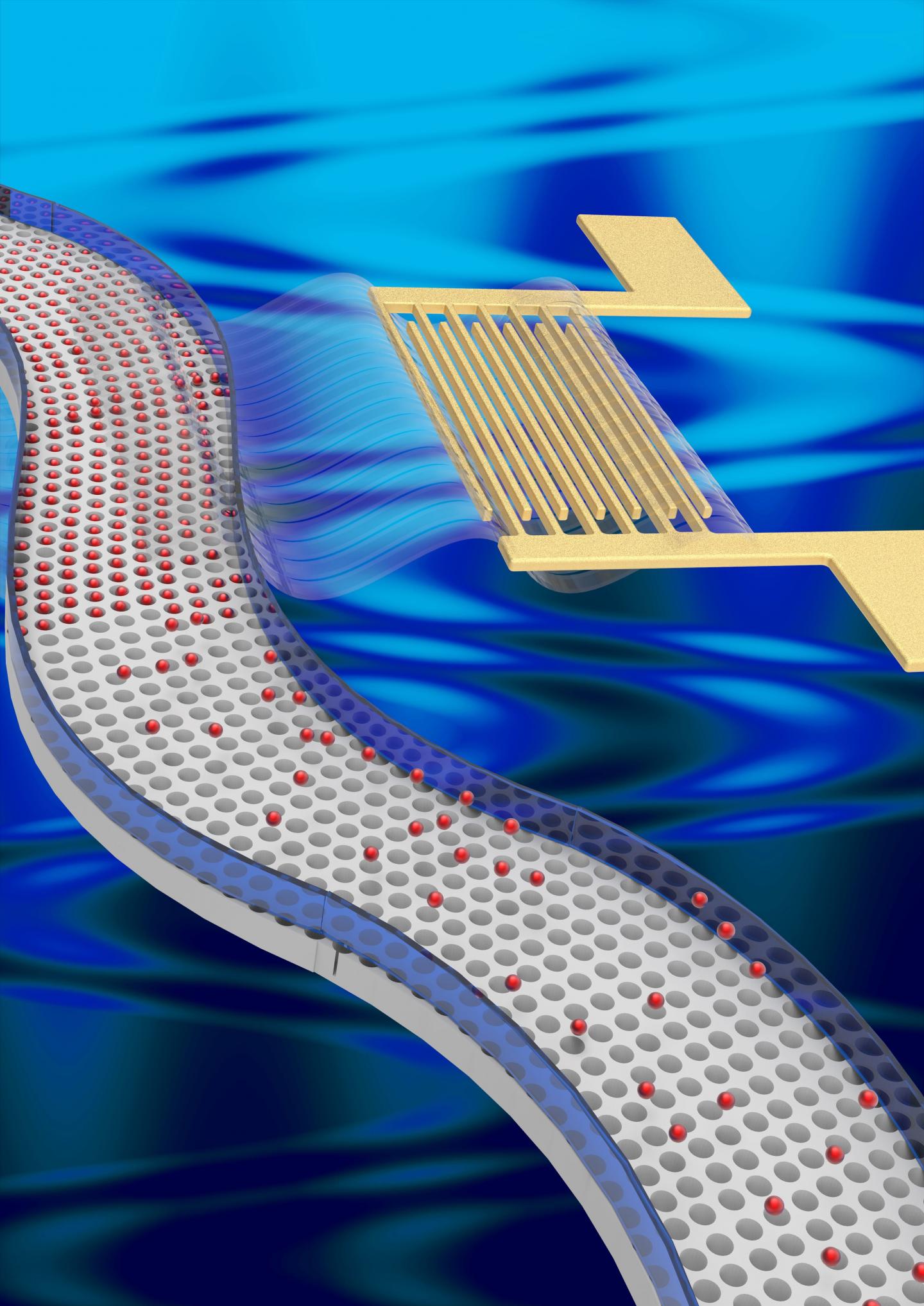
Credit: SUTD

Acoustofluidics is the fusion of acoustics and fluid mechanics which provides a contact-free, rapid and effective manipulation of fluids and suspended particles. The applied acoustic wave can produce a non-zero time-averaged pressure field to exert an acoustic radiation force on particles suspended in a microfluidic channel. However, for particles below a critical size the viscous drag force dominates over the acoustic radiation forces due to the strong acoustic streaming resulting from the acoustic energy dissipation in the fluid. Thus, particle size acts as a key limiting factor in the use of acoustic fields for manipulation and sorting applications that would otherwise be useful in fields including sensing (plasmonic nanoparticles), biology (small bioparticle enrichment) and optics (micro-lenses).

Although acoustic nanoparticle manipulation has been demonstrated, terahertz (THz) or gigahertz (GHz) frequencies are usually required to create nanoscale wavelengths, in which the fabrication of very small feature sizes of SAW transducers is challenging. In addition, single nanoparticle positioning into discrete traps has not been demonstrated in nanoacoustic fields. Hence, there is a pressing need to develop a fast, precise and scalable method for individual nano- and submicron scale manipulation in acoustic fields using megahertz (MHz) frequencies.

An interdisciplinary research team led by Associate Professor Ye Ai from Singapore University of Technology and Design (SUTD) and Dr. David Collins from University of Melbourne, in collaboration with Professor Jongyoon Han from MIT and Associate Professor Hong Yee Low from SUTD, developed a novel acoustofluidic technology for massively multiplexed submicron particle trapping within nanocavities at the single-particle level.

The acoustofluidic device uses surface acoustic waves (SAWs) as the actuation source and contains an elastic nanocavity layer located at the interface of the microfluidic channel and the acoustic transducer. The generated SAW gives rise to acoustically-driven deformations in the nanocavities and produces a time averaged acoustic field that generates a nanoscale acoustic force gradients along the channel.

By taking advantage of this unique nanoscale acoustic force field to overcome the Brownian motion and acoustic streaming, the team was able to manipulate millions of individual nano- and submicron scale particles towards the nanocavities. Nanocavity layer implementation on the SAW actuator provides discrete trapping positions where individual nanoparticles can be confined by exposure to SAW and released with the cessation of SAW excitation. This is a fast-processing and contact-free trapping system with the potential for widespread application in sorting, patterning and size-selective capture of sub-micron and nanoscale objects.

This work has been published in Small, a top-tier, multidisciplinary journal, covering a broad spectrum of topics in nano- and microscale experimental and theoretical studies, and has been featured on the inside cover of the issue. SUTD graduate students and postdoctoral fellows, including Mahnoush Tayebi, Richard O’Rorke and Him Cheng Wong participated in this research project.

###

Media Contact
Melissa Koh
[email protected]

Related Journal Article

http://dx.doi.org/10.1002/smll.202000462

Tags: Biomedical/Environmental/Chemical EngineeringNanotechnology/MicromachinesTechnology/Engineering/Computer Science
Share12Tweet8Share2ShareShareShare2

Related Posts

Here are a few rewritten headlines for a science magazine post, each with a slightly different tone: Intriguing & poetic: How do organs sculpt themselves? Sea stars hold the secret Direct & research-focused: Sea stars reveal the hidden rules of organ formation Metaphorical & inviting: Tiny architects beneath the waves: What sea stars teach us about building organs Short & punchy: Star-shaped clues to how our organs take shape Question-led: Could a sea star show us how organs form? Elegant & feature-style: The body’s blueprint, glimpsed in a sea star’s arm

July 6, 2026
Bacteria evolve faster with unconventional gene copies — Biology

Bacteria evolve faster with unconventional gene copies

July 6, 2026

Neighbours rewire soil feedback via root microbiome shifts

July 6, 2026

Evolution-Inspired Biosensors Revolutionize Lipid Tracking in Real Time

July 2, 2026
Please login to join discussion

POPULAR NEWS

  • Detection of EDCs in Breast Milk and Infant Urine Up to Six Months Highlights Early Exposure Risks

    77 shares
    Share 31 Tweet 19
  • New Drug Candidate Developed at McMaster Shows Potential for Treating Brain Cancer

    58 shares
    Share 23 Tweet 15
  • Saying Goodbye to PGY-6: Pediatric Fellowship Realities

    103 shares
    Share 41 Tweet 26
  • KTU Researchers Explore Ultrasound’s Role in Enhancing Blood Flow Beyond Diagnostics

    53 shares
    Share 21 Tweet 13

About

We bring you the latest biotechnology news from best research centers and universities around the world. Check our website.

Follow us

Recent News

Flame retardant BDE-209 targets molecularly linked to ulcerative colitis

Ultra-high frequency particle impacts mimic rockbursts to shatter hard rock

Kidney transplant outcomes in older adults studied by German researchers

Subscribe to Blog via Email

Success! An email was just sent to confirm your subscription. Please find the email now and click 'Confirm' to start subscribing.

Join 83 other subscribers
  • Contact Us

Bioengineer.org © Copyright 2023 All Rights Reserved.

Welcome Back!

Login to your account below

Forgotten Password?

Retrieve your password

Please enter your username or email address to reset your password.

Log In
No Result
View All Result
  • Homepages
    • Home Page 1
    • Home Page 2
  • News
  • National
  • Business
  • Health
  • Lifestyle
  • Science

Bioengineer.org © Copyright 2023 All Rights Reserved.