Credit: ©Science China Press
Many 21st century challenges exist in science and technology, and one of these is the hypersonic vehicle from the dream for human beings to fly faster, higher and further. For developing such the hypersonic vehicle, one of the crucial problems appears to be advanced ground test facilities. After more than sixty year’s research work, hypersonic ground test facilities suitable for verification of hypersonic techniques and exploration of the aero-thermochemistry of hypersonic flows still rely on shock tunnels that have some limitations to meet the ever-increasing demand. For reliable ground tests, four requirements must be considered carefully for hypersonic wind tunnel development: (1) The test gas, instead of any substitute, must be the pure air to accurately simulate chemical reaction mechanisms; (2) The stagnation temperature and total pressure must be achieved to excite correct chemical reactions; (3) The scale of test models must be large enough to ensure that chemical reactions occur at the correct reaction rate on the right location of the test models because chemical reactions are not scalable; (4) Sufficient long test time is necessary for aerodynamic forces and supersonic combustion tests. The fourth requirement is important for the test flow to reach stable combustion and improve the experimental data accuracy of aerodynamic forces and moments. Meeting these four requirements at the same time results in the flight condition duplication in ground test facilities, which has been a challenge in developing hypersonic test facilities for decades.
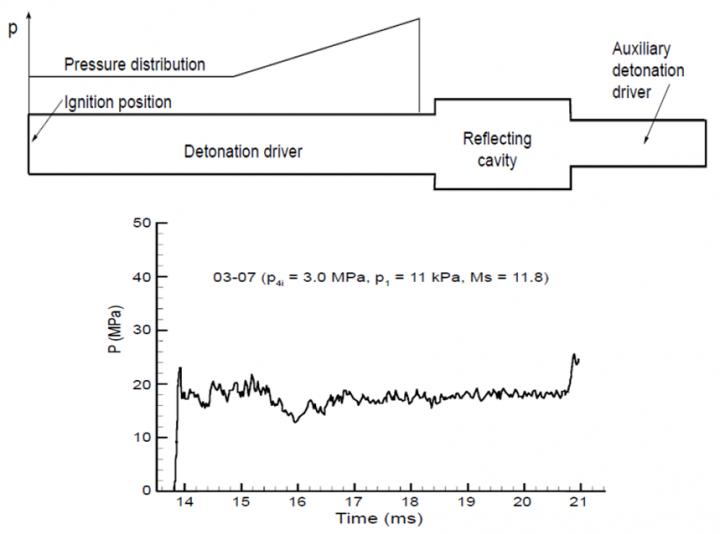
The theory of detonation-driven shock tunnels for developing hypervelocity test facilities is described, covering three important aspects. The first aspect is on the special feature of shock tunnels. The stagnation temperature and the total pressure can be simulated selectively to generate hypersonic flows with a required velocity but at different altitudes if the shock tunnel driver is powerful enough. Two methods can be used to improve shock tunnels’ driving ability by increasing the sound speed of the driver gases. One is choosing light-gases as driver gases and other is heating the driver gases to a high temperature level. The detonation driver has a special advantage in generating high temperature driver gases. The second aspect is on the detonation driver concept that is demonstrated to meet the demand from large-scale high-enthalpy testing. This means that the driver is capable of generating test flows with both the high total temperature and the high power for generating large scale test flow fields. Two kinds of the detonation drivers are developed and applied successfully. One is the backward detonation driver for long test duration. The JF-12 hypersonic flight duplicated shock tunnel (Hyper-dragon I) is built up based on this operation mode and becomes the largest hypersonic shock tunnel with a 2.5 m diameter nozzle. Its performance covers Mach numbers from 5-9 and flight altitudes from 25-50 km. The other is the forward detonation cavity (FDC) driver for gaining high flow enthalpy, and this operation mode is tested in the JF-10 detonation-driven high-enthalpy shock tunnel in the Institute of Mechanics, CAS. The test flow of a total temperature up to 7000 K is achieved with a uniform reservoir pressure maintaining for as long as 6 ms. Figure shows the schematic diagram of the FDC driver and its experimental performance data. The last aspect deals with the interface-matching problem. The interface separating test/driver gases can induce the incident shock reflection, therefor, it is a key issue for improving test flow quality and keeping test time as long as possible. The interface-matching condition is proposed by adjusting the initial detonable gas mixture to make the acoustic resistance of its detonated products be the same with the test gas behind the incident shock wave. Shock tunnel experiments showed that two detonation drivers can be operated under the interface-matching condition with the incident Mach number as high as 9. By operating under such the condition, the 100 ms test duration is achieved by the Hyper-dragon I.
Theory of the detonation-driven hypervelocity shock tunnel is described systemically with experimental demonstration. With the theory, it is possible to develop large-scale hypersonic test facilities for thermal-aerodynamic research on hypersonic flows that are chemically reacting.
###
See the article:
On Theory and Methods for Advanced Detonation-driven Hypervelocity Shock Tunnels
https:/
Media Contact
Zonglin Jiang
[email protected]
Related Journal Article
http://dx.