Australian and German researchers build modular bridge design for nanoscale photonic chip
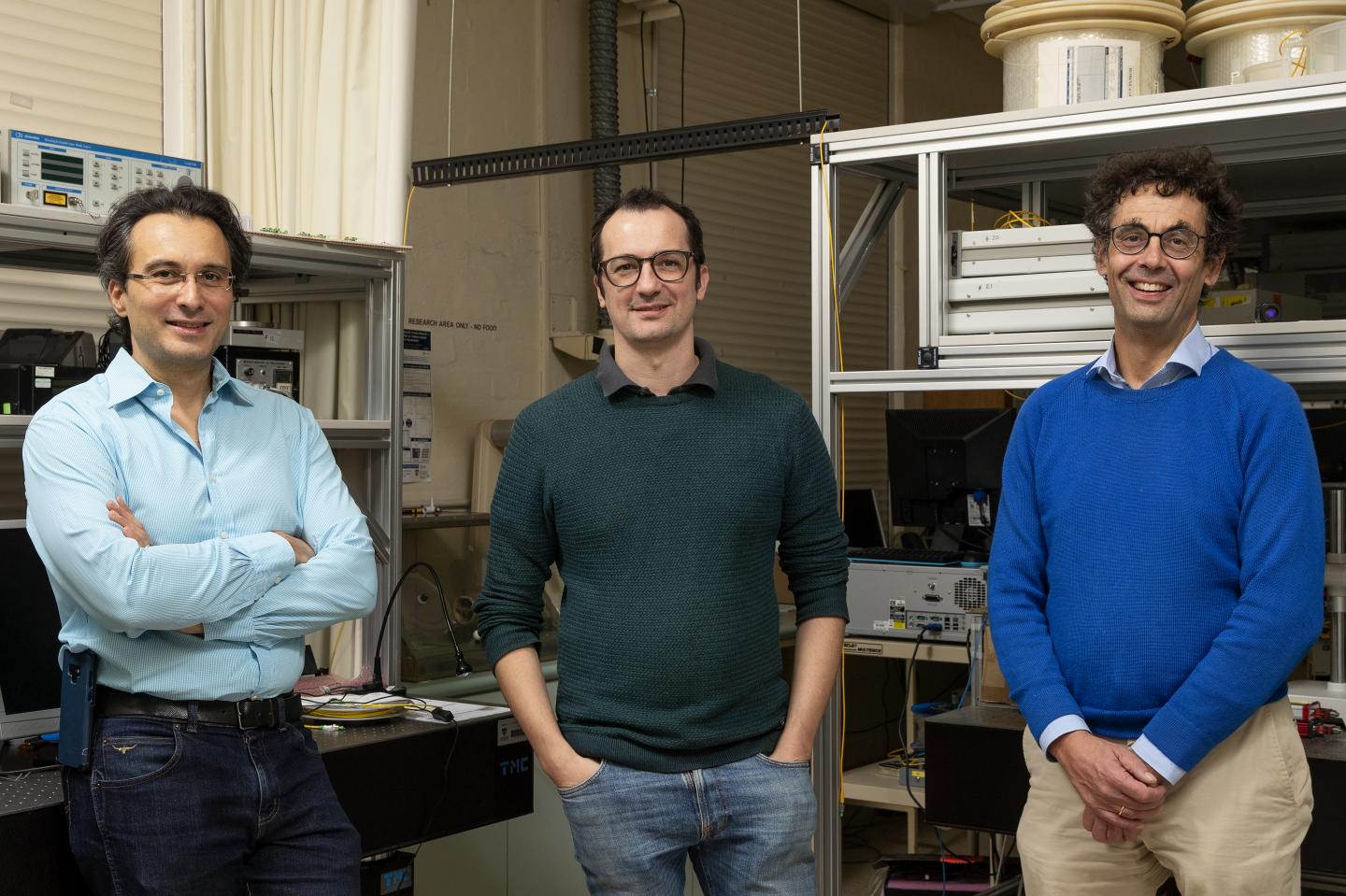
Credit: Louise Cooper/University of Sydney
Light is emerging as the leading vehicle for information processing in computers and telecommunications as our need for energy efficiency and bandwidth increases.
Already the gold standard for intercontinental communication through fibre-optics, photons are replacing electrons as the main carriers of information throughout optical networks and into the very heart of computers themselves.
However, there remain substantial engineering barriers to complete this transformation. Industry-standard silicon circuits that support light are more than an order of magnitude larger than modern electronic transistors. One solution is to ‘compress’ light using metallic waveguides – however this would not only require a new manufacturing infrastructure, but also the way light interacts with metals on chips means that photonic information is easily lost.
Now scientists in Australia and Germany have developed a modular method to design nanoscale devices to help overcome these problems, combining the best of traditional chip design with photonic architecture in a hybrid structure. Their research is published today in Nature Communications.
“We have built a bridge between industry-standard silicon photonic systems and the metal-based waveguides that can be made 100 times smaller while retaining efficiency,” said lead author Dr Alessandro Tuniz from the University of Sydney Nano Institute and School of Physics.
This hybrid approach allows the manipulation of light at the nanoscale, measured in billionths of a metre. The scientists have shown that they can achieve data manipulation at 100 times smaller than the wavelength of light carrying the information.
“This sort of efficiency and miniaturisation will be essential in transforming computer processing to be based on light. It will also be very useful in the development of quantum-optical information systems, a promising platform for future quantum computers,” said Associate Professor Stefano Palomba, a co-author from the University of Sydney and Nanophotonics Leader at Sydney Nano.
“Eventually we expect photonic information will migrate to the CPU, the heart of any modern computer. Such a vision has already been mapped out by IBM.”
On-chip nanometre-scale devices that use metals (known as “plasmonic” devices) allow for functionality that no conventional photonic device allows. Most notably, they efficiently compress light down to a few billionths of a metre and thus achieve hugely enhanced, interference-free, light-to-matter interactions.
“As well as revolutionising general processing, this is very useful for specialised scientific processes such as nano-spectroscopy, atomic-scale sensing and nanoscale detectors,” said Dr Tuniz also from the Sydney Institute of Photonics and Optical Science.
However, their universal functionality was hampered by a reliance on ad hoc designs.
“We have shown that two separate designs can be joined together to enhance a run-of-the-mill chip that previously did nothing special,” Dr Tuniz said.
This modular approach allows for rapid rotation of light polarisation in the chip and, because of that rotation, quickly permits nano-focusing down to about 100 times less than the wavelength.
Professor Martijn de Sterke is Director of the Institute of Photonics and Optical Science at the University of Sydney. He said: “The future of information processing is likely to involve photons using metals that allow us to compress light to the nanoscale and integrate these designs into conventional silicon photonics.”
###
DOWNLOAD the research and a photo of the research team at this link.
INTERVIEWS
Dr Alessandro Tuniz I [email protected]
Institute of Photonics and Optical Science | School of Physics
The University of Sydney Nano Institute
Associate Professor Stefano Palomba | [email protected]
Institute of Photonics and Optical Science | School of Physics
The University of Sydney Nano Institute
Professor Martijn de Sterke | [email protected]
Director, Institute of Photonics and Optical Science | School of Physics
The University of Sydney Nano Institute
MEDIA ENQUIRIES
Marcus Strom | [email protected] | +61 423 982 485
DECLARATION
This research was supported by the University of Sydney Fellowship Scheme, the German Research Foundation (DFG) under Germany’s Excellence Strategy EXC-2123/1. This work was performed in part at the NSW node of the Australian National Fabrication Facility (ANFF).
Media Contact
Marcus Strom
[email protected]
Related Journal Article
http://dx.