• HOME
  • NEWS
  • EXPLORE
    • CAREER
      • Companies
      • Jobs
    • EVENTS
    • iGEM
      • News
      • Team
    • PHOTOS
    • VIDEO
    • WIKI
  • BLOG
  • COMMUNITY
    • FACEBOOK
    • INSTAGRAM
    • TWITTER
Sunday, February 8, 2026
BIOENGINEER.ORG
No Result
View All Result
  • Login
  • HOME
  • NEWS
  • EXPLORE
    • CAREER
      • Companies
      • Jobs
        • Lecturer
        • PhD Studentship
        • Postdoc
        • Research Assistant
    • EVENTS
    • iGEM
      • News
      • Team
    • PHOTOS
    • VIDEO
    • WIKI
  • BLOG
  • COMMUNITY
    • FACEBOOK
    • INSTAGRAM
    • TWITTER
  • HOME
  • NEWS
  • EXPLORE
    • CAREER
      • Companies
      • Jobs
        • Lecturer
        • PhD Studentship
        • Postdoc
        • Research Assistant
    • EVENTS
    • iGEM
      • News
      • Team
    • PHOTOS
    • VIDEO
    • WIKI
  • BLOG
  • COMMUNITY
    • FACEBOOK
    • INSTAGRAM
    • TWITTER
No Result
View All Result
Bioengineer.org
No Result
View All Result
Home NEWS Science News Chemistry

Unlocking the gate to the millisecond CT

Bioengineer by Bioengineer
May 14, 2020
in Chemistry
Reading Time: 2 mins read
0
IMAGE
Share on FacebookShare on TwitterShare on LinkedinShare on RedditShare on Telegram

IMAGE

Credit: Tohoku University

Many will undergo a CT scan at some point in their lifetime – being slid in and out of a tunnel as a large machine rotates around. X-ray computed tomography, better known by its acronym CT, is a widely used method of obtaining cross-sectional images of objects.

Now a research team – led by Tohoku University Professor, Wataru Yashiro – has developed a new method using intense synchrotron radiation that produces higher quality images within milliseconds.

High-speed, high-resolution X-ray CT is currently possible using intense synchrotron radiation. However, this requires samples to be rotated at high speed to obtain images from many directions. This would make CT scans more akin to a rollercoaster ride!

Extreme rotation also makes controlling the temperature or atmosphere of the sample impossible.

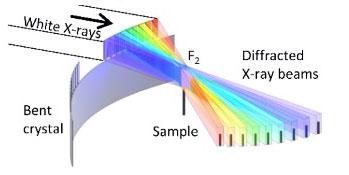
Nevertheless, the research team solved this conundrum by creating an optical system that splits single synchrotron X-ray beams into many. These beams then shine onto the sample from different directions at the same time; thus, negating the need to rotate the sample.

This “multi-beam” method is no easy task since the direction of X-rays cannot be easily changed. Unlike visible light, X-rays interact with matters weakly, making it difficult to utilize mirrors and prisms to change the path of the beams.

To overcome this, the research team used micro-fabrication techniques to create uniquely shaped crystals. These crystals were then bent in the shape of a hyperbola. By combining three rows of crystals, the multi-beam optics were able to cover an angle of ±70°.

Carrying out their experiments at the SPring-8 synchrotron radiation facility, the research team took advantage of a cutting-edge compressed-sensing algorithm that needs only a few dozen projection images for image reconstruction.

“The invention makes 3-D observations of living beings and liquid samples within milliseconds possible” exclaimed Professor Yashiro. “Its possible application is wide-spread, from fundamental material science to life sciences to industry,” added Yashiro.

###

Media Contact
Wataru Yashiro
[email protected]

Original Source

https://www.tohoku.ac.jp/en/press/unlocking_the_gate_to_the_millisecond_ct.html

Related Journal Article

http://dx.doi.org/10.1364/OPTICA.384804

Tags: Chemistry/Physics/Materials Sciences
Share12Tweet8Share2ShareShareShare2

Related Posts

blank

Breakthrough in Environmental Cleanup: Scientists Develop Solar-Activated Biochar for Faster Remediation

February 7, 2026
blank

Cutting Costs: Making Hydrogen Fuel Cells More Affordable

February 6, 2026

Scientists Develop Hand-Held “Levitating” Time Crystals

February 6, 2026

Observing a Key Green-Energy Catalyst Dissolve Atom by Atom

February 6, 2026
Please login to join discussion

POPULAR NEWS

  • Robotic Ureteral Reconstruction: A Novel Approach

    Robotic Ureteral Reconstruction: A Novel Approach

    82 shares
    Share 33 Tweet 21
  • Digital Privacy: Health Data Control in Incarceration

    63 shares
    Share 25 Tweet 16
  • Breakthrough in RNA Research Accelerates Medical Innovations Timeline

    53 shares
    Share 21 Tweet 13
  • Mapping Tertiary Lymphoid Structures for Kidney Cancer Biomarkers

    50 shares
    Share 20 Tweet 13

About

We bring you the latest biotechnology news from best research centers and universities around the world. Check our website.

Follow us

Recent News

Group Therapy Boosts Recovery in Elderly Depression

Evaluating Biosimilar Trastuzumab for Breast Cancer in Thailand

Decoding Phantom Limb Movements via Intraneural Signals

Subscribe to Blog via Email

Success! An email was just sent to confirm your subscription. Please find the email now and click 'Confirm' to start subscribing.

Join 74 other subscribers
  • Contact Us

Bioengineer.org © Copyright 2023 All Rights Reserved.

Welcome Back!

Login to your account below

Forgotten Password?

Retrieve your password

Please enter your username or email address to reset your password.

Log In
No Result
View All Result
  • Homepages
    • Home Page 1
    • Home Page 2
  • News
  • National
  • Business
  • Health
  • Lifestyle
  • Science

Bioengineer.org © Copyright 2023 All Rights Reserved.