They are born from the union between a circular component and a linear component and present very special physical characteristics
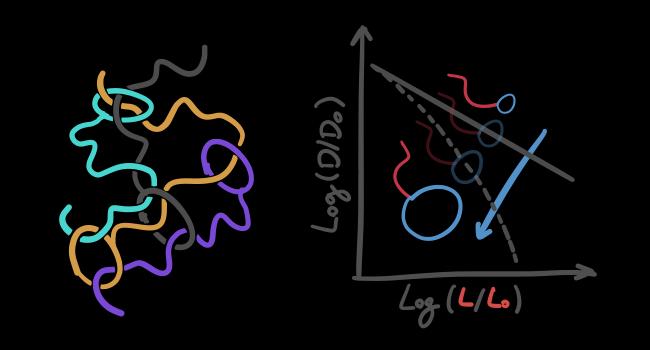
Credit: Angelo Rosa, SISSA
They are in the shape of a tadpole and interact with each other by harpooning between head and tail, thus presenting interesting and unexpected physical properties. Tadpoles are the large molecules at the centre of the new research just published on the journal ACS Macro Letters, and the result of an international collaboration between SISSA and the Universities of Vienna, Warwick and Edinburgh. In the study, the researchers described how these particular constructs, conceived by the scientists as the union between a circular and a linear polymer, in dense solutions present much “slower” molecular dynamics compared to that recorded by the two parts that make it up: and this is because “heads” and “tails” tend to “capture” each other, in a cascade process. What is the result? A much less fluid and much more viscous product. The research has been conducted thanks to computer simulations and made it possible to analyse the dynamics of the molecules in a very fine way, with a resolution that is impossible to reproduce in the laboratory. Studies like this, which allow to shed light on the physical behaviour of the macromolecules under specific conditions, are essential for possible future technological applications of polymers, which range from materials engineering to pharmaceuticals.
In Physics, 1+1 does not always add up to 2
“How many times do we hear ourselves say that 1+1 always adds up to 2? Although this is usually the case when it comes to maths, the same cannot be said about physics: in particular, the physical properties of complex objects deriving from the union of two or more simpler parts, are not always interpretable as intermediate at the same physical properties of the different parts” explain the researchers.
“An important example of this are polymers, large molecules formed by the union of several parts, which can be summarised according to various architectures: linear polymers, circular polymers and polymers which we could call “chimeric” i.e. resulting from the union of more types of distinct architectures”. Just like the ones used in this research.
This is how tadpoles harpoon
“Exploring various sizes of heads/tails through numeric simulations we have shown how these objects in solution behave differently from what one would suppose considering the behaviour, already known, of the two polymers that make them up: the circular and the linear one. The researchers explain that this slowdown is because the tail of each “tadpole” tends to ‘harpoon’ the head of a tadpole close to it and the latter does the same with the others, in a cascading process. The result is a compound with characteristics very close to those of a highly viscous fluid but achievable with relatively small polymers. The importance of this research above all deals with the possibility to explore and design so-called ‘soft’ materials with new physical properties: all based on relatively small molecules whose reciprocal interactions dramatically affect the structure and the dynamics of the compound. Following the study with the simulations, the research is now awaiting experimental confirmation.
###
Media Contact
Donato Ramani
[email protected]
Original Source
https:/
Related Journal Article
http://dx.