• HOME
  • NEWS
  • EXPLORE
    • CAREER
      • Companies
      • Jobs
    • EVENTS
    • iGEM
      • News
      • Team
    • PHOTOS
    • VIDEO
    • WIKI
  • BLOG
  • COMMUNITY
    • FACEBOOK
    • INSTAGRAM
    • TWITTER
Saturday, February 7, 2026
BIOENGINEER.ORG
No Result
View All Result
  • Login
  • HOME
  • NEWS
  • EXPLORE
    • CAREER
      • Companies
      • Jobs
        • Lecturer
        • PhD Studentship
        • Postdoc
        • Research Assistant
    • EVENTS
    • iGEM
      • News
      • Team
    • PHOTOS
    • VIDEO
    • WIKI
  • BLOG
  • COMMUNITY
    • FACEBOOK
    • INSTAGRAM
    • TWITTER
  • HOME
  • NEWS
  • EXPLORE
    • CAREER
      • Companies
      • Jobs
        • Lecturer
        • PhD Studentship
        • Postdoc
        • Research Assistant
    • EVENTS
    • iGEM
      • News
      • Team
    • PHOTOS
    • VIDEO
    • WIKI
  • BLOG
  • COMMUNITY
    • FACEBOOK
    • INSTAGRAM
    • TWITTER
No Result
View All Result
Bioengineer.org
No Result
View All Result
Home NEWS Science News Chemistry

Genes of high temperature superconductivity expressed in 3D materials

Bioengineer by Bioengineer
May 13, 2020
in Chemistry
Reading Time: 2 mins read
0
IMAGE
Share on FacebookShare on TwitterShare on LinkedinShare on RedditShare on Telegram

IMAGE

Credit: ©Science China Press

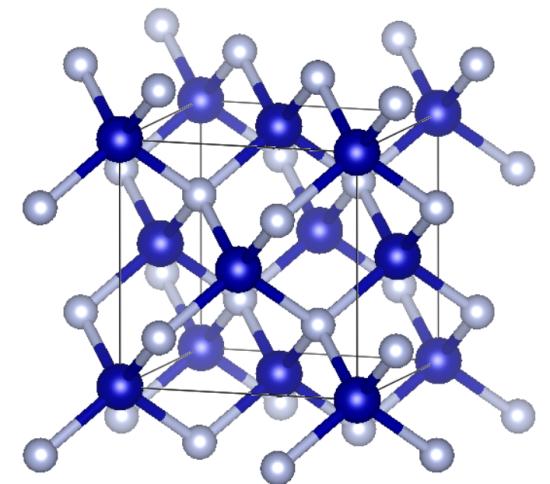
The problems of high temperature superconductor (HTSC) are important for the physics community and even the whole science area. Ever since its discovery, many researchers have conducted various studies, still lacking of widely accepted solutions. Recently, Prof. Jiangping Hu from Institute of Physics, Chinese of Science, proposed the “gene” theory of high temperature superconductivity based on the electronic properties of existing quasi-two dimensional HTSCs, and used it to search for new families of HTSCs. According to this theory, their group further explored the conditions of expressing of the “gene” in high symmetric three-dimensional structure and predicted cobalt compounds in the zinc-blende structure as new families of HTSC.

This work is titled as Unconventional high temperature superconductivity in cubic zinc-blende transition metal compounds, recently published in SCIENCE CHINA Physics, Mechanics & Astronomy. The researchers used the group theory, electronic band and slave-boson mean-field method to analysis the symmetries of electron motion and to predict the properties of superconductivity. This is a d-wave superconducting state spontaneously breaking time reversal symmetry and maintaining nodes in diagonal directions.

To be specific, the structure considered in this work is the zinc-blende structure as shown in Figure 1. Under this structure, the local symmetries are the same to the global symmetries, which keeps the degeneracy of the t2g orbitals from the three-dimensional representation of Td group. When the electronic configuration is close to d7, those three orbitals are isolated near the Fermi surface, with strong hopping and antiferromagnetic super-exchange in all the directions, triggering the expression of HTSC “gene”. The pairing wave under this environment is d+id, breaking time reversal symmetry. This pairing wave vanishes at the bulk diagonal direction in the Brillouin zone, as the direct analogy of quasi-two-dimensional superconductivity in cuprate. By adopting band structure and mean-field calculation, the electron doped zinc-blende cobalt-oxygen-nitrogen compounds may realize such physics.

This result further enriched the prediction of families of HTSCs according to the “gene” theory. If verified by the following experiments, the “gene” theory would be justified and more HTSCs materials would be found.

###

More information:

Q. Zhang, K. Jiang, Y. H. Gu, and J. P. Hu, Unconventional high temperature superconductivity in cubic zinc-blende transition metal compounds, Sci. China-Phys. Mech. Astron. 63, 277411 (2020), https://doi.org/10.1007/s11433-019-1495-3

http://engine.scichina.com/publisher/scp/journal/SCPMA/63/7/10.1007/s11433-019-1495-3?slug=fulltext

Media Contact
Hu, Jiangping
[email protected]

Related Journal Article

http://dx.doi.org/10.1007/s11433-019-1495-3

Tags: Chemistry/Physics/Materials Sciences
Share12Tweet8Share2ShareShareShare2

Related Posts

blank

Breakthrough in Environmental Cleanup: Scientists Develop Solar-Activated Biochar for Faster Remediation

February 7, 2026
blank

Cutting Costs: Making Hydrogen Fuel Cells More Affordable

February 6, 2026

Scientists Develop Hand-Held “Levitating” Time Crystals

February 6, 2026

Observing a Key Green-Energy Catalyst Dissolve Atom by Atom

February 6, 2026
Please login to join discussion

POPULAR NEWS

  • Robotic Ureteral Reconstruction: A Novel Approach

    Robotic Ureteral Reconstruction: A Novel Approach

    82 shares
    Share 33 Tweet 21
  • Digital Privacy: Health Data Control in Incarceration

    63 shares
    Share 25 Tweet 16
  • Study Reveals Lipid Accumulation in ME/CFS Cells

    57 shares
    Share 23 Tweet 14
  • Breakthrough in RNA Research Accelerates Medical Innovations Timeline

    53 shares
    Share 21 Tweet 13

About

We bring you the latest biotechnology news from best research centers and universities around the world. Check our website.

Follow us

Recent News

Evaluating Pediatric Emergency Care Quality in Ethiopia

TPMT Expression Predictions Linked to Azathioprine Side Effects

Improving Dementia Care with Enhanced Activity Kits

Subscribe to Blog via Email

Success! An email was just sent to confirm your subscription. Please find the email now and click 'Confirm' to start subscribing.

Join 73 other subscribers
  • Contact Us

Bioengineer.org © Copyright 2023 All Rights Reserved.

Welcome Back!

Login to your account below

Forgotten Password?

Retrieve your password

Please enter your username or email address to reset your password.

Log In
No Result
View All Result
  • Homepages
    • Home Page 1
    • Home Page 2
  • News
  • National
  • Business
  • Health
  • Lifestyle
  • Science

Bioengineer.org © Copyright 2023 All Rights Reserved.