• HOME
  • NEWS
  • EXPLORE
    • CAREER
      • Companies
      • Jobs
    • EVENTS
    • iGEM
      • News
      • Team
    • PHOTOS
    • VIDEO
    • WIKI
  • BLOG
  • COMMUNITY
    • FACEBOOK
    • INSTAGRAM
    • TWITTER
Thursday, May 21, 2026
BIOENGINEER.ORG
No Result
View All Result
  • Login
  • HOME
  • NEWS
  • EXPLORE
    • CAREER
      • Companies
      • Jobs
        • Lecturer
        • PhD Studentship
        • Postdoc
        • Research Assistant
    • EVENTS
    • iGEM
      • News
      • Team
    • PHOTOS
    • VIDEO
    • WIKI
  • BLOG
  • COMMUNITY
    • FACEBOOK
    • INSTAGRAM
    • TWITTER
  • HOME
  • NEWS
  • EXPLORE
    • CAREER
      • Companies
      • Jobs
        • Lecturer
        • PhD Studentship
        • Postdoc
        • Research Assistant
    • EVENTS
    • iGEM
      • News
      • Team
    • PHOTOS
    • VIDEO
    • WIKI
  • BLOG
  • COMMUNITY
    • FACEBOOK
    • INSTAGRAM
    • TWITTER
No Result
View All Result
Bioengineer.org
No Result
View All Result
Home NEWS Science News Chemistry

NMR confirms molecular switches retain function in 2D-array

Bioengineer by Bioengineer
May 13, 2020
in Chemistry
Reading Time: 2 mins read
0
IMAGE
Share on FacebookShare on TwitterShare on LinkedinShare on RedditShare on Telegram

IMAGE

Credit: Tomas Bellon / IOCB Prague

Prague, 15 May 2020 – Researchers led by Jiri Kaleta of IOCB Prague have synthesized regular 2D assemblies of isotopically labelled molecular switches and measured the properties of their isomerization, revealing that formation of such an assembly doesn’t hamper the photochemical switching properties of the embedded molecules. The isotopic labels came into use when measuring the switching properties using an analytic technique dependent on the labels. The team published the results in the Journal of the American Chemical Society.

Self-organization of individual molecular machines, such as motors, rotors, and switches, into regular and well-defined two- (2D) or three-dimensional (3D) arrays is a promising path towards a new generation of smart materials. Two-dimensional assemblies seem to be particularly interesting because of their possible application in fields such as optics (OLEDs) and nanoelectronics (memory devices, frequency filters, etc.).

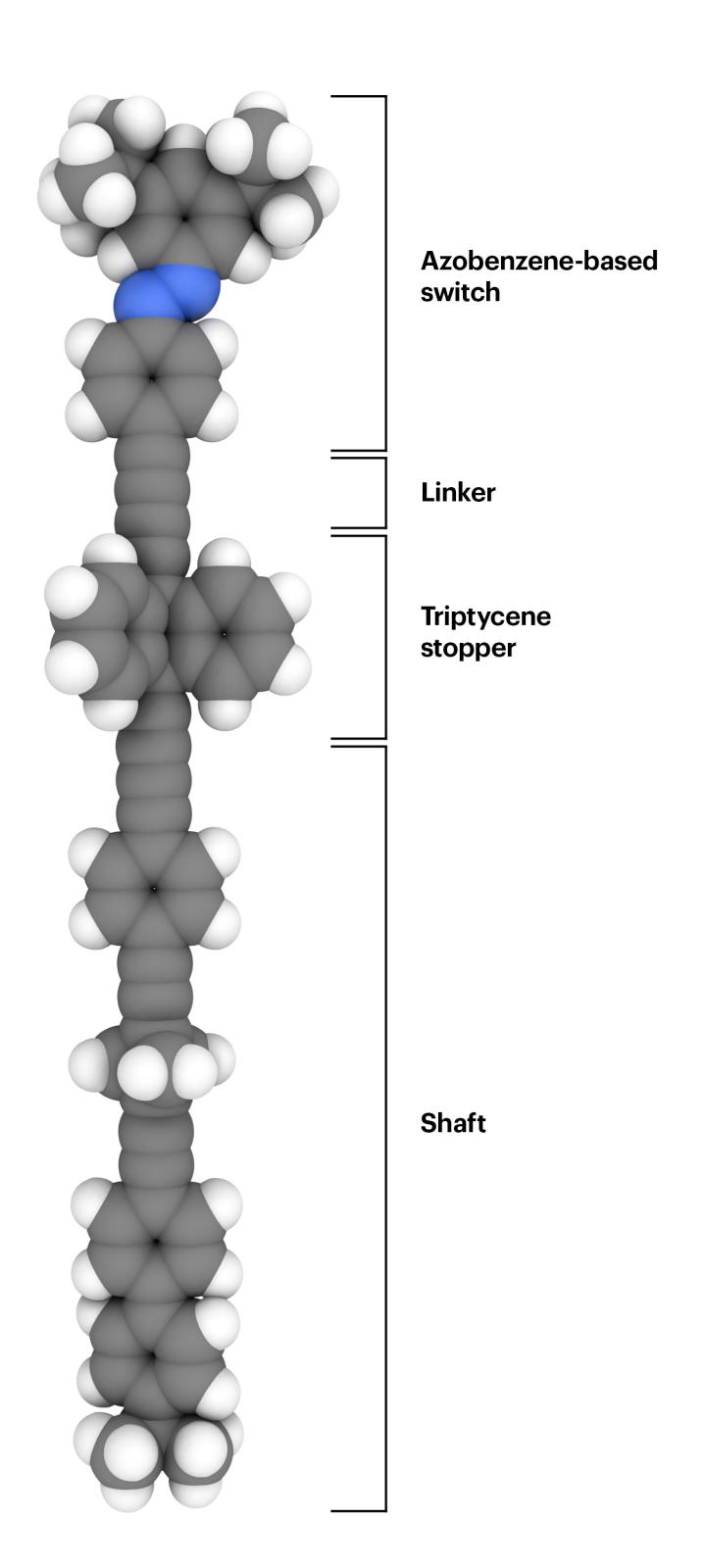
In collaboration with researchers from the Faculty of Science, Charles University in Prague and the University of Colorado, the IOCB Prague team obtained these assemblies with a method previously tested on other molecular machines in accordance with their ongoing research in the 2D arrays of such supramolecular systems. The researchers mounted the molecular switch moieties (substituted azobenzenes) onto rod-like molecules and distributed them on the porous nanocrystals of a tris(o-phenylenedioxy)cyctlotriphosphazene (TPP) matrix. The regularly distributed straight pores enforced the regular spread and parallel orientation of these structures.

The researchers labelled the switches 15N, which allowed them to use solid-state 15N NMR spectroscopy to detect the cis/trans isomerization. A suite of other analytical techniques confirmed the regular structure of the assemblies. Comparison of thermal steps in solution and supramolecular surface inclusions revealed that switching of individual molecules is not compromised by the close proximity of neighbors.

Binding the molecular switches to the surface of a solid material produces several key advantages. Unlike in bulk crystals, the switch segments of the molecules have enough space to change their configuration. And unlike in a solution, the molecules are part of a solid periodical system, giving more control of their position, which may lead to the potential use of such materials in applications where their specific position plays a role, e.g. memory devices.

###

The original paper: Santos Hurtado, C.; Bastien, G.; Masat, M.; Stocek, J. R.; Dracinsky, M.; Roncevic, I.; Cisarova, I.; Rogers, C. T.; Kaleta, J., Regular Two-Dimensional Arrays of Surface-Mounted Molecular Switches: Switching Monitored by UV-vis and NMR Spectroscopy. Journal of the American Chemical Society 2020. DOI: 10.1021/jacs.0c01753

Video: https://youtu.be/Ya6qAoupOx0

Media Contact
Dusan Brinzanik
[email protected]

Original Source

https://www.uochb.cz/en/news/171/

Related Journal Article

http://dx.doi.org/10.1021/jacs.0c01753

Tags: Chemistry/Physics/Materials SciencesNanotechnology/Micromachines
Share12Tweet8Share2ShareShareShare2

Related Posts

Advancing In Vivo and In Situ Monitoring: Science Bulletin Highlights Host-Based Antifouling Gold Nanotube Sensor for Selective Detection of Mechanically Sensitive Serotonin Release in Intestinal Mucosa — Chemistry

Advancing In Vivo and In Situ Monitoring: Science Bulletin Highlights Host-Based Antifouling Gold Nanotube Sensor for Selective Detection of Mechanically Sensitive Serotonin Release in Intestinal Mucosa

May 20, 2026
How Magnetic Orientation Could Influence the Building Blocks of Life — Chemistry

How Magnetic Orientation Could Influence the Building Blocks of Life

May 20, 2026

Breaking a 200-Year-Old Belief: Novel Surface Design Achieves Two Distinct Wetting States on One Substrate

May 20, 2026

Unveiling Sound Waves: Scientists Discover Hidden Behaviors in Acoustic Phenomena

May 20, 2026
Please login to join discussion

POPULAR NEWS

  • blank

    New Study Reveals Plants Can Detect the Sound of Rain

    733 shares
    Share 292 Tweet 183
  • ESMO 2025: mRNA COVID Vaccines Enhance Efficacy of Cancer Immunotherapy

    303 shares
    Share 121 Tweet 76
  • Research Indicates Potential Connection Between Prenatal Medication Exposure and Elevated Autism Risk

    846 shares
    Share 338 Tweet 212
  • Breastmilk Balances E. coli and Beneficial Bacteria in Infant Gut Microbiomes

    58 shares
    Share 23 Tweet 15

About

We bring you the latest biotechnology news from best research centers and universities around the world. Check our website.

Follow us

Recent News

Astrocyte Glucocorticoid Signals Limit Neuronal Plasticity

Scalable Cladding-Free Thermal Drawn Piezoelectric Fibers

New Study Discovers Marker to Pinpoint Advanced Prostate Cancer Patients Most Likely to Benefit from Combination Immunotherapy

Subscribe to Blog via Email

Enter your email address to subscribe to this blog and receive notifications of new posts by email.

Join 82 other subscribers
  • Contact Us

Bioengineer.org © Copyright 2023 All Rights Reserved.

Welcome Back!

Login to your account below

Forgotten Password?

Retrieve your password

Please enter your username or email address to reset your password.

Log In
No Result
View All Result
  • Homepages
    • Home Page 1
    • Home Page 2
  • News
  • National
  • Business
  • Health
  • Lifestyle
  • Science

Bioengineer.org © Copyright 2023 All Rights Reserved.