• HOME
  • NEWS
  • EXPLORE
    • CAREER
      • Companies
      • Jobs
    • EVENTS
    • iGEM
      • News
      • Team
    • PHOTOS
    • VIDEO
    • WIKI
  • BLOG
  • COMMUNITY
    • FACEBOOK
    • INSTAGRAM
    • TWITTER
Monday, May 11, 2026
BIOENGINEER.ORG
No Result
View All Result
  • Login
  • HOME
  • NEWS
  • EXPLORE
    • CAREER
      • Companies
      • Jobs
        • Lecturer
        • PhD Studentship
        • Postdoc
        • Research Assistant
    • EVENTS
    • iGEM
      • News
      • Team
    • PHOTOS
    • VIDEO
    • WIKI
  • BLOG
  • COMMUNITY
    • FACEBOOK
    • INSTAGRAM
    • TWITTER
  • HOME
  • NEWS
  • EXPLORE
    • CAREER
      • Companies
      • Jobs
        • Lecturer
        • PhD Studentship
        • Postdoc
        • Research Assistant
    • EVENTS
    • iGEM
      • News
      • Team
    • PHOTOS
    • VIDEO
    • WIKI
  • BLOG
  • COMMUNITY
    • FACEBOOK
    • INSTAGRAM
    • TWITTER
No Result
View All Result
Bioengineer.org
No Result
View All Result
Home NEWS Science News

NRL researchers create electronic diodes beyond 5G performance

Bioengineer by Bioengineer
May 12, 2020
in Science News
Reading Time: 2 mins read
0
IMAGE
Share on FacebookShare on TwitterShare on LinkedinShare on RedditShare on Telegram

IMAGE

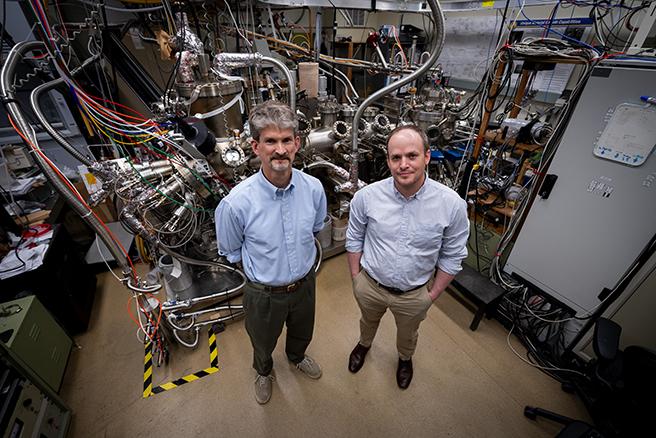
Credit: U.S. Navy photo by Jonathan Steffen

WASHINGTON — David Storm, a research physicist, and Tyler Growden, an electrical engineer, both with the U.S. Naval Research Laboratory, developed a new gallium nitride-based electrical component called a resonant tunneling diode (RTD) with performance beyond the anticipated speed of 5G.

The fifth-generation network technology is now just starting to roll out across the United States.

Storm and Growden’s electronic component diode research findings were published March 19, 2020 in the academic journal Applied Physics Letters.

“Our work showed that gallium nitride-based RTDs are not inherently slow, as others suggested,” Growden said. “They compare well in both frequency and output power to RTDs of different materials.”

The diodes enable extremely fast transport of electrons to take advantage of a phenomenon called quantum tunneling. In this tunneling, electrons create current by moving through physical barriers, taking advantage of their ability to behave as both particles and waves.

Storm and Growden’s design for gallium nitride-based diodes displayed record current outputs and switching speeds, enabling applications requiring electromagnetics in the millimeter-wave region and frequencies in terahertz. Such applications could include communications, networking, and sensing.

The team developed a repeatable process to increase the diodes yield to approximately 90%; previous typical yields range around 20%.

Storm said accomplishing a high yield of operational tunneling devices can be difficult because they require sharp interfaces at the atomic level and are very sensitive to many sources of scattering and leakage.

Sample preparation, uniform growth, and a controlled fabrication process at every step were the key elements to the diodes satisfactory results on a chip.

“Until now, gallium nitride was difficult to work with from a manufacturing perspective,” Storm said. “I hate to say it, but our high yield was as simple as falling off a log, and a lot of it was due to our design.”

Storm and Growden said they are committed to continue refining their RTD design to improve the current output without losing power potential. They performed their work along with colleagues at Ohio State University, Wright State University, as well as industry partners.

###

About the U.S. Naval Research Laboratory

NRL is a scientific and engineering command dedicated to research that drives innovative advances for the Navy and Marine Corps from the seafloor to space and in the information domain. NRL headquarters is located in Washington, D.C., with major field sites in Monterey, California; Key West, Florida; Stennis Space Center, Mississippi, and employs approximately 2,500 civilian scientists, engineers and support personnel.

Media Contact
J. Raynel Koch
[email protected]

Original Source

https://www.nrl.navy.mil/news/releases/nrl-researchers-create-electronic-diodes-beyond-5g-performance

Related Journal Article

http://dx.doi.org/10.1063/1.5139219

Tags: Electrical Engineering/ElectronicsInternetNanotechnology/MicromachinesResearch/DevelopmentSuperconductors/SemiconductorsTechnology/Engineering/Computer ScienceTelecommunications
Share13Tweet8Share2ShareShareShare2

Related Posts

New Post-Hoc Analysis Explores Daily Oral Orforglipron Use in Adults Over 65 with Obesity, Regardless of Diabetes Status

May 11, 2026

Evaluating Digoxin Use in Patients with Symptomatic Rheumatic Heart Disease

May 10, 2026

Evaluating the Effectiveness and Safety of Digitalis Glycosides in Treating Heart Failure

May 10, 2026

Urdu Fall Risk Questionnaire Adapted for Elderly

May 10, 2026
Please login to join discussion

POPULAR NEWS

  • Research Indicates Potential Connection Between Prenatal Medication Exposure and Elevated Autism Risk

    840 shares
    Share 336 Tweet 210
  • New Study Reveals Plants Can Detect the Sound of Rain

    727 shares
    Share 290 Tweet 181
  • Salmonella Haem Blocks Macrophages, Boosts Infection

    61 shares
    Share 24 Tweet 15
  • Breastmilk Balances E. coli and Beneficial Bacteria in Infant Gut Microbiomes

    57 shares
    Share 23 Tweet 14

About

We bring you the latest biotechnology news from best research centers and universities around the world. Check our website.

Follow us

Recent News

New Post-Hoc Analysis Explores Daily Oral Orforglipron Use in Adults Over 65 with Obesity, Regardless of Diabetes Status

Evaluating Digoxin Use in Patients with Symptomatic Rheumatic Heart Disease

Evaluating the Effectiveness and Safety of Digitalis Glycosides in Treating Heart Failure

Subscribe to Blog via Email

Enter your email address to subscribe to this blog and receive notifications of new posts by email.

Join 82 other subscribers
  • Contact Us

Bioengineer.org © Copyright 2023 All Rights Reserved.

Welcome Back!

Login to your account below

Forgotten Password?

Retrieve your password

Please enter your username or email address to reset your password.

Log In
No Result
View All Result
  • Homepages
    • Home Page 1
    • Home Page 2
  • News
  • National
  • Business
  • Health
  • Lifestyle
  • Science

Bioengineer.org © Copyright 2023 All Rights Reserved.