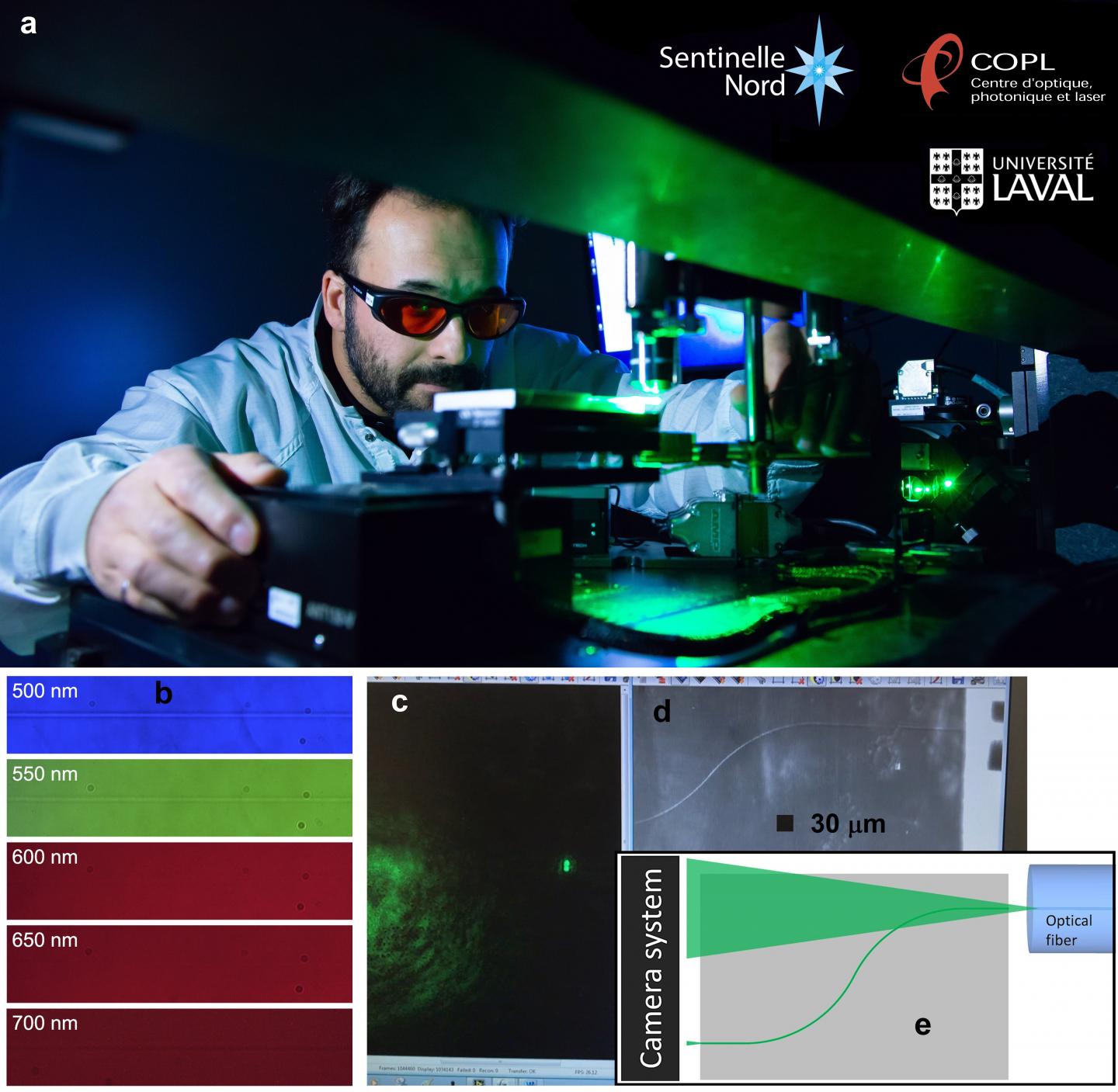
Credit: Jerome Lapointe, Jean-Philippe Bérubé, Yannick Ledemi, Albert Dupont, Vincent Fortin, Younes Messaddeq, and Réal Vallée
From compact biosensors and spectrometers to invisible devices and quantum computers, applications related to integrated photonics are increasingly sought after. As in optical fibres, guiding light in integrated photonic circuits is achieved by a local increase of the refractive index (RI) of the material. Ultrafast laser writing is the only technology that allows three-dimensional RI modification in transparent materials, thus the direct fabrication of 3D photonic devices. Following the first laser writing of photonic channels in glass in the late 90s, it was believed that the technology would quickly become the tool of choice for the manufacture of integrated photonics. However, despite numerous efforts, the magnitude of the laser-induced RI change remains limited, preventing the fabrication of compact devices with bendy optical channels which require high RI changes.
In a new paper published in Light: Science & Applications, Dr Jerome Lapointe from the Centre for Optics, Photonics and Lasers (COPL), Laval University, Canada and colleagues discovered a physical phenomenon related to the electronic resonance of laser processed materials which addresses the RI change issue. Using the new concept, the scientists demonstrated photonic channels with micron-size bending radii, which was not achieved in three dimensions before. The new technology has the potential to significantly miniaturize 3D photonics circuits, allowing denser integration of photonic applications on a same chip or increasing optical quantum computer capacity, for example. These scientists explain their discovery:
“We have discovered that femtosecond laser pulses can locally and permanently modify the electronic resonance of a material. By mathematical definition, the RI exponentially depends on the electronic resonance of the material as a function of light frequencies (or colors). We then demonstrated that photonic circuits could take advantage of this phenomenon in a transparent region of the material. In this region, the change in RI (which is the basis of the photonic circuits) can reach a very large positive value, which allows light guiding in miniaturized photonic circuits.”
“European scientists recently fabricated quantum computer components using laser writing. The quantum devices are 5 to 10 centimeters long. Our discovery suggests that the same quantum devices could be over 10 times smaller. This is very promising since the computing capacity of any computer is directly proportional to the quantity of components on a same chip.” they added.
Surprisingly, the scientists observed that the circuits are invisible when red light is shone through them. They found that the circuits become invisible for certain colors depending on the material and the laser writing conditions. The scientists explain the phenomenon using the same theory implying the electronic resonance variation. This new concept paves the way to invisible photonic applications, which could be placed on phone screens, car windshields, and industrial displays.
“We found that the positive RI change induced by the electronic resonance variation can exactly compensate the negative RI change induced by a structural expansion (both caused by the laser writing), resulting in a zero RI change for certain colors. To our knowledge, this is a new concept of direct fabrication of invisible structures. The beneficial combination of high RI change for operating frequencies and the invisibility for the rainbow frequencies may help to enable several invisible applications in phone screens, for example.” the scientists forecast.
###
Media Contact
Jerome Lapointe
[email protected]
Related Journal Article
http://dx.