Renowned physicist joins prestigious institution established in 1863
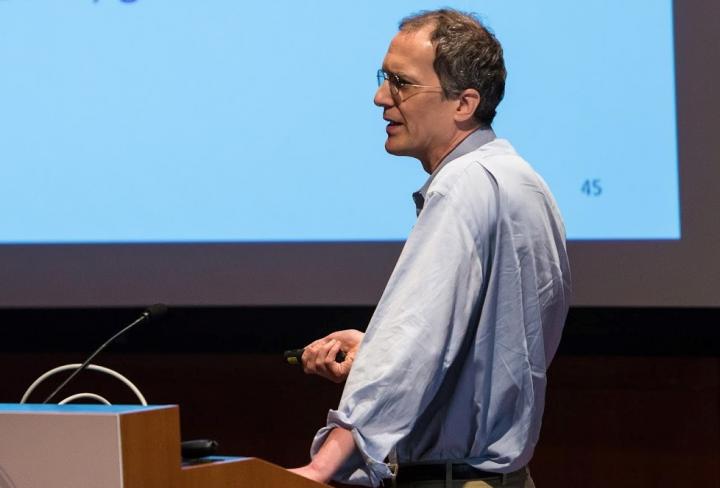
Credit: Dan Komoda/Institute for Advanced Study
Rutgers Professor Gregory W. Moore, a renowned physicist who seeks a unified understanding of the basic forces and fundamental particles in the universe, has been elected to the prestigious National Academy of Sciences.
Moore, Board of Governors Professor in the Department of Physics and Astronomy at Rutgers University-New Brunswick, joins 119 other new academy members and 26 international members this year who were recognized for their distinguished and ongoing achievements in original research.
“The Department of Physics and Astronomy is absolutely thrilled that Greg Moore has received this richly deserved honor. It is difficult to think of a more deserving person,” said Robert A. Bartynski, who chairs the department in the School of Arts and Sciences. “Greg is an internationally recognized mathematical physicist whose research focuses on the essential elements of string theory. He has won numerous awards and prizes in the fields of mathematics and theoretical physics. Election into the academy seems a natural extension of his exceptional accomplishments.”
String theory seeks to provide a coherent framework for the basic forces and fundamental particles in the universe. These include gravity, electromagnetism and forces responsible for the stability and decay of atomic nuclei.
“Greg is also an outstanding mentor to graduate students, postdocs and junior faculty members, an extraordinary teacher and a leading intellect in the Rutgers New High Energy Theory Center,” Bartynski said.
Scott Thomas, center director and a Distinguished Professor in the department, said: “Greg is a recognized leader in the field of physical mathematics that bridges theoretical physics and pure mathematics. He is well known for the high level of mathematical rigor he has developed in the study of theories with extra quantum dimensions of space-time known as supersymmetry. Among his many accomplishments is a proposal for a new phase of topological matter that someday may form the basis for computational elements of quantum computers.”
Moore received his bachelor’s degree in physics from Princeton University in 1982 and his doctorate in physics from Harvard University in 1985. He then joined the Harvard Society of Fellows and in 1987 became a five-year member at the Institute for Advanced Study in Princeton. He joined the Yale University faculty in 1989 and moved to the Rutgers Department of Physics and Astronomy in 2000. He has held visiting professorships at the Kavli Institute for Theoretical Physics at the University of California, Santa Barbara, and the Institute for Advanced Study.
Moore has written more than 200 papers on physical mathematics and string theory. He served as a general member of the Aspen Center for Physics from 2005 to 2015 and is a fellow of the American Mathematical Society. He received the 2014 Leonard Eisenbud Prize for Mathematics and Physics from the American Mathematical Society and the 2014 Dannie Heineman Prize for Mathematical Physics from the American Physical Society. In 2015, he shared the Dirac Medal from the Abdus Salam International Centre for Theoretical Physics with Caltech Professor Alexei Kitaev and Yale University Professor Nicholas Read.
###
The National Academy of Sciences – a private, nonprofit institution established through a congressional charter signed by President Abraham Lincoln in 1863 – has 2,403 active members and 501 non-voting international members who have citizenship outside the United States. The academy recognizes achievement in science by election to membership and – with the National Academy of Engineering and National Academy of Medicine – provides science, engineering and health policy advice to the federal government and other organizations.
Media Contact
Todd Bates
[email protected]
Original Source
https:/