• HOME
  • NEWS
  • EXPLORE
    • CAREER
      • Companies
      • Jobs
    • EVENTS
    • iGEM
      • News
      • Team
    • PHOTOS
    • VIDEO
    • WIKI
  • BLOG
  • COMMUNITY
    • FACEBOOK
    • INSTAGRAM
    • TWITTER
Thursday, December 25, 2025
BIOENGINEER.ORG
No Result
View All Result
  • Login
  • HOME
  • NEWS
  • EXPLORE
    • CAREER
      • Companies
      • Jobs
        • Lecturer
        • PhD Studentship
        • Postdoc
        • Research Assistant
    • EVENTS
    • iGEM
      • News
      • Team
    • PHOTOS
    • VIDEO
    • WIKI
  • BLOG
  • COMMUNITY
    • FACEBOOK
    • INSTAGRAM
    • TWITTER
  • HOME
  • NEWS
  • EXPLORE
    • CAREER
      • Companies
      • Jobs
        • Lecturer
        • PhD Studentship
        • Postdoc
        • Research Assistant
    • EVENTS
    • iGEM
      • News
      • Team
    • PHOTOS
    • VIDEO
    • WIKI
  • BLOG
  • COMMUNITY
    • FACEBOOK
    • INSTAGRAM
    • TWITTER
No Result
View All Result
Bioengineer.org
No Result
View All Result
Home NEWS Science News Chemistry

Screw cancer: Microneedle sticks it to cancer tissue

Bioengineer by Bioengineer
May 6, 2020
in Chemistry
Reading Time: 2 mins read
0
IMAGE
Share on FacebookShare on TwitterShare on LinkedinShare on RedditShare on Telegram

Scientists are finding safer ways to keep drug-loaded microrobots attached to cancer tissue
IMAGE

Credit: DGIST

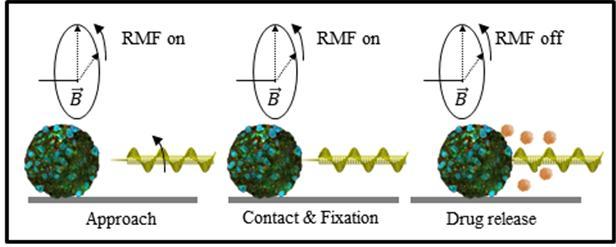
A drug-loaded microrobotic needle effectively targets and remains attached to cancerous tissue in lab experiments without needing continuous application of a magnetic field, allowing more precise drug delivery. The details were published by researchers at DGIST’s Microrobot Research Center in Korea and colleagues in the journal Advanced Healthcare Materials.

“Chemotherapeutic drugs cause a wide range of side effects due to their impacts on healthy and cancerous tissues,” explains robotics engineer Hongsoo Choi of Korea’s Daegu-Gyeongbuk Institute of Science & Technology (DGIST), who led the research. “To avoid these unwanted effects, scientists have been experimenting with microrobots of different shapes that deliver drugs to specific tissues.”

Drug-toting microrobots usually require a magnetic field to direct them to targeted tissues and then hold them in place, otherwise they are easily flushed away by body fluids such as blood flow. Choi and colleagues wanted to design a functional microrobot that avoids impractical and prolonged use of an energy-consuming magnetic field.

They succeeded by making a microrobot shaped like a corkscrew with a needle at its end.

Choi worked with DGIST’s Seungmin Lee and colleagues to fabricate the corkscrew-shaped microneedle using laser lithography. The microrobot is then layered with nickel and titanium oxide to ensure it can be magnetically manipulated and is biocompatible with the human body. Drugs can be loaded onto the porous, corkscrew-shaped scaffold and inside the needle.

The team tested the microrobots in tiny chambers filled with fluid. They successfully used a magnetic field to direct them to spear and attach to tissue. Once fixed, it took a fluid flow speed of 480 millimetres per second to flush the needle out of the tissue. For comparison, the flow rate in small arterioles is around 100 millimetres per second.

They then used a computational approach for more precise automatic, rather than manual, targeting of tissue using a magnetic field. Automatic targeting and fixation took only seven seconds, whereas manual control of the magnetic field took 55 seconds.

Finally, they loaded the microneedles with the anticancer drug paclitaxel and tested them in a microchamber containing human colorectal cancer cells. The microrobots effectively targeted and killed the cells.

Next, the team plans to improve the microrobot for more efficient drug loading and to optimize the magnetic field system for more precise control. Further tests in animals and then human trials will be needed before the microrobots can be used as a treatment strategy.

###

Media Contact
Kwanghoon Choi
[email protected]

Original Source

https://dgist.ac.kr/en/html/sub06/060202.html

Related Journal Article

http://dx.doi.org/10.1002/adhm.201901697

Tags: Nanotechnology/MicromachinesRobotry/Artificial IntelligenceTechnology/Engineering/Computer Science
Share12Tweet8Share2ShareShareShare2

Related Posts

Cutting Electrolyte Reduction Boosts High-Energy Battery Performance

Cutting Electrolyte Reduction Boosts High-Energy Battery Performance

December 19, 2025
Microenvironment Shapes Gold-Catalysed CO2 Electroreduction

Microenvironment Shapes Gold-Catalysed CO2 Electroreduction

December 11, 2025

Photoswitchable Olefins Enable Controlled Polymerization

December 11, 2025

Cation Hydration Entropy Controls Chloride Ion Diffusion

December 10, 2025
Please login to join discussion

POPULAR NEWS

  • Nurses’ Views on Online Learning: Effects on Performance

    Nurses’ Views on Online Learning: Effects on Performance

    70 shares
    Share 28 Tweet 18
  • NSF funds machine-learning research at UNO and UNL to study energy requirements of walking in older adults

    71 shares
    Share 28 Tweet 18
  • Unraveling Levofloxacin’s Impact on Brain Function

    54 shares
    Share 22 Tweet 14
  • Exploring Audiology Accessibility in Johannesburg, South Africa

    51 shares
    Share 20 Tweet 13

About

We bring you the latest biotechnology news from best research centers and universities around the world. Check our website.

Follow us

Recent News

Genes, Environment Shape Weight Gain Across Lifespan

Engineered Vesicles Boost Oral Antibiotic Efficiency, Gut Health

MEI1 Variants Linked to Female Infertility and Embryo Issues

Subscribe to Blog via Email

Enter your email address to subscribe to this blog and receive notifications of new posts by email.

Join 70 other subscribers
  • Contact Us

Bioengineer.org © Copyright 2023 All Rights Reserved.

Welcome Back!

Login to your account below

Forgotten Password?

Retrieve your password

Please enter your username or email address to reset your password.

Log In
No Result
View All Result
  • Homepages
    • Home Page 1
    • Home Page 2
  • News
  • National
  • Business
  • Health
  • Lifestyle
  • Science

Bioengineer.org © Copyright 2023 All Rights Reserved.