Toward applications in next-generation wireless communications
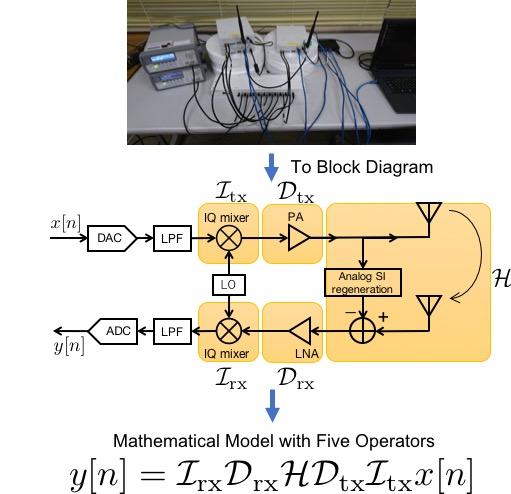
Credit: COPYRIGHT (C) TOYOHASHI UNIVERSITY OF TECHNOLOGY. ALL RIGHTS RESERVED.
Overview
The research team of Assistant Professor Miyaji of the Department of Electrical and Electronic Information Engineering at Toyohashi University of Technology has developed a self-interference cancellation filter that is indispensable for the realization of in-band full duplex using the same frequency to transmit and receive simultaneously in wireless communications. The developed self-interference cancellation filter can estimate the distortion caused by radio and the distortion of the radio channel with high accuracy and cancel self-interference. In addition, it can quickly reach the solution of the filter with low computational complexity. It is expected to be applied to next-generation wireless communication technology.
Details
In wireless communications, simultaneous transmission and reception using the same frequency (in-band full duplex) is a very difficult task. Even in the latest wireless communication standard 5G, this in-band full duplex has not been realized. Currently, it is necessary to divide the time when transmitting and receiving at the same frequency, or to divide the frequency when transmitting and receiving at the same time. It is necessary to separate one of them (time or frequency) because the strength of the radio wave that it emits is up to several hundred million times greater than the strength of the radio wave to receive (self-interference).
The filters considering multiple distortions that have been developed so far remove the self-interference with high precision, but also require high computational complexity and take a long time to obtain the solution of the filter. Therefore, the research team of Assistant Professor Miyaji worked on the development of a self-interference cancellation filter that simultaneously satisfies the conditions of high precision, high speed, and low computational complexity.
The first author, Kazuki Komatsu, in the doctoral program (JSPS Research Fellow), explains, “Compared to base stations, low-cost radios such as smartphones have complex distortions, and self-interference cancellation in such devices is a very difficult problem. To solve a complex problem, it is important to boil the problem down to an essence and break it down into multiple smaller problems. We have decomposed the problem of self-interference cancellation due to the complex distortion of radio equipment into five small problems and expressed each using mathematical operators. As a result, it was clarified that the solution method of each small problem and the solution method of the big problem which connected them could be derived using five operators and their inverse operators. By applying the derived solution to a filter, we were able to cancel self-interference with higher precision, higher speed, and lower computational complexity than before. The developed filter increases the feasibility of in-band full-duplex communications in small and inexpensive radios such as smartphones.”
Future outlook
The research team is planning theoretical performance analysis and field evaluation of the developed self-interference cancellation filter. They also believe that by using the developed filter, it can be applied to wireless networks that cooperate with small mobile objects such as drones. Since it is necessary to recreate the filters periodically according to changes in the radio environment due to movement, we can expect contributions from this technology, which has the features of high precision, high speed, and low calculation complexity.
###
Reference
Kazuki Komatsu, Yuichi Miyaji, and Hideyuki Uehara (2020). Iterative Nonlinear Self-Interference Cancellation for In-Band Full-Duplex Wireless Communications Under Mixer Imbalance and Amplifier Nonlinearity,
IEEE Transactions on Wireless Communications, 10.1109/TWC.2020.2983407.
Funding agency
Hoso Bunka Foundation and Japan Society for the Promotion of Science (JSPS) KAKENHI (JP18K04138, JP19K14979, and JP19J12727).
Media Contact
Yuko Ito
[email protected]
Related Journal Article
http://dx.