• HOME
  • NEWS
  • EXPLORE
    • CAREER
      • Companies
      • Jobs
    • EVENTS
    • iGEM
      • News
      • Team
    • PHOTOS
    • VIDEO
    • WIKI
  • BLOG
  • COMMUNITY
    • FACEBOOK
    • INSTAGRAM
    • TWITTER
Thursday, July 30, 2026
BIOENGINEER.ORG
No Result
View All Result
  • Login
  • HOME
  • NEWS
  • EXPLORE
    • CAREER
      • Companies
      • Jobs
        • Lecturer
        • PhD Studentship
        • Postdoc
        • Research Assistant
    • EVENTS
    • iGEM
      • News
      • Team
    • PHOTOS
    • VIDEO
    • WIKI
  • BLOG
  • COMMUNITY
    • FACEBOOK
    • INSTAGRAM
    • TWITTER
  • HOME
  • NEWS
  • EXPLORE
    • CAREER
      • Companies
      • Jobs
        • Lecturer
        • PhD Studentship
        • Postdoc
        • Research Assistant
    • EVENTS
    • iGEM
      • News
      • Team
    • PHOTOS
    • VIDEO
    • WIKI
  • BLOG
  • COMMUNITY
    • FACEBOOK
    • INSTAGRAM
    • TWITTER
No Result
View All Result
Bioengineer.org
No Result
View All Result
Home NEWS Science News Chemistry

KIST develops high-performance ceramic fuel cell that operates on butane gas

Bioengineer by Bioengineer
April 27, 2020
in Chemistry
Reading Time: 3 mins read
0
IMAGE
Share on FacebookShare on TwitterShare on LinkedinShare on RedditShare on Telegram

Thin-film catalyst incorporation enables high-performance over butane fuel at 600°C or below. The technology considerably widens the application range of ceramic fuel cells that use portable fuel.
IMAGE

Credit: Korea Institute of Science and Technology (KIST)

A Korean research team has developed a high-performance ceramic fuel cell that can operate on butane fuels. Since butane can be liquified and thus can be stored and carried easily, the new technology is expected to expand the application range of ceramic fuel cells to portable and mobile applications such as electric cars, robots and drones. Previously, ceramic fuel cells had only been considered for application to large-capacity power generation systems due to their high-temperature operation.

The Korea Institute of Science and Technology (KIST, https://www.nst.re.kr/nst_en/member/03_02.jsp) announced that Dr. Son Ji-Won’s research team at KIST’s Center for Energy Materials Research had developed a high-performance, thin-film-based ceramic fuel cell that could operate at mid-to-low temperatures below 600 °C using butane fuels.

Ceramic fuel cells are a type of high-temperature fuel cell that operates over 800 ?. This high temperature allows the use of inexpensive catalysts, such as nickel, in contrast to low-temperature fuel cells, such as polymer electrolyte fuel cells, which use high-priced platinum catalysts to supplement their low catalytic activity. Another major advantage of high-temperature fuel cells is that they can various fuels other than pure hydrogen, such as LPG and LNG with low emission due to high efficiency. However, ironically, even though high-temperature fuel cells use inexpensive catalysts, their operation requires expensive refractory materials and manufacturing technologies. Another limiting factor is that their system on-off process takes a long time due to the characteristics of high-temperature operation, which restrict their application to large-scale stationary power generation systems.

Many research teams around the world have worked on thin-film-based ceramic fuel cells, which can operate at low temperatures without performance loss. Unfortunately, the problem is that lower-temperature operation causes ceramic fuel cells to lose one of their important advantages, that is, their ability to use various fuels. When the nickel catalyst of ceramic fuel cells is used with hydrocarbon fuels, such as methane, propane, and butane, the carbon generated during fuel conversion is deposited on the surface of nickel. This worsens seriously as the temperature lowers, leading to the failure of the cell operation.

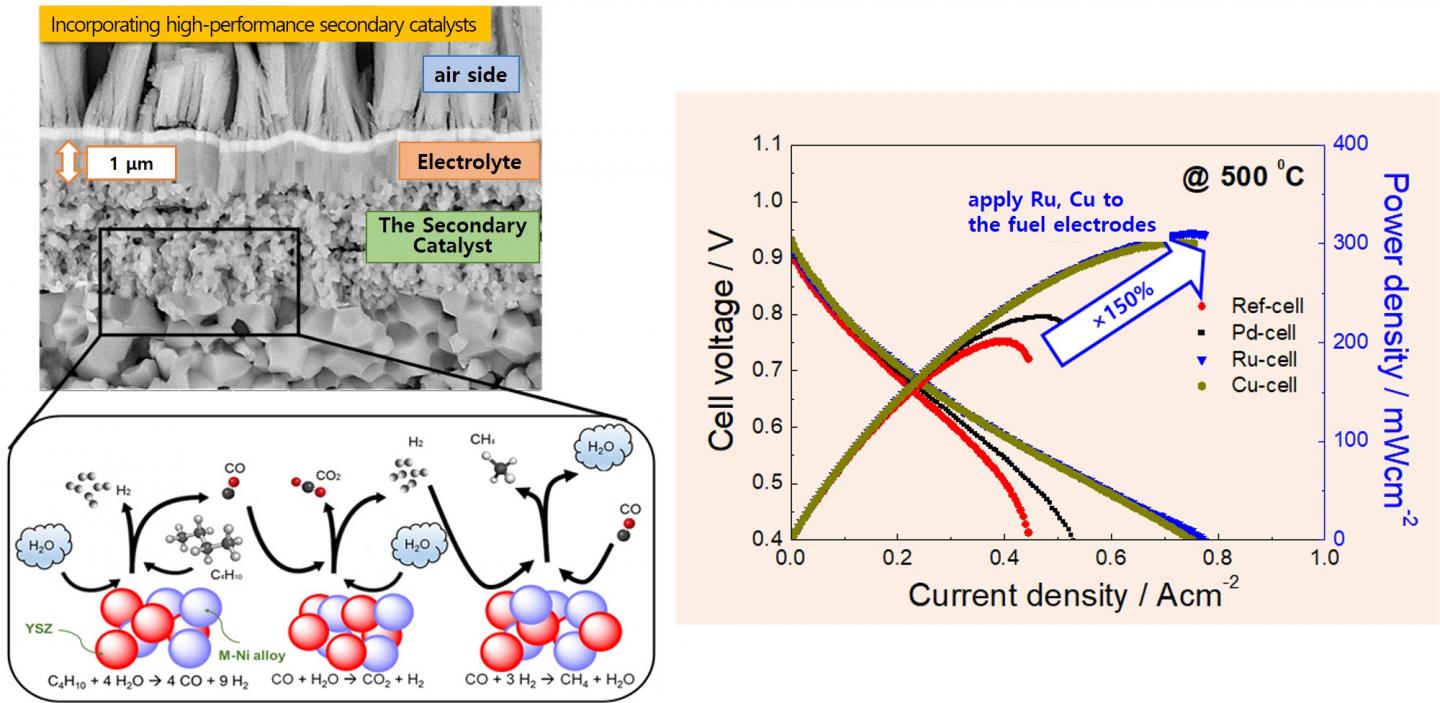
Dr. Son Ji-Won’s research team solved this problem by incorporating high-performance secondary catalysts, which can convert fuels more easily, by thin-film technology. Using alternating deposition of the secondary catalyst and the main catalyst layers, the team was able to effectively distribute the secondary catalyst at the nearliest parts of the fuel electrodes to the electrolyte. By this way, controlled incorporation of small amount but effectively positioned secondary catalysts was possible.

Using this procedure, the KIST research team was able to successfully apply secondary catalysts known for their high catalytic activity at low temperatures, such as palladium (Pd), ruthenium (Ru), and copper (Cu), to the nano-structure fuel electrodes. They confirmed the high-performance operation of the newly developed thin-film-based ceramic fuel cells at mid and low operation temperatures (500-600 ?), using butane fuel, which is a very affordable fuel.

“This research systematically examined the possible uses of hydrocarbon fuels in ceramic fuel cells operating at low temperatures,” said Dr. Son Ji-won. “The use of the portable fuels like butane at lower operating temperatures would enable the development of smaller and integrated ceramic fuel cell systems, which can be applied to portable and mobile power sources.”

###

The research was supported by Korea’s Ministry of Science and ICT (https://english.msit.go.kr/english/main/main.do), and conducted as parts of projects on KIST’s Future Fundamental Technology, Global Frontier Multiscale Energy Systems, and Climate Change Solutions. An article explaining the results of the research was published in the latest issue of Applied Catalysis B – Environmental, an international journal on environmental and chemical engineering (IF: 14.229, top 0.962% of JCR).

Media Contact
Kim, Do-Hyun
[email protected]

Related Journal Article

http://dx.doi.org/10.1016/j.apcatb.2019.118349

Tags: Chemistry/Physics/Materials Sciences
Share12Tweet8Share2ShareShareShare2

Related Posts

Shaping light like never before – with photonic time crystals

Shaping light like never before – with photonic time crystals

July 30, 2026
Sensing-storage monolithically integrated system for wearable physiological sensing

Sensing-storage monolithically integrated system for wearable physiological sensing

July 30, 2026

Thermal engineering of ZnMgO enables high-reliability and long-lifetime quantum dot light-emitting diodes

July 30, 2026

Realization of an atom-holography microscope for direct visualization of three-dimensional atomic arrangements in nanoscale regions

July 30, 2026
Please login to join discussion

POPULAR NEWS

  • Lanthanide carriers can enhance biomedical imaging and combined diagnosis and treatment approaches

    29 shares
    Share 12 Tweet 7
  • New strategy for controlling hypertension

    29 shares
    Share 12 Tweet 7
  • Amazonian ‘zombie’ fungus harbors a hidden stage inside forest mosses, new study reveals

    29 shares
    Share 12 Tweet 7
  • Associations between opioid exposure and brain size among extremely preterm infants

    29 shares
    Share 12 Tweet 7

About

We bring you the latest biotechnology news from best research centers and universities around the world. Check our website.

Follow us

Recent News

Lanthanide carriers can enhance biomedical imaging and combined diagnosis and treatment approaches

New strategy for controlling hypertension

Amazonian ‘zombie’ fungus harbors a hidden stage inside forest mosses, new study reveals

Subscribe to Blog via Email

Enter your email address to subscribe to this blog and receive notifications of new posts by email.

Join 85 other subscribers
  • Contact Us

Bioengineer.org © Copyright 2023 All Rights Reserved.

Welcome Back!

Login to your account below

Forgotten Password?

Retrieve your password

Please enter your username or email address to reset your password.

Log In
No Result
View All Result
  • Homepages
    • Home Page 1
    • Home Page 2
  • News
  • National
  • Business
  • Health
  • Lifestyle
  • Science

Bioengineer.org © Copyright 2023 All Rights Reserved.