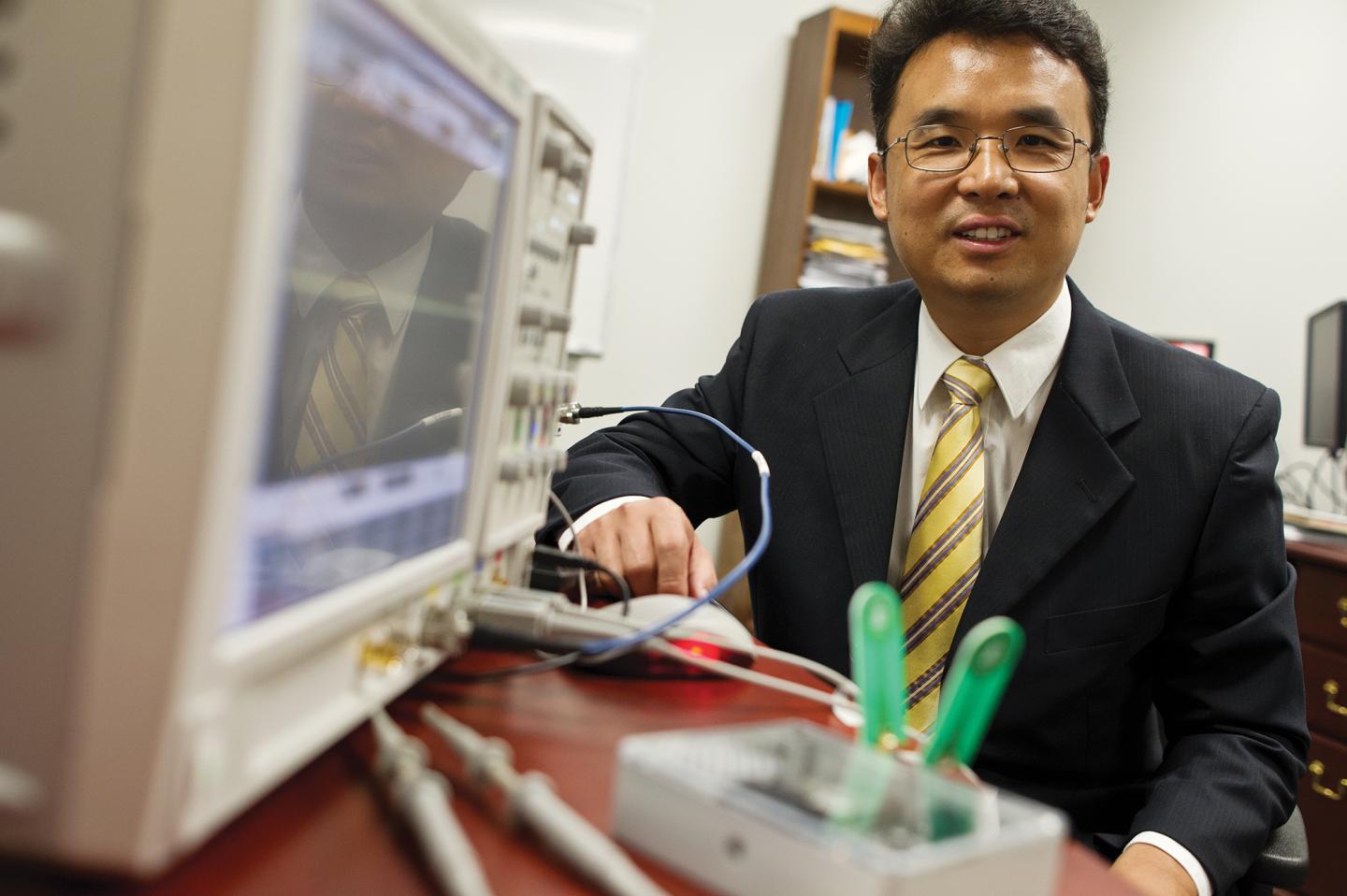
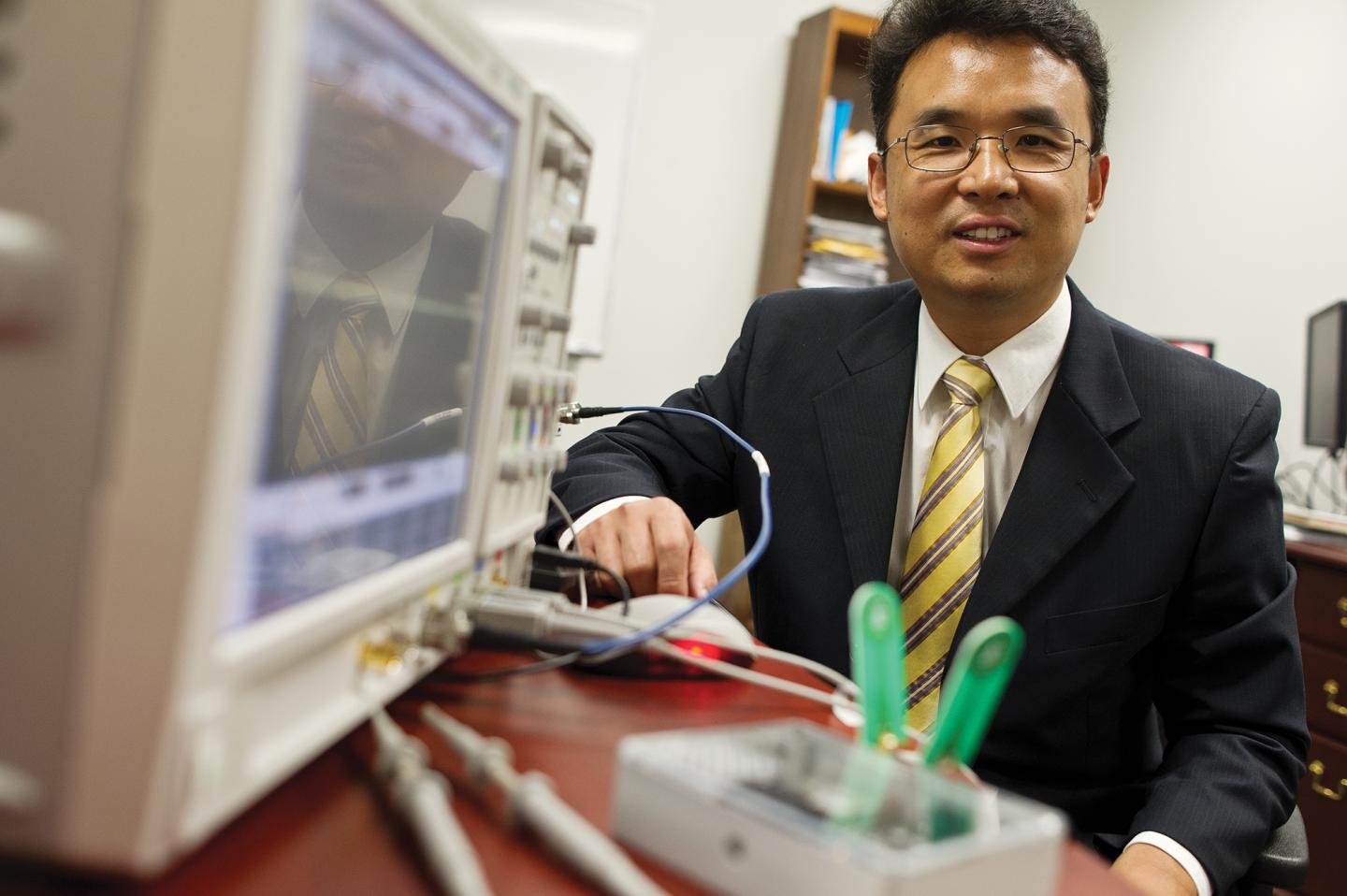
Credit: UT Arlington
Qilian Liang, a professor in the Electrical Engineering Department at The University of Texas at Arlington, has been named a Fellow of the Institute of Electrical and Electronics Engineers.
In its letter informing Liang of his honor, IEEE's Board of Directors cited his "contributions to interval type-2 fuzzy logic systems."
Fuzzy logic is aimed at efficient computing methods that are tolerant of imprecise inputs, much like a human decision-making process where not all answers are as simple as yes or no, or true or false. Examples include thermostats for home heating and cooling and automatic transmission systems in vehicles.
In addition to fuzzy logic, Liang is an expert in radar and wireless sensor networks, wireless communications, compressive sensing, smart grids and signal processing for communications.
Liang joined UTA as an assistant professor in 2002. He was promoted to associate professor in 2008 and became a full professor in 2011. He received an Office of Naval Research Young Investigator Award in 2003 to develop a fuzzy logic system for wireless sensor networks and has earned grants totaling $6 million in his career.
"It is a great honor to be elevated to Fellow status. It recognizes my body of work and my contributions to the field. I hope more colleagues from UTA will join this group in the near future," Liang said.
Liang has made great contributions to knowledge and use of fuzzy logic systems. He established the theoretical foundation of Interval Type-2 systems, which use simpler mathematics and allow uncertainties to be quantified, and he widely expanded the use of fuzzy controllers in signal processing and digital communication applications. His work has led to applications in military product development and knowledge processing and threat assessment within sensor networks.
Liang has published more than 280 journal and conference papers and seven book chapters, and has several patents pending. His work is an example of UTA's focus on data-driven discovery as part of the Strategic Plan 2020: Bold Solutions | Global Impact.
"Being named an IEEE Fellow is a great honor, and Dr. Liang is a truly deserving recipient. His research into fuzzy logic systems has been recognized by his peers worldwide as groundbreaking and this new status bestowed upon Dr. Liang is clear recognition of this," said Peter E. Crouch, dean of the College of Engineering and an IEEE Fellow. "It is the hard work, dedication and peer recognition of faculty like Dr. Liang that helps the College of Engineering grow in stature and meet the goals of the College and the University."
Liang is the 11th current College of Engineering professor to be honored as an IEEE Fellow. Zeynep Çelik-Butler, Crouch, George Kondraske, Wei-Jen Lee, Frank Lewis, Robert Magnusson and K.R. Rao (electrical engineering), Ishfaq Ahmad, Bill Carroll and Hong Jiang (computer science and engineering), and Khosrow Behbehani (bioengineering) also are IEEE fellows. Purnendu "Sandy" Dasgupta, UTA's Jenkins Garrett Professor of Chemistry, also was named a IEEE Fellow.
IEEE is the world's largest technical professional organization dedicated to advancing technology for the benefit of humanity. It has more than 421,000 members in more than 160 countries and is a leading developer of international standards that are the basis of many telecommunications, information technology, and power-generation products and services. IEEE and its members inspire a global community through its highly cited publications, conferences, technology standards, and professional and educational activities.
Fewer than one-tenth of 1 percent of IEEE members worldwide are selected as Fellows in any year. Fellow status is awarded to individuals who have "an extraordinary record of accomplishments in any of the IEEE fields of interest."
###
About The University of Texas at Arlington
The University of Texas at Arlington is a Carnegie Research-1 "highest research activity" institution of about 55,000 students in campus-based and online degree programs and is the second-largest institution in The University of Texas System. U.S. News & World Report ranks UTA fifth in the nation for undergraduate diversity. The University is a Hispanic-Serving Institution and is ranked as the top four-year college in Texas for veterans on Military Times' 2016 Best for Vets list. Visit http://www.uta.edu to learn more, and find UTA rankings and recognition at http://www.uta.edu/uta/about/rankings.php. For more on the Strategic Plan, see Strategic Plan 2020: Bold Solutions | Global Impact.
Media Contact
Herb Booth
[email protected]
817-272-7075
@utarlington
http://www.uta.edu
############
Story Source: Materials provided by Scienmag