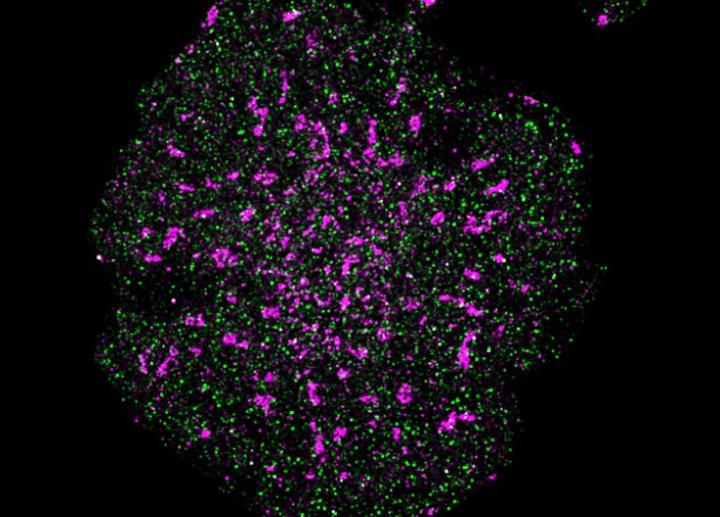
Credit: Single Molecule Science, UNSW Sydney
UNSW medical researchers have achieved unprecedented resolution capabilities in single-molecule microscopy to detect interactions between individual molecules within intact cells.
The 2014 Nobel Prize in Chemistry was awarded for the development of super-resolution fluorescence microscopy technology that afforded microscopists the first molecular view inside cells, a capability that has provided new molecular perspectives on complex biological systems and processes.
Now the limit of detection of single-molecule microscopes has been smashed again, and the details are published in the current issue of Science Advances.
While individual molecules could be observed and tracked with super-resolution microscopy already, interactions between these molecules occur at a scale at least four times smaller than that resolved by existing single-molecule microscopes.
“The reason why the localisation precision of single-molecule microscopes is around 20-30 nanometres normally is because the microscope actually moves while we’re detecting that signal. This leads to an uncertainty. With the existing super-resolution instruments, we can’t tell whether or not one protein is bound to another protein because the distance between them is shorter than the uncertainty of their positions,” says Scientia Professor Katharina Gaus, research team leader and Head of UNSW Medicine’s EMBL Australia Node in Single Molecule Science.
To circumvent this problem, the team built autonomous feedback loops inside a single-molecule microscope that detects and re-aligns the optical path and stage.
“It doesn’t matter what you do to this microscope, it basically finds its way back with precision under a nanometre. It’s a smart microscope. It does all the things that an operator or a service engineer needs to do, and it does that 12 times per second,” says Professor Gaus.
Measuring the distance between proteins
With the design and methods outlined in the paper, the feedback system designed by the UNSW team is compatible with existing microscopes and affords maximum flexibility for sample preparation.
“It’s a really simple and elegant solution to a major imaging problem. We just built a microscope within a microscope, and all it does is align the main microscope. That the solution we found is simple and practical is a real strength as it would allow easy cloning of the system, and rapid uptake of the new technology,” says Professor Gaus.
To demonstrate the utility of their ultra-precise feedback single-molecule microscope, the researchers used it to perform direct distance measurements between signalling proteins in T cells. A popular hypothesis in cellular immunology is that these immune cells remain in a resting state when the T cell receptor is next to another molecule that acts as a brake.
Their high precision microscope was able to show that these two signalling molecules are in fact further separated from each other in activated T cells, releasing the brake and switching on T cell receptor signalling.
“Conventional microscopy techniques would not be able to accurately measure such a small change as the distance between these signalling molecules in resting T cells and in activated T cells only differed by 4-7 nanometres,” says Professor Gaus.
“This also shows how sensitive these signalling machineries are to spatial segregation. In order to identify regulatory processes like these, we need to perform precise distance measurements, and that is what this microscope enables. These results illustrate the potential of this technology for discoveries that could not be made by any other means.”
Postdoctoral researcher, Dr Simao Pereira Coelho, together with PhD student Jongho Baek – who has since been awarded his PhD degree – led the design, development, and building of this system. Dr Baek also received the Dean’s Award for Outstanding PhD Thesis for this work.
###
Media Contact
Isabelle Dubach
[email protected]
Original Source
https:/
Related Journal Article
http://dx.