New chemical tools can control the concentration of lipids in living cells
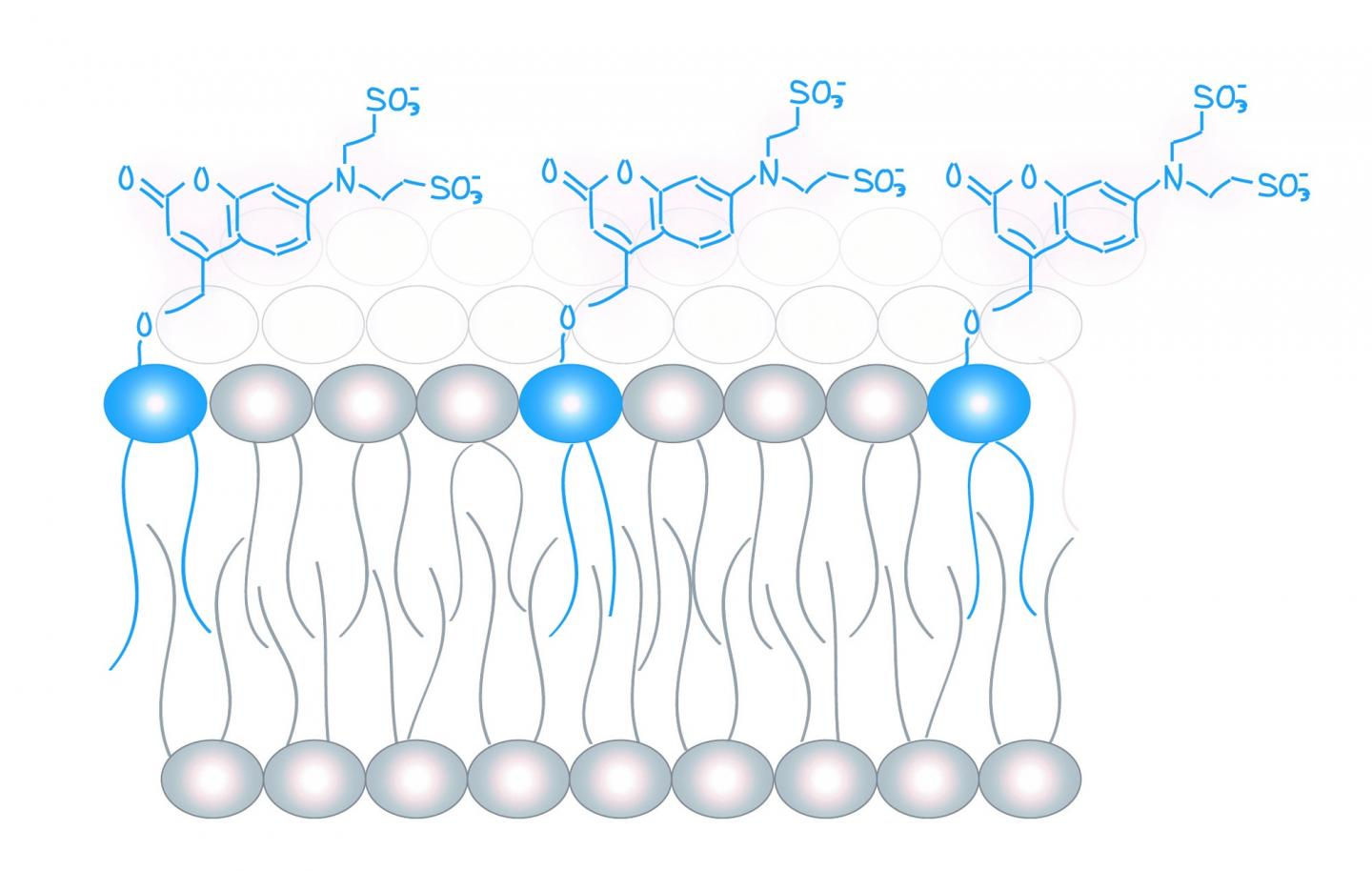
Credit: Schuhmacher et al., MPI-CBG
Lipids, or fats, have many functions in our body: They form membrane barriers, store energy or act as messengers, which regulate cell growth and hormone release. Many of them are also biomarkers for severe diseases. So far, it has been very difficult to analyze the functions of these molecules in living cells. Researchers at the Max Planck Institute of Molecular Cell Biology and Genetics (MPI-CBG) in Dresden and the Leibniz Research Institute for Molecular Pharmacology (FMP) in Berlin have now developed chemical tools that can be activated by light and used to influence lipid concentration in living cells. This approach could enable medical doctors to work with biochemists to identify what molecules within a cell actually do. The study was published in the journal PNAS.
Every cell can create thousands of different lipids (fats). However, little is known how this chemical lipid diversity contributes to the transport of messages within the cell, in other words, the lipid code of the cell is still unknown. This is mainly due to the lack of methods to quantitatively study lipid function in living cells. An understanding of how lipids work is very important because they control the function of proteins throughout the cell and are involved in bringing important substances into the cell through the cell membrane. In this process it is fascinating that only a limited number of lipid classes on the inside of the cell membrane act as messenger molecules, but they receive messages from thousands of different receptor proteins. It is still not clear, how this abundance of messages can still be easily recognized and transmitted.
The research groups led by André Nadler at the MPI-CBG and Alexander Walter at the FMP, in collaboration with the TU Dresden, have developed chemical tools to control the concentration of lipids in living cells. These tools can be activated by light. Milena Schuhmacher, the lead author of the study, explains: “Lipids are actually not individual molecular structures, but differ in tiny chemical details. For example, some have longer fatty acid chains and some have slightly shorter ones. Using sophisticated microscopy in living cells and mathematical modelling approaches, we were able to show that the cells are actually able to recognize these tiny changes through special effector proteins and thus possibly use them to transmit information. It was important that we were able to control exactly how much of each individual lipid was involved.” André Nadler, who supervised the study, adds: “These results indicate the existence of a lipid code that cells use to re-encode information, detected on the outside of the cell, on the inner side of the cell.”
The results of the study could enable membrane biophysicists and lipid biochemists to verify their results with quantitative data from living cells. André Nadler adds: “Clinicians could also benefit from our newly developed method. In diseases such as diabetes and high blood pressure, more lipids that act as biomarkers are found in the blood. This can be visualized with a lipid profile. With the help of our method, doctors could now see exactly what the lipids are doing in the body. That wasn’t possible before.”
###
Media Contact
Dr. Alexander M. Walter
[email protected]
Original Source
https:/
Related Journal Article
http://dx.