A new computer model may shed a light on why some animals show warning colors when they are about to be attacked
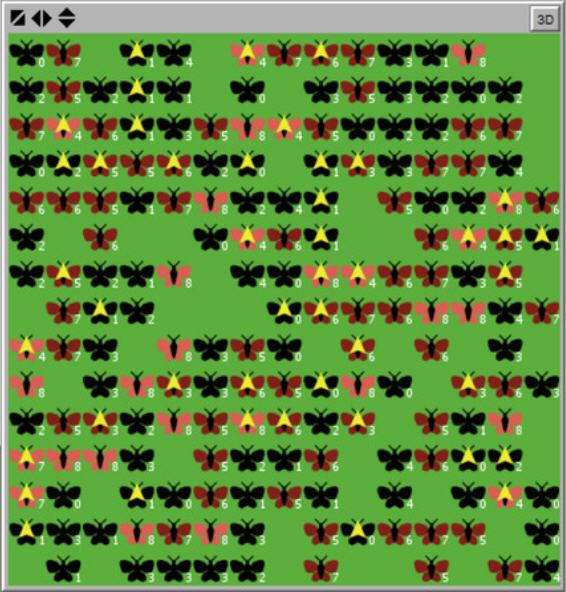
Credit: Song W., Lee SI, Jablonski PG.
Scientists have understood quite well why so many poisonous or distasteful animals have brightly colored bodies – the colors send a message to the predators: “don’t eat me, or you’ll get sick and die.” These permanent warning signals became textbook examples of “aposematism”: use of conspicuous signals to warn predators. But not all animals show their warning colors all the time. Some toxic animals actually hide the warning colors, showing them only at the very last moment when they are about to be attacked (thus called “switchable aposematism”). Also, some other prey animals never advertise their distastefulness and defend themselves after attack only by chemicals creating a perception of bad taste in the predators. Scientists do not fully understand the reasons for such a diversity of prey behaviors.
In a recent report in PeerJ, a Korean-Polish team composed of Woncheol Song and Piotr Jablonski from the Seoul National University and Polish Academy of Sciences, and Sang-im Lee from DGIST, has presented the first comprehensive computer simulation (ApoSim) to understand the evolution of the diversity of warning signals. The ApoSim model interface was built within a user friendly NetLogo framework and it can be used by anyone interested in simulation of biological evolution. A you tube video shows an example of how changing the predator learning speed may change the evolutionary outcome.
According to Dr. Woncheol Song, evolutionary biologists have paid disproportionate attention to the permanent aposematism. “It is relatively easy to understand why poison dart frogs have yellow color, giant hornets have bright orange-and-black stripes, etc. These animals gain the benefits of constantly warning the predators to avoid being eaten, but also increase the chance of detection by predators that are not deterred by the poison. However, when prey have choices to either show or hide the warning signal and of when to do it, it is not a simple matter. You need to weigh the costs and benefits of how and when to present the warning signals,” points out Dr. Song.
The integration of the extremely diverse forms of animal behavior into one framework was not easy. “A praying mantis posturing to strike, a rattlesnake producing the alarm sound, a ladybug releasing foul-odored hemolymph, a cuttlefish flashing like a neon-sign, and a skunk raising its striped tail – their messages are all the same, to tell you stay away from them. But they are also different from each other in countless ways. However, if you want to conduct theoretical studies with them, you have to put them in the same formula. It is like doing sums of apples and oranges while convincing other scientists that it is a good idea,” Dr. Song recalls the difficulty of model-building process. The researchers considered energy costs, timing, anatomy and physiology, detectability, memorability, and many other properties of prey aposematic behaviors, as well as predators’ learning processes. Finally, the authors successfully created a simplified artificial digital world that reasonably captures the diversity of permanent and switchable aposematism, and can be used by anybody without prior programming experience.
The model was run over 88 thousand times in order to find out which aposematic behavior is the best depending on how fast the predators are learning, how high is the proportion of predators that have not yet learned to avoid the defended prey, how easy it is to detect a prey, how easy it is to detect a prey after the warning is displayed and the signal intensity is increased, how hard it is for the prey to develop and keep the ability to switch signals. The outcome of the simulations brought new discoveries as well as confirmed some of the already existing ideas. For example, one may argue that there are multiple types of predators in the ecosystem. If some predators are not deterred by the warning and attack the prey anyway, the prey may be better protected by withholding the warning to avoid detection by those predators. This is but one simple example that can be visualized and understood by using the new model.
“We have not only demonstrated that the predator mix can drive the evolution of switchable aposematism, but we have also evaluated several other equally-compelling hypotheses, all of them interacting in a five-dimensional parameter space defined by properties of prey and predators. There have been many ideas published since the time of Darwin, but only a few of them have been thoroughly examined. Now, each of them can be explored in the digital world provided in this model, and the model results can be integrated with findings made in nature, like the recent studies conducted by us on the spotted lanternfly [https:/
###
Media Contact
Woncheol Song
[email protected]
Related Journal Article
http://dx.