• HOME
  • NEWS
  • EXPLORE
    • CAREER
      • Companies
      • Jobs
    • EVENTS
    • iGEM
      • News
      • Team
    • PHOTOS
    • VIDEO
    • WIKI
  • BLOG
  • COMMUNITY
    • FACEBOOK
    • INSTAGRAM
    • TWITTER
Saturday, February 7, 2026
BIOENGINEER.ORG
No Result
View All Result
  • Login
  • HOME
  • NEWS
  • EXPLORE
    • CAREER
      • Companies
      • Jobs
        • Lecturer
        • PhD Studentship
        • Postdoc
        • Research Assistant
    • EVENTS
    • iGEM
      • News
      • Team
    • PHOTOS
    • VIDEO
    • WIKI
  • BLOG
  • COMMUNITY
    • FACEBOOK
    • INSTAGRAM
    • TWITTER
  • HOME
  • NEWS
  • EXPLORE
    • CAREER
      • Companies
      • Jobs
        • Lecturer
        • PhD Studentship
        • Postdoc
        • Research Assistant
    • EVENTS
    • iGEM
      • News
      • Team
    • PHOTOS
    • VIDEO
    • WIKI
  • BLOG
  • COMMUNITY
    • FACEBOOK
    • INSTAGRAM
    • TWITTER
No Result
View All Result
Bioengineer.org
No Result
View All Result
Home NEWS Science News Chemistry

Construction of sintering resistant Pt based catalyst based on ‘composite energy well’ model

Bioengineer by Bioengineer
April 10, 2020
in Chemistry
Reading Time: 2 mins read
0
IMAGE
Share on FacebookShare on TwitterShare on LinkedinShare on RedditShare on Telegram

IMAGE

Credit: ©Science China Press

Nano-catalysts usually have higher catalytic activity than traditional bulk catalysts. And it is widely acknowledged that the smaller the particle size of the active component is, the higher the activity would be. However, the active component with small size tends to agglomerate or further grow into large particles. Many reaction processes, such as hydrocarbon cracking and combustion, methane dry/wet reforming and automobile exhaust gas purification, have to be operated at very high temperatures, it will lead to the decreasing of activity and product selectivity due to sintering at high temperatures, ultimately limits the practical application of nano-catalysts. Many researchers believe that the sintering of nanoparticles involves two processes: one is the ripening process, single atom or molecular species move from one particle to another; the other is the migration process, whole particles grow into large particles after migration and aggregation. Because the ripening process can hardly be avoided at high temperature, the current strategy to improve the stability of nano-catalysts is to inhibit the migration of nanoparticles on the basis of “confinement effect” or to construct a “migration barrier”.

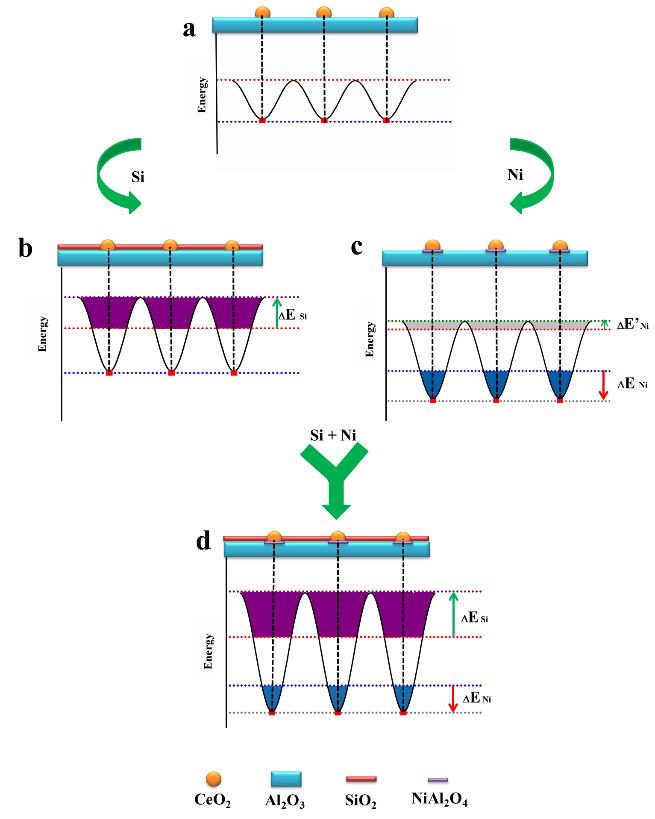
Recently, Pt/CeO2/NiAl2O4/Al2O3@SiO2 model catalyst, based on the “composite energy trap” model, was developed by the State Key Laboratory of Rare Earth Resource Utilization of Changchun Institute of Applied Chemistry, Chinese Academy of Sciences, which can effectively inhibit the migration and agglomeration of loaded nanoparticles. The model catalyst still remains high activity after aging at 1000 ?. The results of DFT indicate that the higher stability of the model catalyst should be attributed to the existence of two kinds of “confinement effect” in its structure, the “composite energy well” model is also suitable for the research and development of other supported catalysts. The first authors of this paper are Jingwei Li and Kai Li, and the correspondent authors are associate professor Yibo Zhang and professor Xiangguang Yang.

###

This research was funded by the National Key Research and Development Program of China (2016YFC0204301), National Nature Science Foundation of China (21872133 and 21273221) and Youth Innovation Promotion Association of Chinese Academy of Science (2018263)

See the article: Li J, Li K, Sun L, Zhang Z, Wu Z, Zhang Y, Yang X. Sinter-resistant and high-efficient Pt/CeO2/NiAl2O4/Al2O3@SiO2 model catalyst with “composite energy trap”. Sci. China Chem., 63, 519-525(2020), DOI: 10.1007/s11426-019-9678-5.

https://doi.org/10.1007/s11426-019-9678-5

Media Contact
Xiangguang Yang
[email protected]

Related Journal Article

http://dx.doi.org/10.1007/s11426-019-9678-5

Tags: Chemistry/Physics/Materials Sciences
Share12Tweet8Share2ShareShareShare2

Related Posts

blank

Breakthrough in Environmental Cleanup: Scientists Develop Solar-Activated Biochar for Faster Remediation

February 7, 2026
blank

Cutting Costs: Making Hydrogen Fuel Cells More Affordable

February 6, 2026

Scientists Develop Hand-Held “Levitating” Time Crystals

February 6, 2026

Observing a Key Green-Energy Catalyst Dissolve Atom by Atom

February 6, 2026
Please login to join discussion

POPULAR NEWS

  • Robotic Ureteral Reconstruction: A Novel Approach

    Robotic Ureteral Reconstruction: A Novel Approach

    82 shares
    Share 33 Tweet 21
  • Digital Privacy: Health Data Control in Incarceration

    63 shares
    Share 25 Tweet 16
  • Study Reveals Lipid Accumulation in ME/CFS Cells

    57 shares
    Share 23 Tweet 14
  • Breakthrough in RNA Research Accelerates Medical Innovations Timeline

    53 shares
    Share 21 Tweet 13

About

We bring you the latest biotechnology news from best research centers and universities around the world. Check our website.

Follow us

Recent News

Barriers and Boosters of Seniors’ Physical Activity in Karachi

Evaluating Pediatric Emergency Care Quality in Ethiopia

TPMT Expression Predictions Linked to Azathioprine Side Effects

Subscribe to Blog via Email

Enter your email address to subscribe to this blog and receive notifications of new posts by email.

Join 73 other subscribers
  • Contact Us

Bioengineer.org © Copyright 2023 All Rights Reserved.

Welcome Back!

Login to your account below

Forgotten Password?

Retrieve your password

Please enter your username or email address to reset your password.

Log In
No Result
View All Result
  • Homepages
    • Home Page 1
    • Home Page 2
  • News
  • National
  • Business
  • Health
  • Lifestyle
  • Science

Bioengineer.org © Copyright 2023 All Rights Reserved.