Credit: ©Science China Press
Grain boundaries, which are consist of periodic arrangement of structural units and generally recognized as a two-dimensional “phase”, can exhibit novel properties that are not existed in the intrinsic bulk crystal. The altered continuity of atomic bonding at grain boundaries cause local chemical environment dramatically change at a few unit cells, subsequently alter local electrical activity, magnetic order or other physical properties. The effects of grain boundary on properties is even more significant in the complex oxides due to the substantial interactions between lattice and other order parameters. Therefore, such an inhomogeneity of materials with grain boundary may dominate the entire response in nanoscale devices and have garnered particular interest in designing novel functional devices.
The nature of structural defects is determined by the atomic arrangements. Correlating the properties of single defect-based device with its specific atomic structure is vital and prerequisite for the device application. However, experimentally revealing such a structure-property relation is very challenging due to the atomic-size and chemical and structural complexity of defects, especially for the perovskite oxides that contain multiple elements.
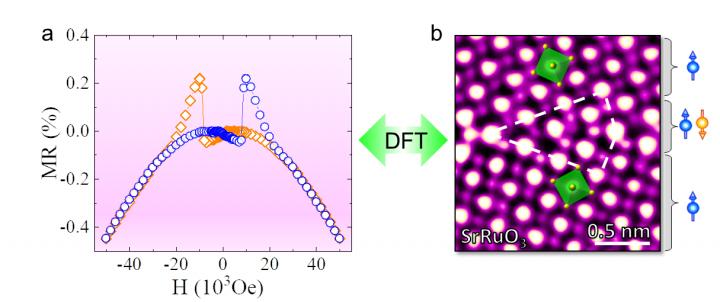
In a new research article published in the Beijing-based National Science Review, scientists at Peking university, Institute of Physics, Chinese Academy of Sciences, and Tianjin University present atomic mechanism of spin-valve magnetoresistance at the asymmetry SrRuO3 grain boundary. The asymmetry atomic structure is very different from the common assumption based on prototype perovskite SrTiO3. The transport measurements exhibit the spin-valve magnetoresistance for the as fabricated centimeter-size and sub-nm-width Σ5(310) SrRuO3 grain boundary. Advanced scanning transmission electron microscopy and spectroscopy reveal its atomic arrangements based on which the first principles calculations reveal its electronic properties. Scientists find that owing to the Ru-O octahedron distortion near the asymmetric grain boundary, Ru d orbital reconstructs and results in reduction of magnetic moments and change of spin polarization along the grain boundary, forming a magnetic/nonmagnetic/magnetic junction. The calculations bridge the atomic structure with transport properties.
“Our findings can help us to understand the past transport properties such as the negative magnetoresistance and absence of tunneling magnetoresistance at the SrRuO3 grain boundary, and also predict new effects of SrRuO3 grain boundary such as the interfacial magnetoelectric coupling when SrRuO3 is used as a bottom electrode for growth of ferroelectric thin films.” Prof. Peng Gao said, “In a broader perspective, control of defect structure at atomic scale can realize peculiar physical properties, providing us a new strategy to design devices with new low-dimensional magnetic properties by using boundary engineering.”
This work was supported by the National Key R&D Program of China (2016YFA0300804), National Equipment Program of China (ZDYZ2015-1), National Natural Science Foundation of China (51672007 and 11974023), the Key-Area Research and Development Program of GuangDong Province (No. 2018B030327001?2018B010109009) and “2011 Program” Peking-Tsinghua-IOP Collaborative Innovation Center of Quantum Matter. Project was also supported by State Key Laboratory of Powder Metallurgy, Central South University, Changsha, China
###
See the article:
Xujing Li, Li Yin, Zhengxun Lai, Mei Wu, Yu Sheng, Lei Zhang, Yuanwei Sun, Shulin Chen, Xiaomei Li, Jingmin Zhang, Yuehui Li, Kaihui Liu, Kaiyou Wang, Dapeng Yu, Xuedong Bai, Wenbo Mi, Peng Gao
Atomic origin of spin-valve magnetoresistance at the SrRuO3 grain boundary
Natl Sci Rev
https:/
The National Science Review is the first comprehensive scholarly journal released in English in China that is aimed at linking the country’s rapidly advancing community of scientists with the global frontiers of science and technology. The journal also aims to shine a worldwide spotlight on scientific research advances across China.
Media Contact
Peng Gao
[email protected]
Related Journal Article
http://dx.