• HOME
  • NEWS
  • EXPLORE
    • CAREER
      • Companies
      • Jobs
    • EVENTS
    • iGEM
      • News
      • Team
    • PHOTOS
    • VIDEO
    • WIKI
  • BLOG
  • COMMUNITY
    • FACEBOOK
    • INSTAGRAM
    • TWITTER
Friday, April 10, 2026
BIOENGINEER.ORG
No Result
View All Result
  • Login
  • HOME
  • NEWS
  • EXPLORE
    • CAREER
      • Companies
      • Jobs
        • Lecturer
        • PhD Studentship
        • Postdoc
        • Research Assistant
    • EVENTS
    • iGEM
      • News
      • Team
    • PHOTOS
    • VIDEO
    • WIKI
  • BLOG
  • COMMUNITY
    • FACEBOOK
    • INSTAGRAM
    • TWITTER
  • HOME
  • NEWS
  • EXPLORE
    • CAREER
      • Companies
      • Jobs
        • Lecturer
        • PhD Studentship
        • Postdoc
        • Research Assistant
    • EVENTS
    • iGEM
      • News
      • Team
    • PHOTOS
    • VIDEO
    • WIKI
  • BLOG
  • COMMUNITY
    • FACEBOOK
    • INSTAGRAM
    • TWITTER
No Result
View All Result
Bioengineer.org
No Result
View All Result
Home NEWS Science News Chemistry

Tracking the atomic pathways by in-situ liquid cell TEM

Bioengineer by Bioengineer
April 8, 2020
in Chemistry
Reading Time: 2 mins read
0
IMAGE
Share on FacebookShare on TwitterShare on LinkedinShare on RedditShare on Telegram

IMAGE

Credit: ©Science China Press

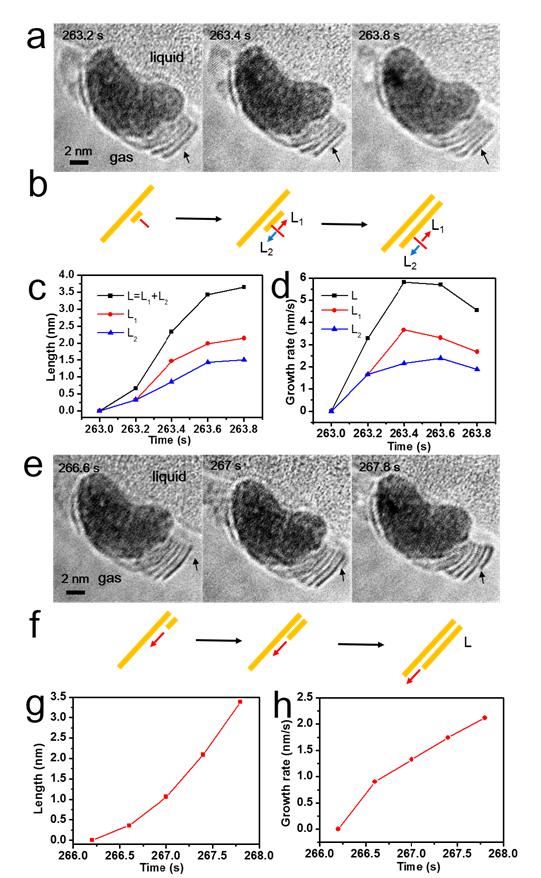
Recently, platinum-containing core-shell structures with tunable magnetic and catalytic properties have attracted intensive attentions and offered a wide range of applications. To date, their synthetic routes are mostly based on galvanic replacement, co-reduction, thermal decomposition and seed-mediated method. But the detailed formation mechanisms of core-shell structures in solution, especially, at gas-liquid interface are still not completely clear, which is mostly achieved based on post reaction studies or ex situ characterizations. In this regard, it is worthwhile but still very challenging to directly visualize the complicate and delicate dynamic processes.

Technical advantages of in-situ liquid electron microscopy (TEM) allow us to monitor the growth trajectory of pure metal nanoparticles in liquid media, including nucleation growth, nanorod self-assembly, and electrochemical deposition. Compared with pure metal nanocrystals, the growth pathway for alloy and its oxide core-shell structures is more complicated. It is noteworthy that little is known about the atomic growth pathway of Pt based-oxide core-shell structures and structural stability in solution, especially, at the gas-liquid interface. Due to the lack of direct observation method with high spatial resolution, some intermediate states may be easily missed.

Herein, Honggang Liao’s group first observed the atomic growth way of Pt3Ni-Ni(OH)2 core-shell structure at gas-liquid interface using in-situ liquid cell TEM. Experiment results revealed the underlying growth and transformation mechanisms of the Pt3Ni-Ni(OH)2 core-shell structure by systematically changing the Ni:Pt ratio in the precursor solution and tuning electron beam dose rate. Key questions regarding the growth mechanism for single- and multi-layer Ni(OH)2 flakes were addressed. It is anticipated that this work could provide atomic insights on the rational design of metal-2D core-shell structures for potential wide range applications.

###

This work was supported by the National Key Research and Development Program of China (2017YFA0206500) and the National Natural Science Foundation of China (21673198, 21373008, 21621091).

See the article: Zhang J, Li G, Liao HG, Sun SG. Tracking the atomic pathways of Pt3Ni-Ni(OH)2 core-shell structures at the gas-liquid interface by in-situ liquid cell TEM. Sci China Chem, 2020, 63, 513-518. https://doi.org/10.1007/s11426-019-9663-8

Media Contact
Hong-Gang Liao
[email protected]

Related Journal Article

http://dx.doi.org/10.1007/s11426-019-9663-8

Tags: Chemistry/Physics/Materials Sciences
Share12Tweet8Share2ShareShareShare2

Related Posts

Rice scientists uncover novel metal-oxygen binding mechanism, opening a ‘new chapter’ in chemistry

Rice scientists uncover novel metal-oxygen binding mechanism, opening a ‘new chapter’ in chemistry

April 10, 2026
“’Poor Man’s Majoranas’ as Quantum Spin Probes: A New Frontier in Quantum Science”

“’Poor Man’s Majoranas’ as Quantum Spin Probes: A New Frontier in Quantum Science”

April 9, 2026

Revealing Unexpected Discoveries on Hydroxyl Radical Chemistry at BESSY II

April 9, 2026

Crystalline/Amorphous Bi-BiNiOx Electrocatalyst Drives Efficient Simultaneous Formate Production from CO2 and Methanol

April 9, 2026
Please login to join discussion

POPULAR NEWS

  • Boosting Breast Cancer Risk Prediction with Genetics

    47 shares
    Share 19 Tweet 12
  • Popular Anti-Aging Compound Linked to Damage in Corpus Callosum, Study Finds

    44 shares
    Share 18 Tweet 11
  • Imagine a Social Media Feed That Challenges Your Views Instead of Reinforcing Them

    1012 shares
    Share 400 Tweet 250
  • Revolutionary Theory Transforms Quantum Perspective on the Big Bang

    40 shares
    Share 16 Tweet 10

About

We bring you the latest biotechnology news from best research centers and universities around the world. Check our website.

Follow us

Recent News

Neuronal Motor Protein Composition Determines Cargo Specificity

AI Detects Disease “Tipping Points” Early — Often From Just One Patient Sample

New Study Finds No Link Between Asbestos-Free Talc and Respiratory Cancer Risk

Subscribe to Blog via Email

Enter your email address to subscribe to this blog and receive notifications of new posts by email.

Join 78 other subscribers
  • Contact Us

Bioengineer.org © Copyright 2023 All Rights Reserved.

Welcome Back!

Login to your account below

Forgotten Password?

Retrieve your password

Please enter your username or email address to reset your password.

Log In
No Result
View All Result
  • Homepages
    • Home Page 1
    • Home Page 2
  • News
  • National
  • Business
  • Health
  • Lifestyle
  • Science

Bioengineer.org © Copyright 2023 All Rights Reserved.