• HOME
  • NEWS
  • EXPLORE
    • CAREER
      • Companies
      • Jobs
    • EVENTS
    • iGEM
      • News
      • Team
    • PHOTOS
    • VIDEO
    • WIKI
  • BLOG
  • COMMUNITY
    • FACEBOOK
    • INSTAGRAM
    • TWITTER
Sunday, May 10, 2026
BIOENGINEER.ORG
No Result
View All Result
  • Login
  • HOME
  • NEWS
  • EXPLORE
    • CAREER
      • Companies
      • Jobs
        • Lecturer
        • PhD Studentship
        • Postdoc
        • Research Assistant
    • EVENTS
    • iGEM
      • News
      • Team
    • PHOTOS
    • VIDEO
    • WIKI
  • BLOG
  • COMMUNITY
    • FACEBOOK
    • INSTAGRAM
    • TWITTER
  • HOME
  • NEWS
  • EXPLORE
    • CAREER
      • Companies
      • Jobs
        • Lecturer
        • PhD Studentship
        • Postdoc
        • Research Assistant
    • EVENTS
    • iGEM
      • News
      • Team
    • PHOTOS
    • VIDEO
    • WIKI
  • BLOG
  • COMMUNITY
    • FACEBOOK
    • INSTAGRAM
    • TWITTER
No Result
View All Result
Bioengineer.org
No Result
View All Result
Home NEWS Science News Chemistry

Proposed SwRI/UNH mission LEAPs forward

Bioengineer by Bioengineer
April 7, 2020
in Chemistry
Reading Time: 2 mins read
0
IMAGE
Share on FacebookShare on TwitterShare on LinkedinShare on RedditShare on Telegram

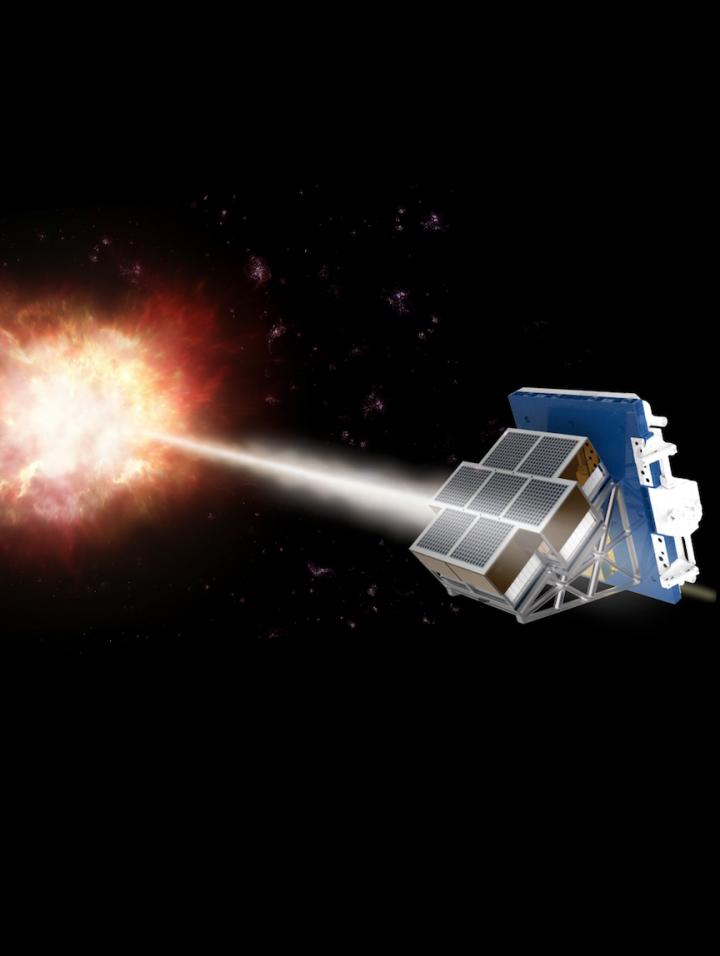
NASA selected LargE Area burst Polarimeter mission for further development
IMAGE

Credit: Southwest Research Institute/University of New Hampshire

SAN ANTONIO — April 7, 2020 — NASA has selected Southwest Research Institute and the University of New Hampshire to continue developing a mission to look for evidence of distant energetic events, such as the birth of black holes. NASA’s Small Explorers Program (SMEX) selected the “LargE Area burst Polarimeter” (LEAP) program for a mission concept study.

Mounted on the outside of the International Space Station, LEAP would study energetic jets such as those erupting from the explosive death of a massive star or the merger of compact objects such as neutron stars. LEAP’s ability to measure the polarization of gamma-ray bursts (GRB) could resolve competing theories about the nature of the jets. LEAP would complement NASA’s Imaging X-ray Polarimetry Explorer (IXPE), scheduled to launch in 2021, which will study lower-energy X-ray phenomena.

“Gamma rays are the smoking gun for some of the most energetic events in the universe,” said Mark McConnell, director of SwRI’s Earth, Oceans and Space (SwRI-EOS) Department at UNH’s Durham, New Hampshire, campus. “When a very massive star explodes in a supernova and then collapses into a black hole, it ejects jets with energies that can exceed anything observed in the universe since the Big Bang. LEAP will measure the resulting GRB with previously unachievable precision.”

LEAP will improve our understanding of the role that magnetic fields play in these systems, especially with regard to the formation and sustainment of the high-speed jets that are responsible for what we see. It should also reveal how the observed gamma radiation is produced within the jet.

“Measuring the polarization of the GRB radiation could answer several open questions about the jet physics and the underlying processes that produce the jets,” McConnell said.

LEAP is a single instrument with nine polarimeter modules based on well-established, flight-proven technologies. It will measure gamma-ray burst polarization while self-sufficiently providing the source localization required to analyze polarization data. These data will allow LEAP to differentiate between classes of GRB models. Detailed time-resolved and/or energy-resolved studies will be conducted for the brightest GRBs.

“While LEAP promises to advance our understanding of gamma-ray bursts and high-energy astrophysics,” McConnell said, “it could also help inform studies of gravitational radiation, which was first observed from merging black holes in 2016.”

NASA selected four missions to advance their proposed mission concepts. In 2021, NASA intends to fund two of the proposed missions for launch in 2025.

For more information, visit https://www.swri.org/astrophysics.

###

Media Contact
Deb Schmid
[email protected]

Original Source

https://www.swri.org/press-release/large-area-burst-polarimeter-leap-smex-energetic-jets

Tags: AstrophysicsExperiments in SpaceSatellite Missions/ShuttlesSpace/Planetary Science
Share12Tweet8Share2ShareShareShare2

Related Posts

Miniature Sensor Uses Light to Detect Touch — Chemistry

Miniature Sensor Uses Light to Detect Touch

May 8, 2026
Iron Minerals Determine Whether Dissolved Organic Matter Fuels Microbes or Becomes Long-Term Carbon Storage — Chemistry

Iron Minerals Determine Whether Dissolved Organic Matter Fuels Microbes or Becomes Long-Term Carbon Storage

May 8, 2026

Kate Evans Appointed Associate Lab Director for Biological and Environmental Systems Science at ORNL

May 8, 2026

Advancing Multiscale Modeling and Overcoming Operational Challenges in Autothermal COâ‚‚-to-Methanol Reactors

May 8, 2026
Please login to join discussion

POPULAR NEWS

  • Research Indicates Potential Connection Between Prenatal Medication Exposure and Elevated Autism Risk

    840 shares
    Share 336 Tweet 210
  • New Study Reveals Plants Can Detect the Sound of Rain

    727 shares
    Share 290 Tweet 181
  • Scientists Investigate Possible Connection Between COVID-19 and Increased Lung Cancer Risk

    68 shares
    Share 27 Tweet 17
  • Salmonella Haem Blocks Macrophages, Boosts Infection

    61 shares
    Share 24 Tweet 15

About

We bring you the latest biotechnology news from best research centers and universities around the world. Check our website.

Follow us

Recent News

Evaluating Digoxin Use in Patients with Symptomatic Rheumatic Heart Disease

Evaluating the Effectiveness and Safety of Digitalis Glycosides in Treating Heart Failure

Urdu Fall Risk Questionnaire Adapted for Elderly

Subscribe to Blog via Email

Success! An email was just sent to confirm your subscription. Please find the email now and click 'Confirm' to start subscribing.

Join 82 other subscribers
  • Contact Us

Bioengineer.org © Copyright 2023 All Rights Reserved.

Welcome Back!

Login to your account below

Forgotten Password?

Retrieve your password

Please enter your username or email address to reset your password.

Log In
No Result
View All Result
  • Homepages
    • Home Page 1
    • Home Page 2
  • News
  • National
  • Business
  • Health
  • Lifestyle
  • Science

Bioengineer.org © Copyright 2023 All Rights Reserved.