• HOME
  • NEWS
  • EXPLORE
    • CAREER
      • Companies
      • Jobs
    • EVENTS
    • iGEM
      • News
      • Team
    • PHOTOS
    • VIDEO
    • WIKI
  • BLOG
  • COMMUNITY
    • FACEBOOK
    • INSTAGRAM
    • TWITTER
Wednesday, December 3, 2025
BIOENGINEER.ORG
No Result
View All Result
  • Login
  • HOME
  • NEWS
  • EXPLORE
    • CAREER
      • Companies
      • Jobs
        • Lecturer
        • PhD Studentship
        • Postdoc
        • Research Assistant
    • EVENTS
    • iGEM
      • News
      • Team
    • PHOTOS
    • VIDEO
    • WIKI
  • BLOG
  • COMMUNITY
    • FACEBOOK
    • INSTAGRAM
    • TWITTER
  • HOME
  • NEWS
  • EXPLORE
    • CAREER
      • Companies
      • Jobs
        • Lecturer
        • PhD Studentship
        • Postdoc
        • Research Assistant
    • EVENTS
    • iGEM
      • News
      • Team
    • PHOTOS
    • VIDEO
    • WIKI
  • BLOG
  • COMMUNITY
    • FACEBOOK
    • INSTAGRAM
    • TWITTER
No Result
View All Result
Bioengineer.org
No Result
View All Result
Home NEWS Science News Health

Repair instead of renew: Damaged powerhouses of cells have their own ‘workshop mode’

Bioengineer by Bioengineer
April 2, 2020
in Health
Reading Time: 2 mins read
0
IMAGE
Share on FacebookShare on TwitterShare on LinkedinShare on RedditShare on Telegram

IMAGE

Credit: Alexandra Kukat

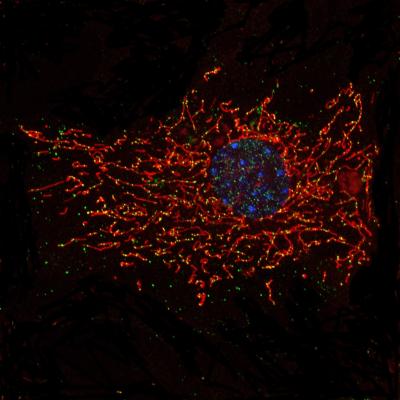
If the energy supply of a cell is disturbed by damage, it can protect itself from functional losses and repair itself in a kind of workshop mode. That is the result of a new study conducted by Professor Dr. Aleksandra Trifunovic and Dr. Karolina Szcepanowska as a leading scientist in her team, at the CECAD Cluster of Excellence in Aging Research at the University of Cologne. The findings have been published in Nature Communications under the title ‘A salvage pathway maintains highly functional respiratory complex I’.

Trifunovic’s lab works on mitochondria, the powerhouses of every cell. The tasks of mitochondria include very basic processes such as the constant energy supply of the cell. The power machinery in mitochondria consists of five components, the so-called complexes I-V. In them, the food we eat is ultimately converted into energy for the cell. If the cellular energy supply is no longer guaranteed due to disturbances in signalling processes, this has serious consequences for the entire organism, and can cause diseases.

‘In our most recent work, we have discovered a rescue route that enables cells to repair damage of a particularly sensitive part of complex I’, said Trifunovic. ‘Repairing something is a far more energy-efficient self-help mechanism compared to the effort that would be required to completely destroy and rebuild this entire complex.’

The specific rescue route Trifunovic identified also acts as a safety valve for the cell. If the rescue route becomes active, the dysfunctional component quickly switches to a shutdown mode and ‘goes to the workshop’. This way, the cells prevent harmful reactive oxygen species from being produced and released in the powerhouse engine. Trifunovic remarked: ‘So far, very little is known about how this machinery is maintained and regulated. Our results shed light on this process and allow us to explore further therapeutic possibilities.’

Trifunovic and her team are already developing further research questions. In addition to the general novelty of the entire mechanism, she was particularly surprised to see that it is often better for the organism to keep some powerhouse machine components running despite damage, and not to put all damaged components into ‘workshop mode’ at the same time or to dismantle them completely. It is possible that functions of individual components, which go beyond energy supply, also play a role. Trifunovic would like to further investigate the scope and versatility of the molecular repair pathway she discovered in order to identify its full potential for possible therapies.

Trifunovic insisted that this study would not be possible without work of Dr. Karolina Szczepanowska, who was a driving force behind this project, and important collaboration with groups from our and other universities.

###

Media Contact
Aleksandra Trifunovic
[email protected]

Related Journal Article

http://dx.doi.org/10.1038/s41467-020-15467-7

Tags: AgingBiologyCell BiologyGeneticsMolecular Biology
Share13Tweet8Share2ShareShareShare2

Related Posts

Metformin-Alogliptin Combo vs. Monotherapy in Diabetes

December 3, 2025

Botanical Extracts’ Antibacterial Activity Boosted by Enhancers

December 3, 2025

Global Guidelines for Shared Decision-Making in Valvular Heart Disease

December 3, 2025

Hidradenitis Suppurativa Remission Achieved Using Bacteriophage Therapy

December 3, 2025
Please login to join discussion

POPULAR NEWS

  • New Research Unveils the Pathway for CEOs to Achieve Social Media Stardom

    New Research Unveils the Pathway for CEOs to Achieve Social Media Stardom

    204 shares
    Share 82 Tweet 51
  • Scientists Uncover Chameleon’s Telephone-Cord-Like Optic Nerves, A Feature Missed by Aristotle and Newton

    120 shares
    Share 48 Tweet 30
  • Neurological Impacts of COVID and MIS-C in Children

    107 shares
    Share 43 Tweet 27
  • MoCK2 Kinase Shapes Mitochondrial Dynamics in Rice Fungal Pathogen

    68 shares
    Share 27 Tweet 17

About

We bring you the latest biotechnology news from best research centers and universities around the world. Check our website.

Follow us

Recent News

Boosting Cancer Immunotherapy by Targeting DNA Repair

Evaluating eGFR Equations in Chinese Children

Metformin-Alogliptin Combo vs. Monotherapy in Diabetes

Subscribe to Blog via Email

Success! An email was just sent to confirm your subscription. Please find the email now and click 'Confirm' to start subscribing.

Join 69 other subscribers
  • Contact Us

Bioengineer.org © Copyright 2023 All Rights Reserved.

Welcome Back!

Login to your account below

Forgotten Password?

Retrieve your password

Please enter your username or email address to reset your password.

Log In
No Result
View All Result
  • Homepages
    • Home Page 1
    • Home Page 2
  • News
  • National
  • Business
  • Health
  • Lifestyle
  • Science

Bioengineer.org © Copyright 2023 All Rights Reserved.